


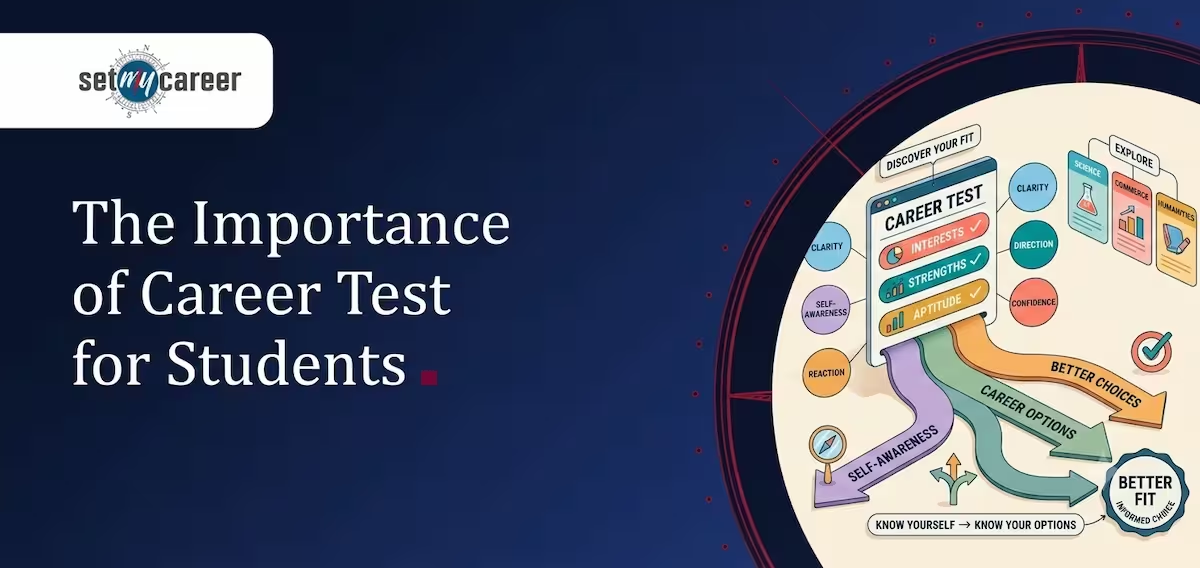
Imagine sitting down for an exam where you literally cannot fail. Instead of grading your knowledge, the results simply hand you a detailed roadmap of what you are naturally good at, what you enjoy doing, and exactly which professions align with those traits.
Career tests are valuable tools, but career counselling provides the human insight needed for interpretation.
That is the exact purpose of a career assessment test. For decades, students have faced the overwhelming pressure of deciding their life’s trajectory at a remarkably young age. Choosing an academic stream, selecting a college major, or figuring out if you should pursue a master's degree can easily trigger decision paralysis.
If you find yourself frequently asking, “Did I choose the right major?” or “Will I actually enjoy working in finance?” you are experiencing a very normal part of professional development. Fortunately, you no longer have to rely on guesswork or well-meaning advice from family members. Psychometric career tests offer a data-driven approach to evaluating your core values, personality traits, and innate aptitudes so you can make highly informed decisions about your future.
What Exactly Is a Career Test?
A career assessment test is a scientifically validated diagnostic tool designed to map your natural talents, cognitive strengths, and personal interests to specific career paths. Rather than providing generalized advice, these psychometric assessments offer customized insights based on your unique psychological profile.
Typically, these evaluations consist of a series of targeted questions that measure several critical parameters:
- Technical and cognitive abilities: How your brain processes information, solves problems, and handles complex logic.
- Soft skills: Your natural communication style, empathy, and leadership tendencies.
- Working styles: Whether you thrive in collaborative environments or prefer autonomous, focused work.
- Motivational triggers: What genuinely drives you to succeed—be it financial security, social impact, or creative freedom.
Because psychologists and industry experts develop these assessments, there are no "right" or "wrong" answers. The goal is complete honesty. By providing authentic responses, the analytical engine can filter through thousands of occupations to recommend domains where you have the highest statistical probability of both success and long-term job satisfaction.
Most importantly, a structured career aptitude test removes external noise. It minimizes the influence of peer pressure and parental expectations, giving you an objective look at what you actually want to do with your professional life.
Key Signs You Should Take a Career Assessment
It is perfectly normal to feel lost during your academic journey. If you catch yourself echoing any of the following sentiments, it might be time to take a psychometric career test.
"I want to understand what genuinely drives me."
With thousands of niche career options emerging every year, finding your true calling can feel like searching for a needle in a haystack. A comprehensive assessment bypasses superficial preferences and digs into your core motivators. It can reveal underlying passions and strengths that you might not have even realized you possessed, giving you the clarity needed to pursue a fulfilling path.
"I feel stuck and need a starting point."
Procrastination often stems from feeling overwhelmed. When you have no idea where to begin your job search or college applications, it is easy to simply do nothing. Career tests act as a professional catalyst. By breaking down your talents and suggesting highly specific industries, they give you a tangible starting line for your research.
"I'm worried my current path doesn't match my personality."
Many students find themselves pursuing prestigious degrees—like law, medicine, or engineering—simply because it is what their parents or peers expect of them. This misalignment between personal temperament and professional expectations is a fast track to burnout. An objective assessment helps validate your true personality, giving you the confidence to pivot toward a career that actually fits who you are.
"I want a career that makes me excited for Monday mornings."
Longevity in any profession requires genuine enthusiasm. If the thought of your future job fills you with dread rather than excitement, you need a course correction. Identifying the intersection where your skills meet your interests is the secret to building a career that feels less like work and more like a natural extension of your daily life.
The Tangible Benefits of Career Aptitude Tests
Selecting a profession is arguably one of the most consequential decisions you will ever make. It dictates your income, your daily routine, and your overall quality of life. Incorporating a scientific assessment into this process offers several undeniable advantages.
Facilitates Deep Internal Growth
Taking a career test forces a level of introspection that most young adults rarely experience. You walk away with a profound understanding of your cognitive abilities, emotional intelligence, and natural inclinations. This heightened self-awareness translates into better decision-making far beyond just choosing a job title.
Uncovers Hidden Opportunities
You cannot aspire to a job you do not know exists. The modern workforce includes incredibly specialized roles like user experience researchers, environmental economists, and supply chain analysts. A robust assessment cross-references your profile against thousands of modern careers, frequently introducing you to lucrative, high-demand fields you had never previously considered.
Saves Significant Time and Money
The cost of a mismatched career path is steep. It often involves wasted university tuition, years spent training for the wrong industry, and lost wages while you figure out how to pivot. By identifying careers with a high likelihood of success right out of the gate, psychometric testing serves as a highly cost-effective investment in your future.
Provides a Massive Confidence Boost
Imposter syndrome is incredibly common among students. Seeing your strengths validated by a scientific, data-backed report provides a tremendous boost in self-worth. When your career choices are supported by objective analysis rather than just a gut feeling, you can pursue interviews, internships, and networking opportunities with absolute conviction.
Crucial Considerations Before Taking Your Test
Before you dive into an assessment, it helps to set realistic expectations. A career test is a highly sophisticated compass, but it is not a magic wand. It will highlight the best possible routes, but you still have to put in the effort to reach the destination.
Make sure the test you choose is age-appropriate and culturally relevant. Many free online quizzes are heavily skewed toward Western job markets or are designed specifically for mid-career professionals rather than students. For the highest level of accuracy, invest in a premium, scientifically validated psychometric test that has been normed for your specific demographic and educational stage.
The 5 Primary Types of Career Tests for Students
Not all assessments measure the same metrics. The most comprehensive career planning strategies usually combine elements from several different testing categories to build a complete psychological profile.
1. Interest Inventories
These tests are specifically tailored for individuals looking to align their passions with their profession. By asking you to rate how much you would enjoy specific daily tasks, interest inventories decipher broad hobbies into viable, real-world career paths.
2. Aptitude and Cognitive Ability Tests
Widely utilized in both academic planning and corporate recruitment, aptitude tests measure your raw cognitive horsepower. They evaluate spatial reasoning, logical deduction, numerical fluency, and verbal comprehension, highlighting the specific intellectual areas where you naturally excel.
3. Skills and Proficiency Assessments
While aptitude measures your potential, proficiency tests measure what you can actually do right now. They help students identify the hard skills they have already mastered and pinpoint critical knowledge gaps that need to be addressed before entering the job market.
4. Core Values Inventories
You could have the perfect skills for a job, but if the company's culture violates your personal beliefs, you will be miserable. Values inventories measure your attitudes toward concepts like work-life balance, financial wealth, corporate social responsibility, and autonomy. They help you define your personal truth so you can find employers who share your priorities.
5. Personality Assessments
These comprehensive evaluations dive deep into your behavioral tendencies. They analyze traits like extroversion, agreeableness, and stress tolerance. Understanding your personality profile allows you to predict how you will handle workplace dynamics, collaborate with management, and respond to high-pressure situations.
What to Expect from Your Assessment Results
Completing the test is just the beginning. A high-quality assessment generates a comprehensive, personalized report that breaks down your psychological makeup and maps it directly to a curated list of compatible occupations.
This data serves as a guiding beacon. Instead of wondering what to do next, you gain a clear, actionable roadmap for your professional development. When paired with a one-on-one session with a certified career counselor, these results allow you to strategically plan your next steps—from selecting specific high school subjects to shortlisting universities and applying for targeted internships.
Charting Your Path Forward with Confidence
Navigating the transition from student to working professional is undeniably intimidating. However, well-designed career tests—combining personality evaluations, interest inventories, and aptitude assessments—remove the overwhelming uncertainty from the equation. They provide definitive, data-backed direction at the exact moments you need it most.
By investing the time to truly understand your cognitive strengths and psychological preferences, you empower yourself to make strategic, highly informed decisions about your future. You can stop chasing careers based on external pressure and start building a professional life tailored to your unique potential. If you are ready to stop guessing and start planning, a scientific psychometric assessment is the absolute best place to start.