



Quick Summary
Embarking on your professional journey begins with a scientifically backed career assessment test, which serves as a supportive mirror reflecting your unique cognitive strengths, personality traits, and core values. By understanding key metrics like your occupational match scoring and leveraging interest profiling diagnostics, you can confidently filter out the noise and pinpoint industries where you are statistically most likely to thrive. At SetMyCareer, we are here to help you translate these data-driven insights into an actionable roadmap through targeted skill gap identification and personalized expert counseling, empowering you to take your next steps with absolute confidence.
Introduction
You have just finished taking a career assessment test, and a detailed report full of charts, personality types, and suggested job titles lands in your inbox. It is completely normal to look at these results and feel a mix of excitement and confusion. You might be wondering how a single online evaluation can accurately reflect your potential, or how to translate these complex charts into a realistic, everyday career path that you actually enjoy.
A career assessment test is not a final exam with right or wrong answers. Instead, it is a scientific mirror reflecting your natural strengths, core values, and professional interests. In this guide, we will help you demystify your results. You will learn how to look past the technical jargon, identify your most valuable skills, and evaluate which high-growth industries genuinely match your personal goals and lifestyle preferences.
At SetMyCareer, we believe that understanding your results is the first step toward building a future you are excited about. Let’s explore how to turn these insights into an actionable, step-by-step roadmap for your education and professional journey in 2026 and beyond.
What is a Career Assessment Test?
A career assessment test is a scientifically validated evaluation tool designed to measure an individual's unique cognitive strengths, personality traits, interests, and professional values. This diagnostic tool provides data-driven clarity to help students and working professionals align their natural abilities with suitable educational pathways and occupational roles.
The Mechanics of Holistic Aptitude Measurement
Modern professional evaluations go far beyond basic interest checklists. Comprehensive career planning relies on a holistic aptitude measurement strategy. This integrated approach evaluates not just what an individual enjoys doing, but also their cognitive speed, spatial reasoning, verbal ability, and mathematical competency. When these diverse metrics are synthesized, they present a complete picture of potential, ensuring that career suggestions align with actual execution capability.
| Aptitude Dimension | Cognitive Skill Evaluated | Targeted Professional Relevance |
|---|---|---|
| Numerical Reasoning | Quantitative analysis and pattern recognition | Finance, engineering, data analytics, and economics. |
| Verbal Ability | Linguistic comprehension and communication clarity | Marketing, corporate law, public relations, and writing. |
| Spatial Relations | Visualizing three-dimensional objects and structural layouts | Architecture, industrial design, civil engineering, and surgery. |
| Logical Reasoning | Inductive and deductive systematic problem-solving | Software development, strategic consulting, and scientific research. |
Utilizing this multidimensional view protects candidates from pursuing pathways where they might have high interest but low natural cognitive alignment, or vice-versa. High school students, in particular, benefit from this structured clarity when selecting academic streams. Incorporating systematic measurement yields several distinct advantages:
- Mitigates academic frustration by matching course demands with natural cognitive patterns.
- Highlights hidden intellectual talents that standardized school examinations often fail to measure.
- Identifies concrete developmental areas to guide targeted cognitive training before entering college.
- Establishes an objective baseline that remains stable over long-term career planning.
How to Interpret Career Assessment Test Results
Learning how to interpret career assessment data requires systematically evaluating personality patterns, cognitive strengths, and interest alignments. Instead of focusing solely on suggested job titles, users must analyze the underlying behavioral tendencies and competency scores to identify broader, highly compatible professional fields that match their long-term potential.
Understanding Occupational Match Scoring
High-quality evaluations provide an occupational match scoring metric. This quantitative calculation represents the statistical alignment between an individual's unique psychometric profile and the verified characteristics of top performers within specific careers. A score of eighty percent or higher indicates strong compatibility with the daily tasks, environmental demands, and cognitive expectations of that specific job family.
| Score Bracket | Statistical Alignment | Recommended Strategy |
|---|---|---|
| 85% to 100% | High Compatibility | Prioritize for primary career consideration and internship opportunities. |
| 70% to 84% | Moderate Compatibility | Consider as viable secondary choices or roles requiring slight skill adjustments. |
| 50% to 69% | Low Direct Alignment | Evaluate as potential secondary pathways; examine specific mismatches. |
| Below 50% | Weak Compatibility | Focus exploration elsewhere, as core trait conflicts may reduce long-term satisfaction. |
Analyzing these scores systematically helps candidates filter out distractions and focus on realistic possibilities. Instead of chasing fleeting job trends, applicants target sectors where they have a high statistical probability of professional thriving.
Leveraging Interest Profiling Diagnostics
Professional interests are not merely hobbies; they are persistent patterns of engagement that drive career endurance. Through advanced interest profiling diagnostics, assessments categorize preferences based on the globally recognized RIASEC framework. This methodology helps users connect their intrinsic motivators directly to specialized career tracks.
- Realistic: High preference for physical, hands-on tasks, machinery operation, and outdoor assignments.
- Investigative: Strong inclination toward intellectual inquiry, scientific research, and complex data analysis.
- Artistic: Natural lean toward creative expression, design, unstructured environments, and innovative conceptual work.
- Social: Innate desire to assist, teach, counsel, and develop other human beings.
- Enterprising: High drive for leadership, persuasion, business ventures, public speaking, and strategic risk-taking.
- Conventional: Strong preference for organized data, systematic procedures, compliance, and detail-oriented record-keeping.
By understanding these behavioral orientations, students and career changers can structure their workplace expectations. If someone scores high in the social and investigative domains, for instance, clinical psychology or educational research represents an excellent cultural and cognitive match.
Evaluating the Validity of Career Assessment Tests
The scientific validity of career assessment tests depends heavily on established psychometric standards, including construct validity and test-retest reliability. High-quality evaluations leverage rigorous peer-reviewed methodologies to ensure that the generated profiles accurately reflect an individual's persistent traits rather than fleeting moods or temporary situational preferences.
Many users question the accuracy of evaluations, especially given the abundance of unscientific quizzes available online. Professional assessments are built on extensive research, requiring years of norm-group testing to prove their accuracy. Authentic platforms publish their statistical reliability coefficients, typically demanding a Cronbach's alpha score above 0.70 to ensure consistent, stable outputs over time.
Comparing Paid Platforms and the Best Free Career Assessment Test Options
While searching for resources, candidates frequently encounter various free options online. Understanding the structural differences between premium enterprise options and the best free career assessment test offerings is essential for making informed career choices.
| Evaluation Criterion | High-End Psychometric Assessment | Standard Free Online Test |
|---|---|---|
| Scientific Methodology | Standardized norm-referencing with peer-reviewed validation | Basic heuristic self-reporting with minimal background research |
| Reporting Depth | Extensive multi-page breakdowns including skill-gap analysis | Single-page summary listing generic job titles |
| Diagnostic Elements | Integrates cognitive, personality, and interest profiling diagnostics | Focuses almost entirely on isolated self-reported interests |
| Professional Guidance | Often paired with certified human career counseling reviews | Completely self-guided with no professional advisory support |
Free assessments are valuable for initial discovery and basic self-reflection. However, high-stakes decisions like university selection or mid-career transitions require the analytical depth that only validated premium systems provide. When evaluating the credibility of a diagnostic tool, check for the following indicators:
- The tool is backed by published academic research or validation studies.
- Questions avoid transparent, easily manipulated answers to prevent user bias.
- The report provides clear comparisons against a broad, representative norm group.
- The assessment framework is updated regularly to reflect modern economic shifts and new industries.
Mapping Your Results to Actionable Career Pathways
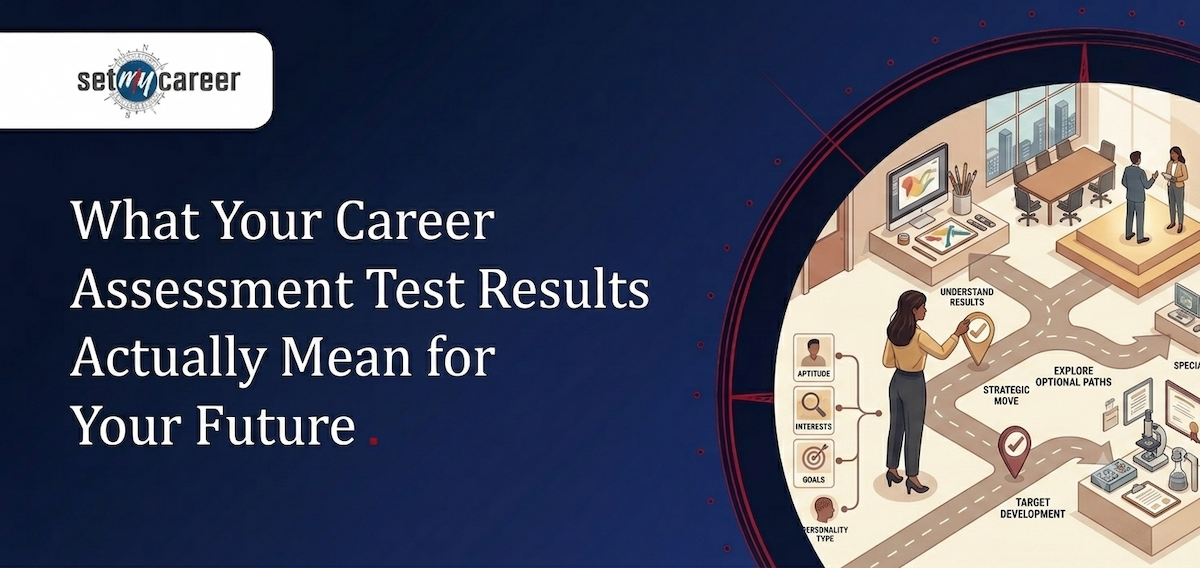
Translating career assessment results into a practical career roadmap involves matching high-scoring professional options with realistic educational choices and industry demands. By combining psychometric insights with proactive planning, individuals can select educational streams and upskilling programs that directly support their targeted professional objectives with minimized risk.
Using Skill Gap Identification for Stream Selection and Upskilling
Once a candidate receives their report, the transition from diagnosis to action begins with rigorous skill gap identification. Even a high occupational match score does not guarantee immediate employment; it indicates potential. Discovering the exact technical and interpersonal skills that are currently lacking is the key step in preparing for modern employment sectors.
| Action Stage | Specific Process | Expected Outcome |
|---|---|---|
| Phase 1: Diagnostics | Analyze low-scoring dimensions in the career assessment report | Clear understanding of hidden competency weaknesses and growth areas. |
| Phase 2: Comparison | Cross-reference assessment reports with real-world target job descriptions | A comprehensive checklist of required technical skills and certifications. |
| Phase 3: Training | Enroll in structured academic courses or professional bootcamps | Verification of new capabilities through recognized credentials. |
| Phase 4: Integration | Apply newly acquired skills to physical projects or real-world internships | Practical portfolio items that prove workplace competence to employers. |
When students utilize these diagnostic steps during high school or university, they can make informed stream selection decisions. Instead of selecting subjects based on peer choices or superficial interests, they construct educational paths tailored to address real professional gaps. To execute this effectively, consider these targeted upskilling methods:
- Professional Certification Programs: Specialized training paths through accredited global providers to build technical credibility.
- Micro-Credentials: Targeted online courses designed to address specific software or analytical competency needs quickly.
- Mentorship Programs: Direct interaction with experienced industry professionals to acquire practical workplace insights.
- Project-Based Portfolios: Practical application of skills through case studies, code repositories, or design samples to demonstrate ability.
Following a diagnostic process allows individuals to step into the workforce with confidence. Rather than guessing which careers might be enjoyable, they utilize clear, objective, and validated insights from a career assessment test to design their future.
Conclusion
A career assessment test is not a final decision; it is a powerful starting point. It provides you with a clear map of your natural strengths, interests, and personality traits. However, a map is only truly valuable when you know how to navigate the roads it reveals. Your results are meant to open doors, spark ideas, and help you narrow down your options so you can focus on paths that genuinely align with who you are.
It is completely natural to feel unsure about how to translate these insights into a concrete career plan. Interpreting the data and matching it with real-world opportunities can feel overwhelming, but you do not have to do it alone. The best way to make sense of your report is to discuss it with a professional who understands the shifting job market and educational landscapes.
At SetMyCareer, our experienced career counselors help you decode your career assessment test results and turn them into a practical, step-by-step roadmap. Whether you are a student choosing a college major or a professional planning a transition, we are here to guide you with clarity and confidence. Reach out to us today to schedule your personalized counseling session and take charge of your future.