





Quick Summary
Choosing your ideal career path doesn’t have to be a guessing game when you rely on scientific self-awareness. By using aptitude tests for career selection, students and professionals can easily identify their natural cognitive strengths and future learning potential. At SetMyCareer, we combine these personalized psychometric insights with expert career counselling to design a clear, actionable roadmap that empowers you to make your next big move with absolute confidence.
Introduction
Choosing a career path can feel like standing at a massive crossroads with too many signs pointing in different directions. Whether you are a student preparing for college, a parent trying to support your child, or a professional looking for a fresh start in 2026, finding the right direction is both exciting and overwhelming. Fortunately, you do not have to rely on guesswork. Using aptitude tests for career selection is one of the most reliable ways to clear the clutter, highlighting your natural strengths and matching them with paths where you are most likely to thrive.
At SetMyCareer, we believe that a successful career starts with self-awareness, not just following trends. Aptitude tests are not standard school exams that you pass or fail; instead, they act as a personal map of your cognitive abilities, problem-solving skills, and natural talents. By understanding how you process information and handle specific tasks, these scientifically validated tools help you narrow down your choices and make decisions with absolute clarity and confidence.
In this guide, we will break down the different types of aptitude tests for career selection, explaining what they measure and how you can use the results to plan your next steps. You will learn how to identify the right assessment for your specific goals and understand how personalized career counselling can turn these test scores into a practical, step-by-step roadmap for your future.
What is an Aptitude Test for Career Selection?
An aptitude test for career selection is a standardized tool designed to measure natural cognitive strengths, problem-solving skills, and learning potential. Unlike knowledge-based exams, it assesses how individuals process information, logical reasoning abilities, and suitability for specific vocational fields, guiding them toward viable career choices.
Rather than measuring what has already been learned, these specialized career assessment tools evaluate an individual’s developmental potential. This makes them highly effective for students who are undecided about their future, as well as working professionals contemplating a industry pivot. Understanding these natural patterns helps individuals target sectors where learning curves are shorter and performance potential is naturally higher.
When combined with professional career guidance, these standardized tests eliminate guesswork. Rather than choosing a path based on peer pressure or temporary market trends, candidates gain objective data showing where their actual talents lie. This ensures that long-term career planning is built on a foundation of scientific self-awareness.
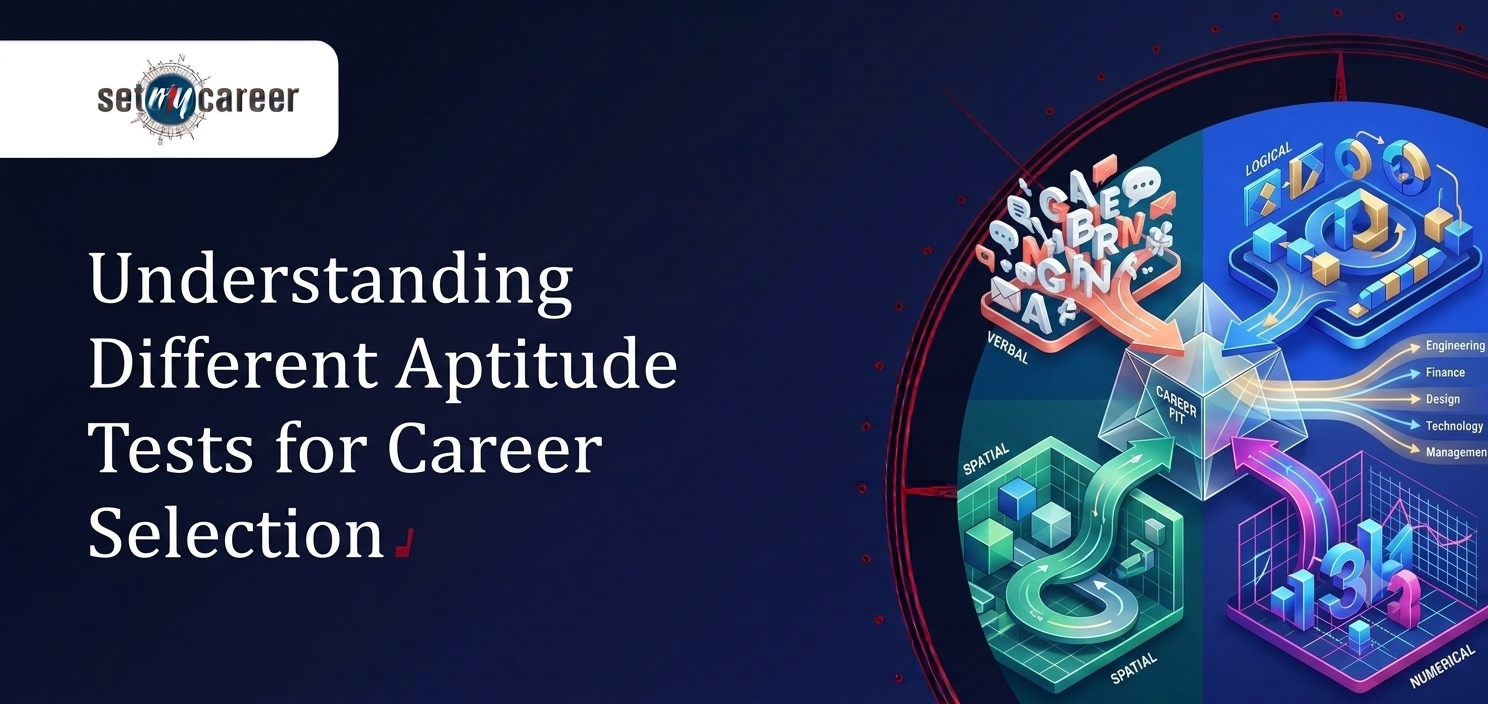
| Aptitude Component | Core Capability Measured | Relevant Career Paths |
|---|---|---|
| Numerical Reasoning | Ability to identify trends in data and solve quantitative challenges. | Finance, Data Science, Engineering, Actuarial Science |
| Verbal Comprehension | Understanding of complex written concepts and vocabulary. | Law, Corporate Communications, Journalism, Marketing |
| Spatial Visualization | Ability to mentally manipulate two-dimensional and three-dimensional shapes. | Architecture, Interior Design, Mechanical Engineering, Aviation |
| Logical Reasoning | Identifying patterns and drawing logical conclusions from abstract data. | Software Development, Strategic Planning, Research, Systems Analysis |
By mapping these cognitive abilities, candidates avoid the expensive mistake of pursuing fields that conflict with their cognitive processing styles. Instead, they focus their energy on developing skills that feel intuitive and satisfying.
The Core Types of Aptitude Tests Used in Career Counselling
The core types of aptitude tests measure numerical, verbal, spatial, mechanical, and logical reasoning. These psychometric assessments isolate specific cognitive abilities, allowing career guidance experts to match individual cognitive profiles with the daily requirements of diverse occupational paths and industries.
A comprehensive career guidance aptitude test does not look at just one skill. It examines multiple dimensions of a person's intellect and behavioral tendencies. This multi-layered evaluation ensures that the final recommendations are balanced, reflecting both intellectual capacity and personal interests.
1. Cognitive Abilities Test
These tests measure general mental ability, tracking how quickly and accurately a person learns new concepts, processes complex information, and solves unfamiliar problems. They are widely utilized by recruiters and university admissions teams to screen for roles that demand high intellectual adaptability and rapid skill acquisition.
2. Vocational Interest Inventory
This assessment focuses on what an individual enjoys doing, mapping interests to the six primary vocational themes: Realistic, Investigative, Artistic, Social, Enterprising, and Conventional. When integrated with a cognitive test, this inventory ensures that a recommended career matches both capability and everyday enjoyment.
3. Spatial and Mechanical Reasoning Tests
For individuals considering careers in physical design, engineering, or technical operations, these assessments are indispensable. They measure the capacity to understand mechanical systems, visualize physical changes, and interpret structural layouts, indicating strong potential for technical and design fields.
A structured assessment process typically evaluates the following areas:
- Abstract Reasoning: Evaluates lateral thinking capabilities and the speed of learning new patterns.
- Clerical Speed and Accuracy: Measures eye-to-hand coordination and the capacity to handle detailed data under time constraints.
- Mechanical Understanding: Assesses practical comprehension of physical laws, machinery, and tools.
- Verbal Reasoning: Measures the capacity to interpret complex written arguments and construct persuasive narratives.
Why Standard Exams and Aptitude Tests Are Different
Standard academic exams evaluate acquired knowledge and syllabus-specific learning, measuring what has already been taught. In contrast, an aptitude test for career evaluation assesses innate cognitive potential and abstract problem-solving skills, predicting how easily a person will acquire new skills in future environments.
This distinction is highly significant for students who may struggle under the weight of rote learning and traditional exam formats. A student might receive average grades in a history class but score in the top percentile for spatial or logical reasoning. This indicates strong potential in fields like architecture or software development, regardless of academic performance.
Understanding this difference relieves the academic anxiety that many young adults face. It shifts the focus from past academic performance to future professional capability, opening up a wider range of viable career options.
| Feature of Evaluation | Standard Academic Exams | Career Aptitude Tests |
|---|---|---|
| Core Focus | Evaluates memory, study habits, and specific academic content knowledge. | Evaluates natural talent, reasoning style, and cognitive potential. |
| Preparation Style | Requires intensive studying, memorization, and structured revision. | Requires no prior study; measures natural, spontaneous problem-solving. |
| Result Interpretation | Expressed as a grade or percentage; indicates past performance. | Expressed as a capability profile; indicates future potential. |
| Long-term Purpose | Determines immediate academic progression or graduation eligibility. | Informs long-term career choices and educational pathway selection. |
By shifting the focus from standard academic testing to broad cognitive evaluation, candidates discover pathways they might have otherwise ignored due to self-doubt or academic setbacks.
How Psychometric Assessments and Cognitive Abilities Tests Build a Clear Career Path
Psychometric assessments and cognitive abilities tests build a clear career path by uncovering raw talent patterns and aligning them with occupational demands. This scientific alignment reduces trial-and-error career choices, minimizes academic misalignment, and highlights specific areas where individuals will naturally excel.
This structured self-discovery is especially helpful during periods of major transition. When high school students select their higher education streams, or when experienced professionals plan a shift, these tools provide objective clarity that reduces stress and prevents costly missteps.
Streamlining Stream Selection for High School Students
Selecting the right subjects in high school is a critical turning point. An aptitude test for career evaluation helps students identify whether their strengths align with Science, Technology, Engineering, and Math (STEM), Humanities, Commerce, or Creative Arts, ensuring their academic choices support their career goals.
Facilitating Career Transitions and Upskilling
For mid-career professionals, these assessments identify transferable skills and cognitive advantages that can be utilized in new sectors. This systematic approach reduces the risks associated with changing careers, helping professionals transition into roles where their established strengths remain highly relevant.
Using a structured psychometric framework offers several distinct advantages:
- Reduces Academic Waste: Helps students avoid choosing majors that they might later drop due to difficulty or lack of interest.
- Enhances Workplace Satisfaction: Aligns daily occupational activities with natural cognitive strengths, leading to greater job satisfaction.
- Saves Time and Money: Reduces the need for costly course corrections, extra training, or sudden career shifts down the road.
- Builds Strong Confidence: Provides objective, verified data that reassures individuals they are moving in the right direction.
| Alignment Level | Short-term Outcome | Long-term Career Impact |
|---|---|---|
| High Alignment | Faster mastery of job skills and less training stress. | Rapid promotions, high job satisfaction, and lower risk of burnout. |
| Moderate Alignment | Acceptable work performance but may require extra effort to keep pace. | Steady progress but potential feelings of stagnation over time. |
| Low Alignment | Frequent struggles with daily tasks and high work anxiety. | Frequent career changes, high frustration, and career dissatisfaction. |
Steps to Take an Aptitude Test for Career Planning
Taking an aptitude test for career planning involves choosing a scientifically validated tool, completing the assessment in a quiet environment, analyzing the comprehensive report with a qualified counsellor, and translating the findings into a structured, step-by-step educational or professional action plan.
To get the most accurate results, it is important to treat these assessments as diagnostic tools rather than traditional pass-or-fail tests. Approaching the questions with a relaxed, focused mindset ensures that the final profile genuinely reflects your natural cognitive tendencies and personal interests.
A typical structured testing process follows these steps:
- Selection: Identify a comprehensive, scientifically validated assessment that evaluates both interests and cognitive abilities.
- Preparation: Set aside dedicated time in a quiet, distraction-free environment to ensure complete focus throughout the session.
- Execution: Complete the assessment honestly without overthinking, allowing your natural preferences to guide your answers.
- De-briefing: Review the resulting multi-page talent profile with a trained career advisor to understand what the scores mean.
How SetMyCareer Translates Aptitude Scores Into Actionable Career Goals
SetMyCareer translates aptitude scores into actionable career goals by pairing advanced psychometric data with expert, one-on-one professional counselling. This personalized approach decodes complex test profiles, connects cognitive strengths to actual market opportunities, and drafts a customized roadmap for long-term occupational success.
A standalone online test profile can provide helpful data, but without professional interpretation, it remains raw information. The career development specialists at SetMyCareer analyze these profiles to understand how your cognitive capabilities, interests, and personality traits interact, helping you turn this data into a clear career plan.
The personalized advisory process at SetMyCareer provides key elements to guide your journey:
- Expert Profile Evaluation: Detailed analysis of your psychometric data by seasoned career development specialists.
- Strategic Career Mapping: Identification of high-growth industries that match your specific cognitive strengths.
- Targeted Skill-Gap Analysis: Guidance on the academic degrees, professional certifications, and technical skills needed to achieve your goals.
- Ongoing Mentorship: Continued guidance to help you confidently manage academic transitions or professional industry shifts.
| Evaluation Parameter | Generic Online Aptitude Test | SetMyCareer Expert Counselling |
|---|---|---|
| Depth of Reporting | Provides automated, generic feedback based on basic algorithm scores. | Provides detailed, multi-dimensional profiles covering aptitude, interest, and behavior. |
| Contextualization | Ignores personal academic history, local job trends, and financial realities. | Integrates results with personal constraints, academic history, and industry growth. |
| Actionability | Leaves the individual to interpret test scores and plan next steps alone. | Delivers a structured, step-by-step career path with targeted milestones. |
| Human Support | No access to professional guidance, mentorship, or personalized advice. | Provides direct access to experienced, professional career counsellors. |
Empowering Your Future with the Right Aptitude Test
Choosing a career path does not have to be a guessing game. Utilizing aptitude tests for career selection provides you with a clear, data-driven map of your natural strengths, cognitive abilities, and potential. Whether you are a student deciding on a college major or a working professional planning a career transition, these assessments take the uncertainty out of the process, helping you align your future choices with your natural talents.
While taking a test is an excellent first step, interpreting the results and turning them into an actionable plan can sometimes feel overwhelming. That is where professional guidance makes a difference. Combining scientific test insights with personalized expert counseling ensures you understand not just what you are good at, but how to build a successful, fulfilling life around those strengths.
Ready to discover where your true potential lies? Take the first step today. Explore our scientifically validated assessments at SetMyCareer, and connect with our friendly experts to turn your test results into a clear, confident roadmap for your future.