




Quick Summary
Deciding on your high school subjects after class 10 can feel overwhelming, but you can easily beat decision fatigue by focusing on your unique strengths through structured aptitude analysis and career mapping. Today's modern, interdisciplinary subject combinations allow you to design a personalized learning path across Science, Commerce, and Humanities that prepares you for exciting, future-proof roles. If you are feeling stuck, SetMyCareer is here to support you with personalized career counselling so you can choose your academic stream with absolute confidence.
Introduction
Standing at the crossroads of high school, trying to choose the right academic path can feel incredibly overwhelming. Between advice from well-meaning relatives, your friends' choices, and endless online searches, it is completely normal to experience decision fatigue. This mental exhaustion makes even simple choices feel heavy, let alone a decision as significant as choosing your high school subjects. If you are feeling stuck, take a deep breath—you are not alone, and this pressure is highly manageable with the right approach.
Making a confident choice during your stream selection process does not require predicting your entire life's path right now. Instead, it is about understanding your unique strengths, interests, and how the choices you make today align with future opportunities in 2026 and beyond. At SetMyCareer, we believe that career guidance should be simple, stress-free, and based on realistic insights rather than peer pressure or guesswork.
In this guide, you will discover practical, step-by-step tips to overcome decision fatigue and identify the path that truly fits you. We will break down how to evaluate your academic strengths, align your interests with real-world careers, and use expert insights to make a choice you feel excited about. Let's clear away the noise and find your path forward together.
What is Stream Selection After Class 10?
Stream selection after class 10 is the process of choosing a specific academic pathway—typically Science, Commerce, or Humanities—along with elective subjects. This foundational decision aligns a student's scholastic strengths and personal interests with future higher education opportunities and specific professional career goals.
For many decades, this choice was treated as a rigid track that locked students into narrow career corridors. Today, modern educational frameworks and interdisciplinary college admissions have transformed how families view this milestone. Instead of viewing it as a permanent label, progressive educators recognize that the right subjects build a strong, flexible platform for lifelong learning.
Why Your Subject Combination Choice Shapes Your Career Path
The specific subjects you choose act as the prerequisite keys for future university degrees. For example, selecting Physics and Mathematics is mandatory for engineering, while choosing Accountancy and Economics sets the groundwork for financial analysis. When students make an informed subject combination choice early, they avoid the frustrating realization in high school that they are ineligible for their preferred university programs.
Below is a comparative look at how different subject selections open paths to higher education and future employment:
| Subject Combination Choice | Core Subjects Involved | Emerging Higher Education Pathways |
|---|---|---|
| Technical & Analytical | Physics, Chemistry, Mathematics, Computer Science | Data Science, Robotics Engineering, Computational Linguistics, Architecture |
| Financial & Management | Accountancy, Business Studies, Economics, Applied Mathematics | FinTech, Actuarial Science, Corporate Law, Business Analytics |
| Socio-Behavioral & Creative | History, Psychology, Political Science, Sociology, English | Public Policy, Clinical Psychology, Digital Journalism, UX/UI Design |
| Interdisciplinary / Mixed | Economics, Mathematics, Psychology, Fine Arts | Behavioral Economics, Environmental Studies, Creative Direction |
Evaluating your options with foresight prevents the common mistake of picking a stream based purely on temporary academic trends. Strategic subject selection ensures you build the specific intellectual competencies required by competitive global industries.
How to Do Stream Selection: A Practical Guide
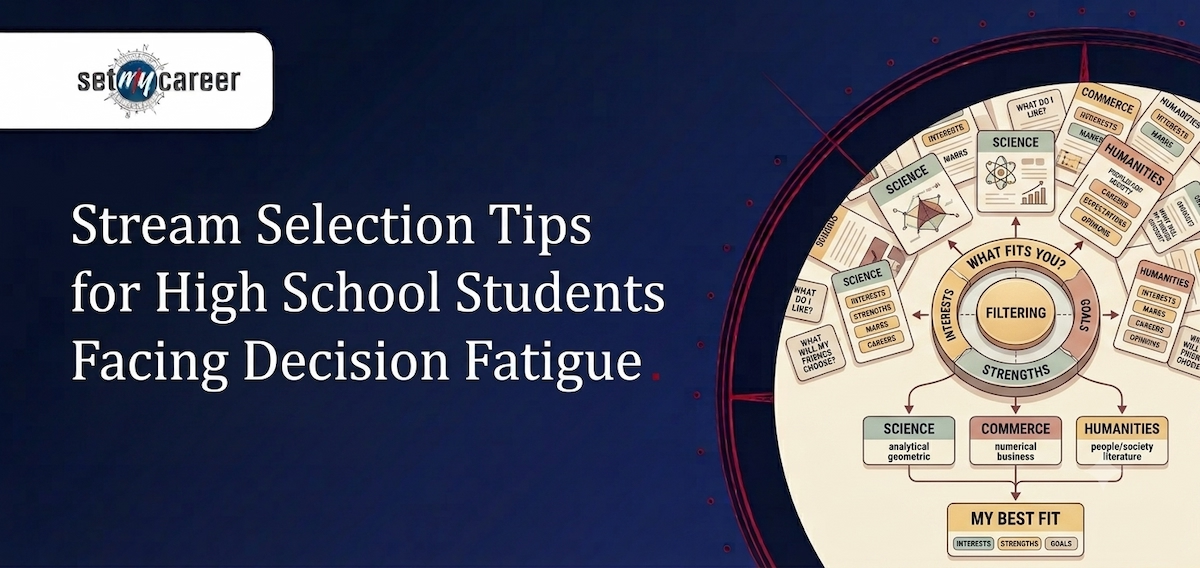
To perform stream selection effectively, students must evaluate their academic performance, analyze cognitive abilities, identify personal interests, and research career trends. This systematic approach ensures that high school subjects directly support long term professional objectives while matching the individual's natural academic learning style.
When studying how to do stream selection, students and parents must look beyond final grade sheets. While school marks provide a historical record of performance, they do not always reflect a student's long-term potential, cognitive durability, or genuine enthusiasm for a subject area.
Step 1: Self-Assessment and Aptitude Analysis
Understanding your cognitive strengths requires a systematic evaluation of your learning habits and problem-solving skills. A structured self-assessment looks at different forms of intelligence, such as numerical reasoning, spatial awareness, verbal ability, and logical deduction. Aligning your natural cognitive style with your academic workload reduces academic stress and prevents burnout.
To identify your core strengths, consider the following self-assessment framework:
- Aptitude: Evaluate your natural ability to acquire specific skills, such as mathematical computation, creative writing, or abstract conceptualization.
- Interest: Distinguish between temporary hobbies and subjects that sustain your curiosity during long periods of self-study.
- Personality Type: Assess whether you thrive in structured, analytical environments or if you prefer open-ended, creative, and collaborative settings.
- Work Style: Determine if you prefer practical, hands-on experiments or theoretical research and conceptual problem-solving.
The following table illustrates how different aptitude strengths match specific high school subject focuses:
| Primary Aptitude Strength | Key Behavioral Indicators | Recommended High School Focus |
|---|---|---|
| Quantitative Reasoning | Enjoys logical puzzles, structured systems, and solving complex numerical patterns. | Advanced Mathematics, Statistics, Computer Science, Physics |
| Verbal & Written Expression | Strong communication skills, enjoys reading, debating, and creative storytelling. | Literature, History, Media Studies, Political Science |
| Scientific & Spatial Inquiry | Curious about natural phenomena, biological systems, and physical structures. | Chemistry, Biology, Environmental Sciences, Geography |
| Systemic & Commercial Logic | Interested in how businesses scale, economic policies, and financial systems. | Economics, Accountancy, Business Studies, Entrepreneurship |
Step 2: Career Mapping for Future-Proof Roles
Career mapping is the process of connecting your current academic choices to the professional roles of tomorrow. With automation and artificial intelligence rapidly changing the job market, choosing a stream based on outdated career paths is risky. Instead, students must research how industries are evolving and select subjects that teach transferable, high-value skills.
Effective career mapping offers several significant benefits for high school students:
- Clear Direction: Creates a step-by-step roadmap from your school subjects to professional degrees, saving time and resources.
- Adaptability: Focuses on developing core skills that remain highly valuable even as specific job descriptions change.
- Targeted Development: Helps you identify key skills, internships, and certification opportunities early in your academic journey.
- Informed Choices: Empowers you to make educational decisions based on factual industry data rather than family expectations or peer influence.
By connecting your stream selection after class 10 to a clear career roadmap, you ensure that every hour of high school study prepares you for real-world opportunities.
Comparing Academic Pathways: Humanities vs Science Stream vs Commerce
Deciding between the major academic tracks requires a objective understanding of what each pathway actually demands and where it leads. The traditional debate of humanities vs science stream often overlooks the unique benefits of the commerce pathway and the growing opportunities in mixed, interdisciplinary studies.
Rather than viewing one stream as superior to another, students should view each path as a unique set of tools designed for different professional landscapes. Let us analyze the distinct features, subject requirements, and professional outcomes of each major option.
Science Stream: Fields of Innovation and Technology
The Science stream is designed for students with strong quantitative skills, natural curiosity, and an interest in rigorous empirical research. It is generally split into two main divisions: the non-medical track (focusing on engineering, computer sciences, and physics) and the medical track (focusing on medicine, research, biotechnology, and healthcare).
Students choosing this path must prepare for a demanding academic workload that requires regular laboratory work, complex problem-solving, and continuous self-study. It builds excellent analytical capabilities and systematic thinking, which are highly valued in technological and scientific industries globally.
Commerce Stream Benefits: Finance, Management, and Trade
The Commerce pathway focuses on the economy, financial systems, corporate structures, and business operations. A primary advantage of this track is its direct practical connection to the global corporate world, offering a clear route into business leadership, finance, and entrepreneurial ventures.
Key commerce stream benefits include:
- Financial Literacy: Students learn the fundamentals of financial management, investment, taxation, and wealth generation early in life.
- Versatile Career Options: Graduates can pursue prestigious qualifications such as Chartered Accountancy (CA), Corporate Law, Investment Banking, and Business Management (MBA).
- Business Skills: Focuses on developing commercial awareness, negotiation, strategic management, and operational logic.
- Economic Insights: Provides a deep understanding of market trends, consumer behavior, and government monetary policies.
Humanities Stream: Human Behavior, Policy, and Creative Industries
The Humanities and Social Sciences stream offers a deep exploration of human history, societal structures, language, creative expression, and political systems. This pathway is excellent for students who possess strong critical thinking, writing, and communication abilities, and who wish to understand the forces that shape culture and policy.
Modern humanities careers are highly diverse, spanning fields such as international relations, public policy, clinical psychology, corporate communications, and digital content strategy. This stream prepares students to analyze complex social situations, draft persuasive arguments, and design creative solutions to human-centered challenges.
The table below provides a comprehensive comparison to help you weigh your options:
| Academic Stream | Core Skills Developed | Key Career Segments |
|---|---|---|
| Science | Empirical research, mathematical modeling, algorithmic thinking, experimental validation. | Software Engineering, Aerospace, Biotech, Medicine, Renewable Energy. |
| Commerce | Financial analysis, resource management, market auditing, business strategy. | Investment Banking, Corporate Administration, Venture Capital, Auditing. |
| Humanities | Qualitative analysis, written persuasion, cultural literacy, behavioral observation. | Public Policy, Civil Services, Journalism, Psychology, Corporate Communications. |
Strategic Decision-Making Frameworks
Making your final selection requires a structured decision-making process that balances your personal academic interests with objective career opportunities. This final phase involves organizing your research, consulting with qualified mentors, and planning flexible subject combinations that keep your options open.
Students must actively protect themselves from cognitive biases, peer pressure, and outdated advice during this time. Using structured decision-making models helps families approach this choice with logic and clear perspective instead of emotional stress.
Modern Subject Combinations and Interdisciplinary Choices
With many modern educational boards offering greater academic flexibility, students are no longer restricted to rigid traditional streams. You can now design customized learning plans that bridge the gaps between different areas of study, creating a unique and valuable academic profile.
The table below compares traditional stream limits with modern, flexible subject combinations:
| Decision Area | Traditional Fixed Model (Rigid Track) | Modern Flexible Model (Interdisciplinary) |
|---|---|---|
| Subject Choice | Strictly science subjects or strictly commerce subjects. | Mixing subjects, such as Business Studies with Applied Mathematics and Psychology. |
| Career Focus | Preparing for a single traditional profession (e.g., Doctor, Engineer, Accountant). | Developing a versatile skillset suited for hybrid and emerging professional roles. |
| Learning Style | Rote memorization of subject-specific theories and standardized testing. | Project-based learning, practical applications, and conceptual analysis. |
To implement this flexible approach successfully, parents and students should collaborate closely throughout the planning process:
- Open Discussions: Schedule regular, stress-free family conversations to discuss academic interests and long-term career goals.
- Gather Facts: Base decisions on current labor market reports and university admission criteria, rather than opinions from relatives.
- Consult Experts: Use professional career counselling and psychometric evaluations to identify natural cognitive strengths.
- Support Independence: Encourage students to take ownership of their education, which builds confidence and academic responsibility.
By using a structured decision-making framework, families can turn a potentially stressful academic milestone into an exciting journey of self-discovery and strategic career planning.
Choosing Your Path with Confidence
Making your stream selection decision does not have to feel overwhelming. When decision fatigue sets in, the best approach is to pause, simplify your options, and focus on what truly aligns with your natural interests and strengths. Remember, this choice is not about locking yourself into a rigid path forever. Instead, it is about opening doors to areas where you can grow, learn, and build a solid foundation for your future.
You do not have to figure this out alone. If you are still feeling stuck or want to validate your choices with objective insights, professional guidance can make all the difference. At SetMyCareer, our experienced counsellors help you cut through the noise, map out your potential, and make a confident stream selection. Book your personalized counselling session today and take the first step toward a clear, rewarding academic journey.