


Quick Summary
Deciding on the best career after 12th can feel overwhelming, but the secret to long-term success lies in aligning your journey with your unique strengths rather than external pressure. By using scientific personality mapping, you can confidently match your natural talents with rewarding, high-paying paths across science, commerce, and the humanities. As your trusted career guidance partner, SetMyCareer is here to help you move from confusion to clarity with expert counseling and personalized, data-driven insights.
Introduction
Finishing your 12th board exams is a massive milestone, but it often comes with a heavy question: "What next?" With thousands of options available, searching for the best career after 12th can feel overwhelming. You might be receiving endless advice from well-meaning relatives, friends, and teachers, leaving you unsure of which path actually fits who you are. It is completely normal to feel this pressure, but the secret to a fulfilling career lies in looking inward before you look outward.
Choosing a profession based solely on trending jobs or peer pressure often leads to burnout. Instead, aligning your career with your unique personality type ensures long-term success and daily satisfaction. Whether you are an introvert who thrives in quiet, analytical settings, or an expressive leader who loves working with people, your natural traits are the best compass for your future. At SetMyCareer, we believe that understanding your strengths is the first step toward making an informed and confident decision.
In this guide, we will break down how to identify your personality type and match it with the best career after 12th. You will discover practical frameworks, real-world career paths for different traits, and actionable steps to plan your journey for 2026 and beyond. Let us take the guesswork out of your future and help you find a path that feels authentic, exciting, and uniquely yours.
What Defines the Best Career After 12th?
The best career after 12th is a professional path that perfectly aligns an individual's unique cognitive strengths, interest patterns, and personality traits with sustainable economic opportunities. It balances personal satisfaction with market demand, ensuring lasting employment stability, mental health protection, and continuous professional growth throughout adulthood.
Historically, career choices were dictated by rigid family expectations or immediate academic scores. High-performing students were funneled into engineering or medicine, while others chose general degrees without a clear long-term strategy. Today, finding the ideal match requires evaluating individual potential against future industry shifts, ensuring that young professionals do not face early career stagnation.
By moving away from external pressures, students can establish a trajectory that honors their natural skills. Expert career guidance platforms like SetMyCareer assist high school graduates in matching their internal capabilities with real-world requirements. This foundational step ensures a transition into higher education that is based on facts and strategic planning rather than guesswork.
| Evaluation Factor | Traditional Selection Method | Scientific Alignment Method |
|---|---|---|
| Primary Driver | Peer patterns and generic societal trends | Individual aptitude profiles and personal traits |
| Evaluation Process | Immediate board examination marks alone | Psychometric mapping and structured counseling |
| Skill Integration | Passive theoretical education | Hands-on experience and targeted technical training |
| Long-Term Outcome | Elevated risk of mid-career burnout | Continuous occupational engagement and growth |
To achieve a reliable alignment, students should focus on four essential evaluation areas before finalizing their decisions:
- Aptitude Mapping: Measuring cognitive processing, spatial awareness, logical reasoning, and numerical capabilities.
- Interest Profiling: Identifying activities that naturally sustain attention and engagement without external rewards.
- Personality Evaluation: Understanding behavioral preferences to ensure a healthy match with future work environments.
- Market Demand Analysis: Ensuring that selected interest areas align with actual economic growth patterns.
Why Personality Mapping is Key to Career Success
Personality mapping is key because it translates intrinsic behavioral traits into sustainable professional roles. Identifying strengths like analytical thinking, structured organization, or creative expression prevents career misalignment. This empirical approach ensures that individuals choose paths where their natural inclinations match daily task requirements, resulting in higher productivity.
When students choose roles that clash with their innate traits, they often face daily friction. For example, placing an introverted, detail-oriented student in a highly social, aggressive sales environment can lead to high stress. Conversely, keeping an expressive, action-oriented individual in a repetitive data-entry role can stifle their motivation. Personality mapping removes this trial-and-error approach, placing students where they can naturally perform at their best.
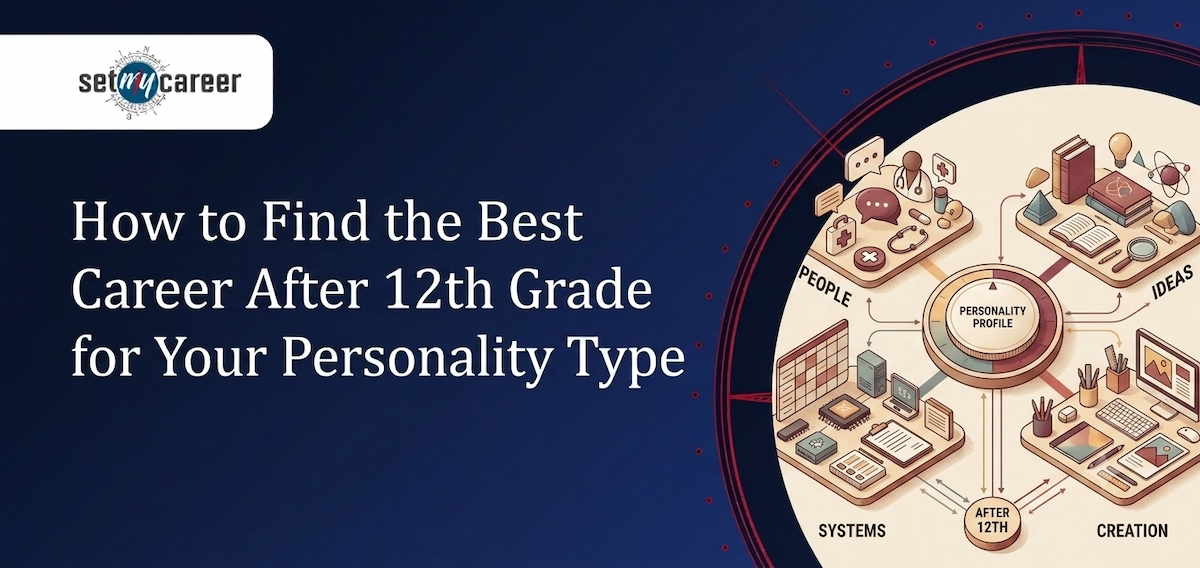
The personality evaluation models used by SetMyCareer help categorize individuals into recognizable behavior profiles. By understanding these profiles, students, parents, and counselors can work together to map out educational choices that match the student's natural cognitive style.
| Aspirant Personality Type | Innate Strengths & Characteristics | Optimal Professional Areas |
|---|---|---|
| Investigative (Analytical) | Intellectual curiosity, systematic investigation, precise data analysis | Data Analytics, Scientific Research, Software Architecture |
| Artistic (Creative) | Intuitive communication, aesthetic design, expressive experimentation | User Experience (UI/UX) Design, Copywriting, Fine Arts |
| Enterprising (Persuasive) | Leadership capabilities, strategic negotiations, entrepreneurial initiative | Corporate Law, Investment Banking, Public Relations |
| Social (Empathetic) | Collaborative teaching, constructive support, team coordination | Clinical Psychology, Human Resource Management, Career Advisory |
By examining these core personality types, students can discover specific behavioral patterns that point to clear professional goals:
- Analytical Minds: Excel in environments that reward systematic problem-solving and deep technical focus.
- Creative Spirits: Require flexible settings that prioritize visual, written, or structural innovation.
- Enterprising Leaders: Demonstrate high motivation when managing teams, making business decisions, and driving projects.
- Empathetic Guides: Build careers around supporting others, professional teaching, and community welfare.
What is the Best Career After 12th Science?
The best career after 12th science integrates rigorous technical expertise with high demand industries like software architecture, data science, biotechnology, and medicine. These fields offer strong starting salaries, diverse research opportunities, and robust long term career growth for students with strong analytical and mathematical capabilities.
Science graduates have access to a wide range of academic paths, but selecting the right one requires looking beyond traditional options. The expansion of the digital economy has created multi-disciplinary roles that combine biological sciences with computing, and physical sciences with economic modeling. Consequently, students must look beyond standard career paths to identify fields with lasting growth potential.
To assist in this process, evaluating options within structured technological and biological categories helps simplify the selection phase for both students and parents.
The Analytical Investigator: Engineering, Data, and Tech
Students with strong logical reasoning skills and a passion for technology often find that the best career after 12th science lies in computing, data science, or systems design. The rise of machine learning, cloud architecture, and industrial automation has led to high demand for graduates who can build and manage complex digital frameworks. When planning a college course selection in this area, students should look for programs that offer practical coding experience, industry partnerships, and hands-on project work.
The Medical and Life Sciences Pioneer
For those interested in biological processes, chemistry, and human health, the medical and life sciences field offers diverse opportunities. Beyond the traditional MBBS and BDS pathways, there is rapidly rising demand in biotechnology, genetic research, clinical data management, and bioinformatics. These roles are ideal for individuals who want to work in laboratory research, vaccine development, and advanced healthcare technologies to help solve global health challenges.
| Scientific Branch | Core Academic Degrees | Target High Demand Jobs |
|---|---|---|
| Information Science | B.Tech Computer Science, BCA, B.Sc Artificial Intelligence | Machine Learning Engineer, Cybersecurity Lead, Cloud Developer |
| Biological Sciences | B.Sc Biotechnology, MBBS, Bachelor of Pharmacy | Clinical Trial Coordinator, Geneticist, Pharmaceutical Lead |
| Data Sciences | B.Sc Statistics, B.Tech Data Science, BCA Analytics | Quantitative Analyst, Data Architect, Business Intelligence Consultant |
To succeed in these scientific areas, students should focus on building a strong set of foundational skills:
- Advanced Mathematical Logic: Essential for programming algorithms, analyzing statistical data, and performing financial modeling.
- Hands-On Lab Practice: Critical for mastering testing protocols, quality control, and scientific research methods.
- Independent Learning: Crucial for keeping pace with software updates, technical documentation, and shifting industry standards.
High Paying Careers After 12th in Commerce and Humanities
High paying careers after 12th in commerce and humanities include corporate law, investment banking, management consulting, user experience design, and digital marketing. These sectors reward strategic problem-solving, financial acumen, and creative communication, offering exceptional salary packages and leadership development tracks for ambitious high school graduates.
The modern business environment values specialized skills just as much as scientific credentials. Organizations need professionals who understand market dynamics, financial rules, legal compliance, and customer behavior. As a result, non-science fields now offer excellent compensation packages and global career opportunities that rival traditional STEM paths.
Students looking at these areas can target specific fields focused on corporate leadership or creative communication.
The Enterprising Leader: Finance, Management, and Law
Commerce and humanities students who enjoy strategic planning, business development, and legal analysis can explore rewarding roles in finance and law. Comprehensive programs such as integrated BBA-MBA courses, Chartered Accountancy (CA), and integrated five-year law degrees (BA LLB or BBA LLB) build key business skills. These programs prepare students for high-level roles in corporate governance, investment strategies, and international business management.
The Creative Communicator: Design, Media, and Liberal Arts
For individuals with strong artistic talent, visual design skills, or written communication abilities, the creative sectors offer excellent opportunities. Fields like User Experience (UX) design, advertising, corporate communications, and digital content strategy have transformed traditional creative roles. Choosing a specialized Bachelor of Design (B.Des) or a Bachelor of Mass Communication can help students secure roles as brand strategists, digital artists, and user experience leaders.
| Professional Area | Recommended Higher Education Programs | High Paying Careers After 12th |
|---|---|---|
| Finance & Business | B.Com (Hons), Integrated BBA-MBA, CA Certification | Portfolio Manager, Management Consultant, Corporate Treasurer |
| Legal Services | Integrated BA LLB, Integrated BBA LLB | M&A Legal Advisor, Corporate Compliance Officer, Intellectual Property Specialist |
| Creative Design | B.Des (UI/UX), B.Des (Communication), B.Visual Arts | Creative Director, Interactive Interface Designer, Product Designer |
Entering these competitive non-science fields requires careful preparation during undergraduate study:
- Case Study Analysis: Helps students understand complex business scenarios and develop practical problem-solving skills.
- Professional Networking: Connects students with industry internships, experienced mentors, and placement opportunities.
- Portfolio Development: Provides a clear showcase of design projects, market analyses, or legal research papers.
What is the Strategic Undergraduate Admission Path?
The undergraduate admission path requires balancing traditional academic degrees with specialized vocational training programs based on specific career goals. While university degrees focus on theoretical foundations and broad strategic thinking, vocational programs prioritize immediate hands on technical skills for rapid workforce entry.
Making the right choice during college course selection is a key step in a student's career journey. An effective decision framework requires looking beyond college brand names to evaluate the actual curriculum, training options, and market relevance. This balanced approach helps ensure that higher education serves as an effective bridge to employment rather than just a theoretical exercise.
To help make this decision, comparing traditional academic structures with vocational pathways can highlight the key differences between these options.
| Comparison Factor | Traditional Degree Pathways | Vocational Training Programs |
|---|---|---|
| Educational Focus | Broad theoretical concepts and analytical methodologies | Direct technical skills and specialized tool training |
| Program Duration | 3 to 4 years of undergraduate study | 6 months to 2 years of focused training |
| Primary Outcome | Diverse strategic opportunities and postgraduate preparation | Immediate employment in targeted technical roles |
| Curriculum Flexibility | Standardized academic guidelines and electives | Regular updates based directly on industry changes |
When evaluating potential institutions and majors, students should use a clear set of criteria:
- Practical Curriculum: Prioritizing courses that include mandatory internships, industry projects, and lab work.
- Industry Partnerships: Selecting colleges with strong ties to active corporate brands for mentorship and placement.
- Program Flexibility: Choosing options that allow students to explore minor subjects as their career interests evolve.
- Integrated Certifications: Combining academic degrees with relevant certifications in specialized tools or analytics platforms.
Taking the Next Step Toward Your Future
Choosing the best career after 12th grade is one of the most significant decisions you will make, but you do not have to figure it out alone. Instead of chasing popular trends or feeling pressured by external expectations, aligning your career choice with your unique personality type ensures long-term satisfaction and success. When your daily work matches your natural strengths and interests, professional growth happens naturally.
Identifying your personality traits is the foundation of this journey. Whether you are an analytical thinker, a creative storyteller, or a natural leader, there is a path designed specifically for how you think and work. Taking the time to understand yourself now saves years of uncertainty later.
If you are ready to move from confusion to clarity, we are here to support you. Discover your ideal path by taking our scientific personality assessment and booking a personalized counseling session with SetMyCareer today. Let us help you find the best career after 12th that truly fits who you are and who you want to become.