





Quick Summary
Choosing the right stream selection after 10th grade is a powerful milestone that establishes the vital foundation for your long-term career mapping and academic success. By exploring the unique opportunities within Science, Commerce, and Arts, and embracing modern interdisciplinary career trends, you can easily align your natural strengths with the future of work. Our friendly experts at SetMyCareer are here to support you and your family with personalized counseling and data-driven insights, helping you make this decision with ease and step into your future with absolute confidence.
Introduction
Choosing the right path after class 10 is one of the first major decisions you will make for your future. It is completely normal to feel a mix of excitement and anxiety during this phase. Your stream selection acts as the foundation for your academic and professional journey, directly opening doors to specific college degrees and career paths while steering you away from others. Making this choice with clarity and confidence, rather than under pressure, sets you up for long-term satisfaction and growth.
In this guide, we will break down how your stream selection shapes your future career options in 2026 and beyond. You will learn how to align your natural strengths and interests with Science, Commerce, or Humanities, and discover how modern, interdisciplinary careers are changing the traditional boundaries of these fields. We aim to replace confusion with practical, research-backed insights so you and your parents can navigate this transition together with ease.
Remember, there is no single "best" stream—only the stream that is right for you. Let’s explore how to evaluate your options, understand career trends, and take the first step toward a fulfilling professional path that matches your true potential.
Why Stream Selection After 10th Grade Shapes Your Entire Career Mapping
Stream selection after 10th grade establishes the foundational academic path that determines eligibility for specific college degrees and professional licensing. This early decision streamlines career mapping by aligning structured subject choices with industry demands, preventing academic misalignment and ensuring long-term educational efficiency.
Understanding the importance of stream selection helps students look beyond short-term academic performance. Many students choose fields based entirely on immediate examination scores or peer trends. However, systematic career mapping requires a more strategic evaluation of long-term professional trends, industry demands, and individual cognitive endurance. Making an informed choice at this early juncture ensures that future transitions into higher education remain direct and free of unnecessary obstacles.
When executing stream selection after 10th grade, parents and students must analyze the structural differences between various curricula. The chosen academic track dictates not only the textbooks a student will read but also the analytical frameworks, logical methodologies, and problem-solving habits they will develop. This cognitive conditioning forms the basis of all future career success.
| Stream Selection Criteria | Science Path | Commerce Path | Arts/Humanities Path |
|---|---|---|---|
| Core Cognitive Skill | Empirical analysis, scientific reasoning | Quantitative analysis, commercial logic | Qualitative evaluation, critical critique |
| Primary Study Method | Laboratory experiments, mathematical proofs | Case studies, balance sheet analysis | Textual review, creative writing, historical analysis |
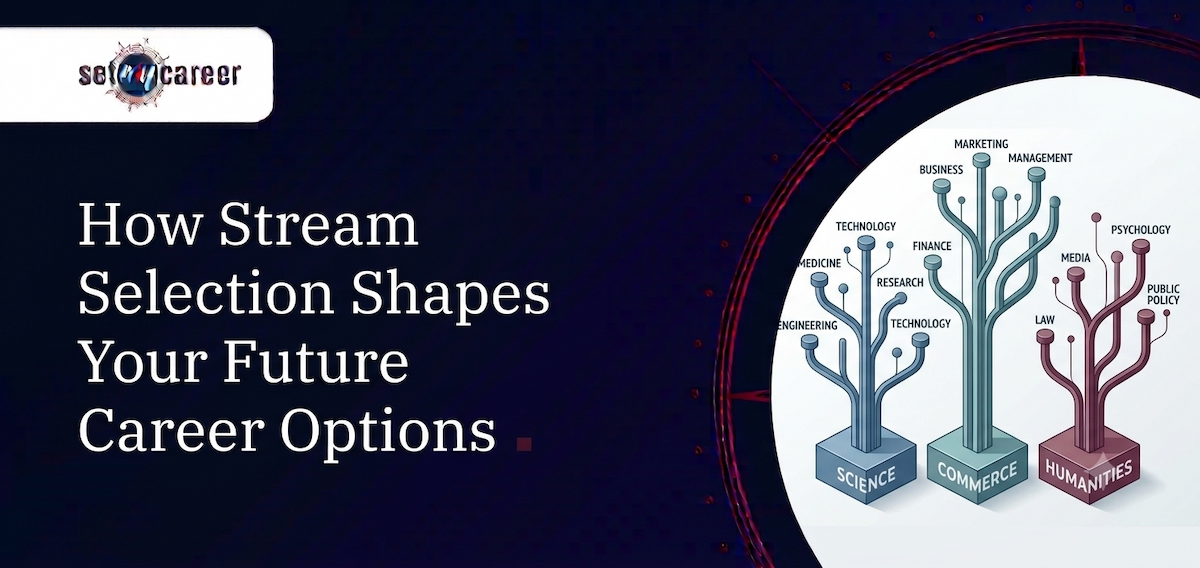
| Typical Career Directions | Engineering, medicine, research, technology | Finance, accounting, corporate management | Public policy, media, design, social sciences |
By treating this milestone as a structural foundation rather than a simple administrative task, families can approach the next academic phase with a sense of control and purpose. A structured approach minimizes academic friction and builds early confidence in decision-making processes.
Understanding the Core Academic Paths: Science, Commerce, or Arts
The three primary academic streams offer distinct entry points into the professional landscape. Choosing science, commerce, or arts determines the balance of analytical, financial, or humanistic training a student receives, directly influencing future career choices, industry readiness, and skill development pathways.
Deciding between science commerce or arts requires a clear-eyed evaluation of each stream's academic workload and operational focus. Each path has its own logic and demands, which dictates how students spend their study hours, the type of homework they encounter, and how they are evaluated.
The Science Stream: Pathways, Subjects, and Opportunities
The science track is highly analytical and built on empirical experimentation. Students who choose this pathway must be comfortable with abstract mathematical models and rigorous scientific methodologies. It offers a structured avenue for entering specialized industries like medical sciences, engineering, and advanced research fields.
Common career pathways within the science stream include:
- Engineering and Technology: Specializations in computer science, mechanical, civil, chemical, and aerospace sectors.
- Medical and Life Sciences: Direct entries into medicine, dentistry, biotechnology, genetics, and pharmaceutical research.
- Pure Sciences and Empirical Research: Deep studies in physics, chemistry, mathematics, and agricultural sciences.
- Data and Computational Analytics: Applied mathematical modeling, statistical computing, and systems engineering.
| Subject Combination | Primary Academic Focus | Target Career Opportunities |
|---|---|---|
| Physics, Chemistry, Mathematics (PCM) | Quantitative reasoning and physical principles | Software Engineering, Architecture, Aerospace, Data Science |
| Physics, Chemistry, Biology (PCB) | Organic systems, clinical structures, and life sciences | Medicine, Biotechnology, Pharmaceuticals, Environmental Science |
| Physics, Chemistry, Biology, Mathematics (PCMB) | Interdisciplinary scientific and mathematical modeling | Bioinformatics, Biomedical Engineering, Biophysics, Epidemiology |
The Commerce Stream: Finance, Business, and Trade
The commerce track focuses on corporate structures, economic principles, financial management, and market logic. This stream prepares students to understand how businesses generate value, manage risk, and allocate resources efficiently across national and global markets.
Students opting for the commerce track develop practical skills in:
- Financial Reporting: Mastery of double-entry bookkeeping, taxation principles, and corporate balance sheet structures.
- Strategic Management: Principles of organizational leadership, marketing mechanisms, and operational distribution systems.
- Economic Interpretation: Analysis of microeconomic decisions and macroeconomic policies on business performance.
- Statistical Evaluation: Application of mathematics to business operations, insurance risk, and financial markets.
| Major Subject Choice | Core Professional Qualification | Typical Industry Placement |
|---|---|---|
| Accountancy & Taxation | Chartered Accountant (CA), Certified Public Accountant (CPA) | Audit firms, corporate finance divisions, tax advisories |
| Business Studies & Economics | Master of Business Administration (MBA), Chartered Financial Analyst (CFA) | Investment banking, market research, portfolio management |
| Applied Mathematics & Statistics | Actuarial Science, Financial Analyst | Insurance companies, risk management firms, hedge funds |
The Arts and Humanities Stream: Creative, Social, and Analytical Fields
The arts and humanities stream provides a thorough education in human behavior, historical context, social structures, and creative communication. Far from being a soft choice, modern humanities programs demand rigorous critical thinking, advanced linguistic clarity, and qualitative research capability.
A student's chosen subject choice within the humanities can lead to major roles across various sectors:
- Legal and Administrative Services: Corporate law, constitutional advocacy, public policy formation, and administrative governance.
- Media and Communications: Mass communication, editorial journalism, corporate relations, and content production.
- Behavioral Sciences: Clinical psychology, industrial organization, occupational therapy, and human resource management.
- Design and Spatial Arts: Graphic design, product design, fashion technology, and urban architectural planning.
Step-by-Step Stream Selection Tips for Students and Parents
Effective stream selection tips for students focus on objective self-assessment, professional aptitude testing, and open parent-student dialogue. By analyzing actual academic performance alongside psychological interests, families can make collaborative, pressure-free choices that support the student's natural cognitive strengths and future potential.
To implement successful stream selection tips for students, it is helpful to follow a systematic assessment process rather than relying on guesswork. Evaluating a student's suitability for a particular stream requires looking closely at multiple core areas: general aptitude, persistent interests, behavioral style, and market viability.
| Assessment Area | Key Question to Ask | Actionable Assessment Method |
|---|---|---|
| Cognitive Aptitude | Does the student possess natural reasoning strengths in numbers, spatial logic, or verbal comprehension? | Standardized psychometric aptitude tests |
| Intrinsic Interest | Which activities or subject matters keep the student deeply engaged without external pressure? | Interest inventory mapping and experiential tracking |
| Personality Profile | Is the student naturally suited to structured analytical tasks, human-centric roles, or creative ventures? | Personality type assessments (such as Myers-Briggs or Holland Codes) |
| Market Viability | Are the target career directions growing, stable, or shrinking over the next decade? | Industry projection reports and expert career counseling sessions |
When selecting a track, students and parents can use these practical steps to guide their decision-making process:
- Initiate Early Conversations: Discuss interests without the immediate pressure of selecting a specific career label.
- Examine Multi-Year Syllabus Workloads: Review class 11 and 12 textbooks of different academic paths to understand actual classroom expectations.
- Consult Independent Advisors: Seek unbiased guidance from certified career mentors rather than relying solely on social circle opinions.
- Avoid Peer Influence Traps: Evaluate academic paths based on individual data points, separate from where close friends are enrolling.
Aligning Subject Choice with Modern Interdisciplinary Career Trends
Aligning subject choice with modern career trends requires blending traditional discipline boundaries to meet evolving industry needs. Combining subjects like computer science with economics or design prepares students for emerging interdisciplinary fields such as data analytics, behavioral finance, and user experience engineering.
The modern educational ecosystem is rapidly evolving away from rigid silos. Progressive systems, including newer national educational frameworks, offer flexible combinations that let students blend subjects from different fields. This structural flexibility allows a student to combine scientific methods with business principles, establishing a highly adaptable base for their academic path.
An integrated subject choice can prepare a student for modern, multi-disciplinary fields. For instance, studying computer science alongside economics builds a foundation for financial technology, algorithmic trading, and quantitative market analysis. Similarly, combining psychological studies with design principles prepares individuals for careers in digital product development, human-computer interaction, and user experience design. By looking beyond traditional boundaries, students can craft a personalized learning path that aligns with the future of work.
Making Your Stream Selection with Confidence
Your stream selection is more than just a temporary choice between science, commerce, or arts. It is the foundational decision that shapes your professional identity and opens doors to your future career opportunities. By aligning your academic choices with your natural strengths, interests, and long-term aspirations, you set yourself up for a satisfying and successful professional journey.
It is completely normal to feel pressured or uncertain during this transition. You do not have to navigate this critical milestone alone. Making an informed decision now saves time and prevents career misalignment later, giving both you and your parents the clarity needed to move forward with peace of mind.
At SetMyCareer, our experienced career counselors are here to help you navigate the stream selection process with ease. Through personalized guidance and reliable, scientific assessments, we help you discover the path that truly fits your unique potential. Take the first step toward a bright future today—schedule your personalized career counseling session and choose your academic path with absolute confidence.