




Quick Summary
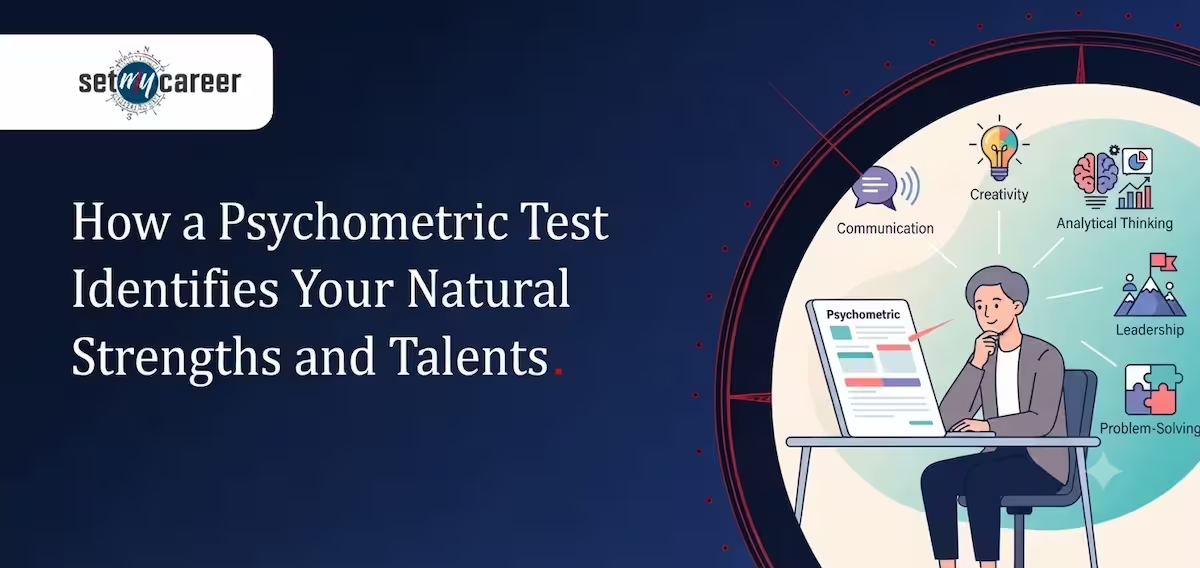
Navigating your career path can feel overwhelming, but a scientific psychometric test removes the guesswork by mapping your unique cognitive abilities, personality traits, and vocational interests. Whether you are a student choosing an academic stream or a working professional planning a transition, these objective insights help you align your daily work with your natural strengths. At SetMyCareer, we combine these data-driven assessments with personalized, expert counseling to empower you to make your next big career decision with absolute confidence.
Introduction
Choosing a career path or planning your next professional move can often feel overwhelming. With so many options available, it is natural to wonder if you are making the right choices or if your daily work will truly align with your natural abilities. This is where a scientific, structured approach can bring much-needed clarity. Taking a psychometric test is one of the most reliable ways to cut through the confusion and uncover your unique cognitive abilities, personality traits, and behavioral style.
Rather than relying on guesswork or well-meaning advice from others, a psychometric test provides an objective, data-driven assessment of your inherent strengths. It acts as a supportive tool that reflects how you solve problems, communicate with others, and handle workplace challenges. At SetMyCareer, we utilize these scientifically validated assessments to help you understand your innate potential, giving you a clear, personalized map of the environments where you are most likely to succeed and find satisfaction.
In this guide, you will learn exactly how a psychometric test decodes your natural talents and translates them into actionable career paths. Whether you are a student exploring college majors, a parent guiding your child, or a working professional planning a transition in 2026, understanding your strengths is the first step toward building a rewarding future. Let's explore how you can use these practical insights to make your next career decision with absolute confidence.
What is a Psychometric Test and How Does It Work?
A psychometric test is a scientifically validated instrument designed to measure an individual's cognitive abilities, behavioral style, personality traits, and career interests. It works by presenting structured, standardized questions that evaluate specific psychological attributes, converting responses into reliable data points to guide professional decision-making.
These assessments provide a structured, objective framework that removes personal bias from the self-evaluation process. Instead of relying on subjective opinions or temporary preferences, they measure stable psychological constructs that correlate with long-term job performance and vocational satisfaction. By evaluating these key human variables, individuals obtain an accurate benchmark of their current abilities and future potential.
The Core Components of a Modern Assessment
Modern psychometric evaluations do not rely on a single metric. Instead, they integrate multiple diagnostic lenses to build a comprehensive, multi-dimensional profile of the candidate. This multi-layered approach ensures that the resulting recommendations are highly personalized and aligned with realistic industry requirements.
The system evaluates several core dimensions to ensure a thorough analysis:
- Cognitive Aptitude: Evaluates problem-solving capabilities, logical reasoning, numerical agility, and verbal comprehension skills.
- Behavioral Patterns: Examines how individuals react under pressure, communicate within teams, and manage task-oriented responsibilities.
- Vocational Interests: Matches personal passions and engagement drivers with functional job roles and specific industry sectors.
- Workplace Values: Pinpoints the core motivators, such as autonomy, collaboration, or innovation, that drive daily professional engagement.
| Core Component | Diagnostic Objective | Practical Career Value |
|---|---|---|
| Cognitive Aptitude | Measures raw mental processing power and analytical capability. | Predicts ease of learning new technical systems and training adaptability. |
| Behavioral Style | Identifies preferred communication modes and team interaction habits. | Determines organizational cultural fit and leadership potential. |
| Vocational Interests | Maps internal drivers and preferred tasks to specific work fields. | Ensures long-term job satisfaction and reduces career burnout risk. |
Types of Assessments: Finding Your True Career Match
Career matching relies on distinct diagnostic assessments, including a career personality test, interest assessment, aptitude measurement, and cognitive profiling. These targeted tools isolate specific professional capabilities and behavioral tendencies, allowing individuals to identify work environments and industries that align perfectly with their natural strengths.
By using these targeted diagnostics, individuals avoid the common mistake of pursuing paths based solely on prestige or external pressure. Instead, they focus on areas where their natural tendencies and learned skills intersect, creating a reliable framework for sustainable professional success.
Career Personality Test vs. Interest Assessment
It is helpful to distinguish between what an individual is naturally suited to do and what they actually enjoy doing. While a career personality test evaluates behavioral traits, communication preferences, and decision-making styles, an interest assessment maps the specific topics, activities, and tasks that spark intrinsic motivation.
Using both assessments in tandem ensures that a career path is not only intellectually stimulating but also matches the individual's daily energy levels and operational preferences. For instance, a highly analytical person may have the ability to work in isolation, but their interests might drive them toward highly collaborative, client-facing consulting roles.
| Feature | Career Personality Test | Interest Assessment |
|---|---|---|
| Primary Focus | Behavioral traits, temperament, and work-style preferences. | Intrinsic motivators, preferred subjects, and activities. |
| Stability Over Time | Highly stable and consistent throughout adult life. | Can evolve with exposure to new industries and experiences. |
| Key Application | Identifying suitable work cultures and team dynamic roles. | Selecting specific industries, job domains, or academic fields. |
Aptitude Measurement and Cognitive Profiling
To round out the evaluation, career planners rely on standardized aptitude measurement and cognitive profiling. These tools move beyond personality traits to measure technical capacity and mental agility under specific functional conditions. This step is indispensable for determining whether a candidate possesses the raw processing skills needed for demanding analytical, technical, or creative fields.
Cognitive profiling breaks down mental processing into distinct, measurable categories, helping candidates understand their cognitive footprint:
- Numerical Reasoning: The capacity to analyze, interpret, and draw logical conclusions from complex data tables, financial charts, and mathematical sequences.
- Verbal Reasoning: The ability to comprehend written business communications, evaluate arguments, and construct persuasive professional narratives.
- Spatial Awareness: The mental capacity to manipulate physical objects, visualize architectural layouts, or excel in mechanical engineering design.
- Logical/Abstract Deduction: The skill of identifying underlying patterns, trends, and connections within non-verbal information to solve novel problems.
How Psychometric Tests Work in Real-World Career Selection
A psychometric test for career selection guides real world decisions by matching an individual's validated traits with job demands. This process removes bias from stream selection, career transitions, and professional skill gap analyses, ensuring that chosen career paths offer both long term performance potential and personal satisfaction.
Understanding how psychometric tests work in practice helps demystify the methodology. Rather than delivering a simple pass or fail grade, these tools evaluate baseline traits against standardized control groups representing successful professionals in various fields, establishing a realistic roadmap for development.
Stream Selection for Students
For high school and college students, academic choices establish the framework for future professional growth. Selecting a stream or college major based on peer trends or partial information often leads to disengagement. By introducing objective data early, students can identify paths that match their cognitive profile and learning preferences from the start.
| Cognitive Profile Focus | Indicated Strengths | Recommended Academic Streams |
|---|---|---|
| High Quantitative & Analytical | Data manipulation, logical deduction, systemic thinking. | Computer Science, Engineering, Actuarial Sciences, Finance. |
| High Verbal & Conceptual | Persuasive communication, thematic synthesis, critical reading. | Law, Corporate Communications, Journalism, Public Policy. |
| High Spatial & Design-Oriented | Visual reasoning, structural planning, aesthetic scaling. | Architecture, Product Design, Industrial Engineering, Fine Arts. |
Career Transitions for Working Professionals
For established professionals seeking a career pivot, these diagnostic tools provide a clear analysis of transferable skills. Instead of starting from scratch, candidates can identify adjacent industries where their existing behavioral strengths and cognitive traits remain highly valuable, reducing transition risk.
When preparing for a professional transition, the assessment highlights several critical pathways:
- Transferable Skill Mapping: Identifies underlying core competencies that can easily migrate from one functional domain to another.
- Leadership Adaptability: Evaluates the individual's readiness to transition from executing technical tasks to managing cross-functional teams.
- Cultural Alignment Check: Determines if a candidate is better suited for structured corporate systems or the fluid environment of a startup.
Understanding Psychometric Test Results for Long-Term Success
Understanding psychometric test results requires examining score profiles objectively rather than viewing them as pass-or-fail metrics. By analyzing patterns across aptitude, personality, and interest scales, individuals uncover clear pathways for targeted skill development, job-role alignment, and long-term professional growth.
A comprehensive assessment profile acts as a blueprint for career management. Rather than prescribing a single, restrictive job title, it outlines broad areas of professional compatibility, highlighting where an individual will find natural synergy and where they might face functional friction.
Translating Data Points into Actionable Next Steps
Raw assessment scores are most valuable when converted into a practical action plan. By pairing the diagnostic findings with professional career guidance, such as the programs offered by SetMyCareer, individuals can design structured development strategies that build upon existing strengths while systematically addressing identified skill gaps.
| Profile Scenario | Diagnostic Interpretation | Actionable Next Steps |
|---|---|---|
| High Aptitude / Low Interest | Possesses capability but lacks intrinsic drive for the domain. | Explore alternative applications of the skill in preferred fields. |
| High Interest / Low Aptitude | Highly motivated but requires technical skill enhancement. | Enroll in structured certifications or targeted mentoring programs. |
| High Aptitude / High Interest | Ideal vocational alignment with strong natural performance potential. | Pursue advanced specializations and leadership pathways directly. |
To convert diagnostic insights into concrete results, career planners recommend following a structured implementation methodology:
- Analyze the Core Discrepancies: Review any gaps between current job requirements and the natural behavioral traits identified in the report.
- Establish Focused Training Milestones: Create a quarterly learning plan targeting the specific cognitive or technical skills marked for development.
- Schedule Strategic Career Reviews: Periodically reassess professional goals against the original psychometric profile to ensure continued alignment as roles evolve.
Conclusion: Your Path to Career Clarity
Understanding your natural talents is the foundation of a fulfilling professional life. A reliable psychometric test removes the guesswork from this process, offering a clear, objective map of your unique strengths, personality traits, and cognitive abilities. Instead of choosing a path based on external pressure or trial and error, you gain the self-awareness needed to make career decisions with absolute confidence.
Whether you are a student choosing your college major, a graduate entering the job market, or a working professional seeking a meaningful career pivot, this scientific tool provides the clarity you need. It helps you align your daily work with what you naturally do best, leading to higher job satisfaction and long-term success.
You do not have to navigate these major life decisions alone. By taking a professional psychometric test with SetMyCareer, you will receive personalized insights and expert guidance to help you translate your results into an actionable career plan. Connect with our experienced career counselors today, discover your true potential, and take the first step toward a successful, aligned future.