




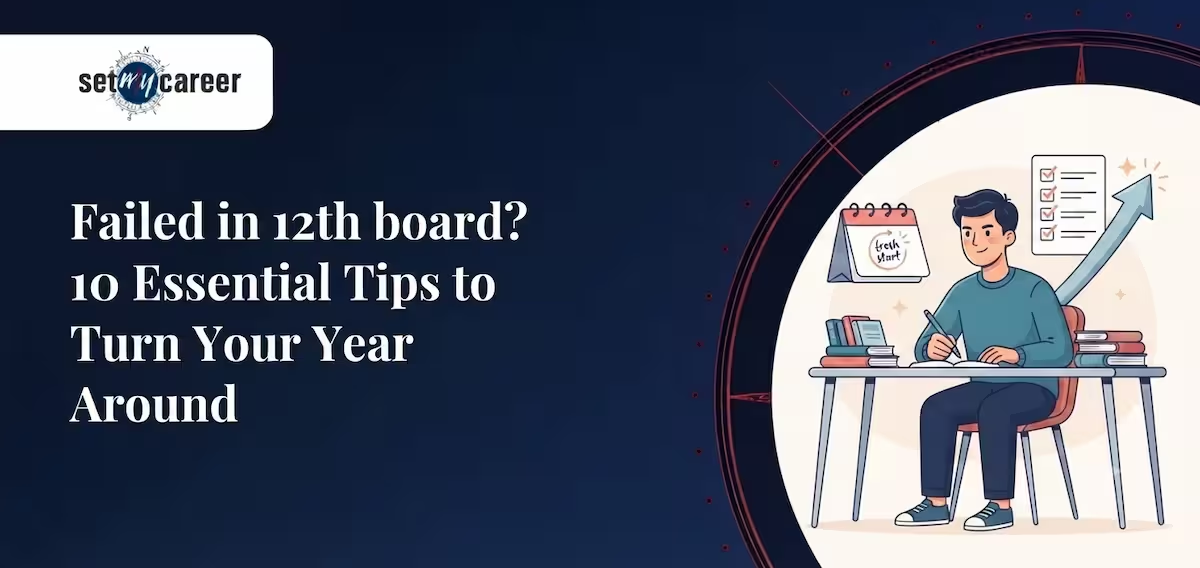
Opening your 12th-grade board results to find you haven't passed is a gut-wrenching experience. It is entirely normal to feel like the ground has given way beneath you, leaving you anxious about derailed plans and a clouded future. Before you spiral into panic, take a deep, grounding breath. This is absolutely not the end of the road. In fact, it is barely a speed bump in the grand scheme of your career and life.
Even after failing in 12th, there are still viable career options after 12th with proper guidance.
Right now, your mind is likely racing. You might be worrying about facing disappointed parents, watching your peers celebrate their admissions, and feeling like your entire academic trajectory just went up in smoke. It is a terrifying and overwhelming moment. However, a single academic setback does not dictate your intelligence, your capability, or your ultimate professional success. Some of the most innovative entrepreneurs, respected professionals, and creative leaders stood exactly where you are today.
If you are currently staring down that daunting "what now?" moment after a disappointing exam result, you are in the right place. We are going to walk through highly practical, actionable ways to turn this situation around. We aren't just offering empty motivational words; we are diving into concrete, strategic steps you can take—from compartment exams and open schooling networks to alternative career paths—to get your life back on track. Everyone stumbles. What truly matters is how you dust yourself off, assess your options, and plan your next move. Let's explore how you can take control of your future right now.
What Failing in 12th Grade Can Actually Teach You
It sounds like a cliché when you are in the middle of a crisis, but failure is frequently one of the most effective teachers you will ever encounter. While the sting of a bad result is fresh, this experience is quietly forging skills you will rely on for decades. Here is what this tough transition phase is actually teaching you:
- You are tougher than you realize: Remember the initial shock of seeing that marksheet? You survived it. Now you are actively searching for solutions. That ability to absorb a heavy hit and keep moving is the definition of resilience—a trait highly valued by every employer and business partner.
- The value of brutal honesty: This is a rare opportunity to get real about what actually went wrong. Did you struggle with time management? Was a specific subject mathematically overwhelming? Acknowledging your own weak spots is the first necessary step toward fixing them.
- Strategic problem-solving: When Plan A falls apart, you are forced to construct Plan B. Navigating alternative education routes forces you to think critically, weigh options, and adapt.
- Time is your most valuable asset: If you spent too many hours scrolling through social media instead of mastering your syllabus, the consequences are now glaringly clear. Learning to respect your time and prioritize your focus is a lesson that will serve you exceptionally well in college and your eventual career.
- Identifying your true support system: Hard times act as an immediate filter for your relationships. You will quickly discover which friends, mentors, and family members stand by you and offer genuine support when the celebrations stop.
- Adaptability in the face of change: Life rarely goes exactly according to a pre-written script. By learning to pivot when your perfect academic plan gets derailed, you are mastering the art of rolling with the punches.
- Perseverance over perfection: Quitting is always the easiest option. By choosing to figure out your next educational steps, you are actively practicing perseverance, which is the cornerstone of long-term career success.
- Emotional intelligence: Dealing with the frustration, anger, and deep disappointment of a failed board exam forces you to process complex emotions. Learning to manage your mental state under intense pressure is crucial for your personal development.
- The importance of a strategic approach: Hard work only pays off when it is directed properly. You are learning that simply putting in hours at a desk isn't enough; you need the right preparation strategy, syllabus breakdown, and study techniques.
- Self-compassion: Beating yourself up will not change your grade. You are learning that everyone makes mistakes, and treating yourself with grace during a highly stressful time is essential for your mental well-being.
Rewriting Your Story: 10 Actionable Power Tips for a Academic Comeback
It is time to pick up the pen and write the next chapter of your academic and professional journey. Here are 10 highly practical strategies to help you bounce back stronger, smarter, and more prepared than before.
1. Embrace the Plot Twist and Assess Your Immediate Options
Think of this as an unexpected detour, not a dead end. Once the initial shock wears off, you need to look at your immediate academic options objectively. Depending on your educational board (such as CBSE, ICSE, or State Boards) and how many subjects you failed, you might be eligible for a compartment or supplementary exam. If you only missed the passing mark in one or two subjects, applying for a compartment exam is often the fastest route to clearing your 12th grade without losing an entire academic year. Check your board's official website immediately for registration deadlines.
2. Explore the NIOS Route (National Institute of Open Schooling)
If a compartment exam isn't a viable option, or if you failed multiple subjects, look into NIOS. The National Institute of Open Schooling is a highly flexible, government-recognized board that allows you to carry forward the marks of up to two subjects you passed (known as Transfer of Credit or TOC). This means you only sit for the exams you failed. NIOS conducts On-Demand Examinations (ODES), meaning you can often clear your 12th grade on your own timeline, much faster than waiting for next year's regular board cycle.
3. Seek Professional Career Guidance
You do not have to figure out this complex landscape alone. Professional career counseling can provide incredible clarity during a confusing time. A certified career expert can help you analyze your inherent strengths through psychometric testing, evaluate your genuine interests, and introduce you to high-paying career paths you may not have known existed. For instance, they can guide you toward lucrative professional courses after 12th science that don't require clearing NEET, or help you understand the vast, high-earning scope in commerce and humanities without relying on advanced mathematics.
4. Set Clear, Achievable Micro-Goals
It is time to recalibrate your trajectory. Instead of feeling paralyzed by the big picture, break your next steps down into micro-goals. Your first goal might simply be downloading the compartment exam syllabus or registering for a re-evaluation. Use the SMART framework (Specific, Measurable, Achievable, Relevant, Time-bound) to structure your days. Setting small, actionable targets gives you a sense of momentum and restores your control over the situation.
5. Develop High-Income Skills Outside the Classroom
While you are sorting out your academic standing, use this gap time to build real-world, employable skills. Academic board grades do not dictate your ability to learn UI/UX design, digital marketing, basic Python coding, video editing, or a foreign language. Earning practical certifications in high-demand fields can significantly boost your confidence, enhance your resume, and open up freelance opportunities regardless of your current board exam scores.
6. Build a Smarter, Evidence-Based Study Strategy
If you are planning to retake your exams, you absolutely cannot use the same study methods that let you down the first time. Analyze your previous approach critically. Do you need a private tutor for a specific subject? Should you rely more heavily on past 10-year question papers? Create a structured, daily study plan that incorporates proven cognitive techniques like active recall, the Pomodoro technique, and spaced repetition to ensure you actually retain complex material.
7. Explore Diploma and Vocational Alternative Paths
A traditional three- or four-year university degree is not the only path to a successful career. There are numerous polytechnic diplomas and vocational training programs that accept students based on their 10th-grade passing certificates. Exploring practical fields like hospitality management, hardware networking, animation, interior design, or allied healthcare tech can provide a direct route into the workforce. You can build a solid career foundation while optionally completing your 12th-grade requirements through open schooling on the side.
8. Lean on Your Support Network Constructively
Do not isolate yourself out of shame or embarrassment. Talk to your parents, trusted teachers, or older siblings about what you are going through. Navigating parental disappointment is tough, but approaching them with a mature, well-thought-out "Plan B" (like NIOS or compartment exams) demonstrates accountability. A strong support system will help keep you grounded, offer objective advice, and remind you that your worth is not tied to a single piece of paper.
9. Prioritize Your Mental Health
Navigating academic failure is mentally and emotionally exhausting. It is incredibly important that you do not let this event consume your entire identity. Maintain a healthy daily routine—exercise regularly to burn off cortisol, get a full eight hours of sleep, and engage in hobbies that help you detach from exam-related anxiety. A clear, healthy, and rested mind is your best possible asset for staging a successful academic comeback.
10. Stay Inspired by Real Comeback Stories
Business history is filled with highly successful entrepreneurs, celebrated artists, and corporate leaders who failed major exams early in their lives. Seek out these biographies and podcasts. Understanding that a poor academic result is a remarkably common hurdle—not a permanent, insurmountable barrier—will help keep your perspective balanced and your motivation high as you work through your own challenges.
Conclusion: Your Setback is Not Your Final Destination
Failing your 12th-grade board exams can temporarily feel like a massive, immovable roadblock, but in the broader context of your life, it is merely a detour on a much longer journey. By intentionally shifting your mindset and leveraging the right strategic options—whether that means preparing rigorously for a compartment exam, transitioning to the flexibility of an open schooling board, or exploring skill-based vocational diplomas—you can turn this difficult moment into a powerful catalyst for growth.
Your ultimate potential is never defined by a single test score; it is defined by your resilience, your willingness to adapt, and your commitment to moving forward. Take the time you need to process your emotions, map out your immediate next steps, and do not hesitate to seek professional career guidance to explore all the doors that remain wide open for you. Your future is entirely in your hands, and your comeback story starts today.