






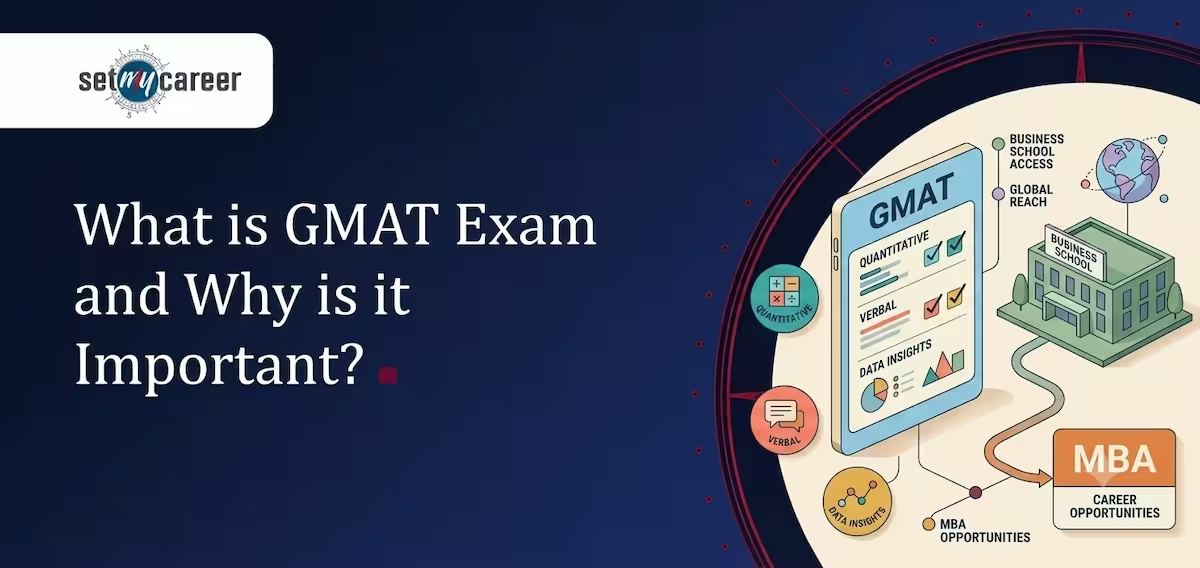
If you are considering an MBA or a graduate management program, the Graduate Management Admission Test (GMAT) is likely already on your radar. As a central pillar of the business school admissions process, it carries significant weight, but understanding what it evaluates and how it impacts your profile requires looking past common myths. Does a high score guarantee admission into an elite business school? Does it pave the way to top-tier leadership roles? Before mapping out your prep strategy, it helps to examine what the GMAT actually measures and how it fits into your broader career roadmap.
The GMAT exam opens up various career options after graduation for business school aspirants.
What Is the GMAT?
The GMAT is a standardized assessment designed to evaluate the critical thinking, problem-solving, data analysis, and decision-making capabilities required in rigorous business and management programs. Administered by the Graduate Management Admission Council (GMAC), it is widely utilized by admissions committees globally to benchmark applicants across diverse academic and professional backgrounds. Securing a competitive score can significantly strengthen your application when targeting top-tier business schools and specialized management degrees.
Who Can Take the GMAT?
The eligibility criteria for the GMAT are remarkably accessible, though test-takers must keep a few logistical rules in mind:
- Age Requirement: Candidates must be at least 18 years old. Minors aged 13 to 17 may test with written consent from a parent or legal guardian.
- Educational Background: There are no strict prerequisite degrees required to register, though the vast majority of test-takers hold or are currently pursuing an undergraduate degree.
- Attempt Limits: You can take the GMAT up to five times within a rolling 12-month period, with a lifetime cap of eight attempts.
- Retake Policy: A mandatory waiting period of 16 days is required between consecutive test attempts.
Understanding the GMAT Focus Edition and Exam Format
The GMAT is a computer-adaptive test (CAT), meaning the difficulty of questions adjusts dynamically based on your performance as you move through the exam. The current structure comprises three core sections (reflecting the streamlined GMAT Focus Edition format):
- Quantitative Reasoning: Evaluates problem-solving and mathematical literacy.
- Time & Format: 45 minutes, 21 questions.
- Skills Tested: Arithmetic and algebra, focusing on logical deduction rather than heavy calculation.
- Verbal Reasoning: Assesses your ability to comprehend written material, evaluate arguments, and correct written text.
- Time & Format: 45 minutes, 23 questions.
- Skills Tested: Reading comprehension and critical reasoning.
- Data Insights: Measures digital literacy and how effectively you evaluate and synthesize information from multiple sources.
- Time & Format: 45 minutes, 20 questions.
- Skills Tested: Data interpretation, multi-source reasoning, graphics interpretation, and two-part analysis.
Your overall GMAT score is aggregated from these three sections, providing admissions teams with a holistic view of your analytical aptitude.
How to Apply and Schedule Your GMAT
Registering for the exam is a straightforward digital process:
- Create an Account: Set up a profile on the official GMAC portal at mba.com.
- Select Your Delivery Mode: Choose between taking the exam at an authorized physical test center or securely online from home.
- Pay the Examination Fee: The standard registration fee is globally benchmarked at approximately $275.
- Choose Your Date: Because the GMAT is offered year-round, you can pick a slot that aligns with your timeline.
- Receive Scores: Unofficial scores are displayed immediately upon completion, while official score reports are delivered securely within 7 to 10 business days.
Because application deadlines for elite institutions vary widely—particularly for premier programs like the Indian School of Business (ISB) or Executive MBAs at various IIMs—it is strategic to complete your GMAT at least 6 to 12 months before your targeted application rounds.
GMAT Cut-Off Scores for Top Global and Indian Business Schools
While admissions standards are holistic and rarely rely on test scores alone, competitive score benchmarks offer a useful target during preparation:
| Business School | Approximate Competitive Score Range |
| Harvard Business School (USA) | 730–740+ (Legacy scale equivalent) / Competitive percentiles |
| Stanford Graduate School of Business (USA) | 740–750+ |
| INSEAD (France/Singapore) | 700+ |
| London Business School (UK) | 680–720+ |
| Indian School of Business - ISB (India) | 710+ |
Keep in mind that an exceptional GMAT score is only one element of a successful dossier. Admissions panels weigh work history, quality of recommendations, personal essays, and interview performance heavily alongside your score.
GMAT vs. Alternative Management Entrance Exams
Choosing the right test depends entirely on your geographic targets and career stage:
- GMAT vs. GRE: While a growing number of business schools accept both, the GMAT is purpose-built for management aptitude with an emphasis on data insights and logical reasoning, whereas the GRE features a heavier focus on advanced vocabulary.
- GMAT vs. CAT: The Common Admission Test (CAT) is tailored specifically for domestic admissions into India's premier public institutions like the IIMs. By contrast, the GMAT is recognized universally for international and premier executive programs.
- GMAT vs. Executive Assessment (EA): The EA is a shorter, streamlined variant designed explicitly for experienced professionals targeting Executive MBA programs, whereas the GMAT is comprehensive and built for full-time candidates.
Why Investing Time in the GMAT Pays Off
Preparing for and conquering the GMAT offers tangible dividends that extend far past the admissions office:
- Global Mobility: Accepted by over 2,300 business institutions across more than 110 countries.
- Merit-Based Scholarships: Many universities utilize high GMAT benchmarks as a primary qualifying metric for substantial tuition fee waivers and merit scholarships.
- Cognitive Conditioning: The rigorous preparation cycle trains your mind in structural problem-solving, rapid data synthesis, and objective decision-making—skills that translate directly into corporate leadership.
- Extended Score Validity: Your official GMAT scores remain valid for five years, offering valuable flexibility as you time your career moves and application windows.
Conclusion
The GMAT is much more than a routine admissions hurdle; it serves as a rigorous mental proving ground that sharpens your analytical acumen and opens doors to top global business networks. Whether you are targeting an elite full-time MBA or positioning yourself for executive leadership, approaching your preparation with discipline, strategic resource allocation, and a clear timeline will set you up for success in the competitive corporate landscape.