





At various stages of our lives, we face the daunting task of choosing a professional path. With thousands of different occupations and a constantly shifting job market, relying on gut feelings, passing interests, or well-meaning advice from family often leads to frustration and burnout. What if you could strip away the guesswork and take a strategic, data-driven approach to your professional future?
Career counselling often begins with a career test to identify suitable career paths.
Professional career tests offer exactly that. These assessments move far beyond simple quizzes and personal opinions. They provide a scientific framework to help you understand how your innate skills, personality traits, and core values align with real-world professions. However, the assessment industry is vast, and not all tools offer the same level of accuracy or insight.
Understanding how these psychometric evaluations work, which metrics actually matter, and how to interpret your results can mark the difference between a fulfilling career and years of professional dissatisfaction. Let’s break down the science of career assessments and how they can guide your next major life decision.
What Is a Career Test?
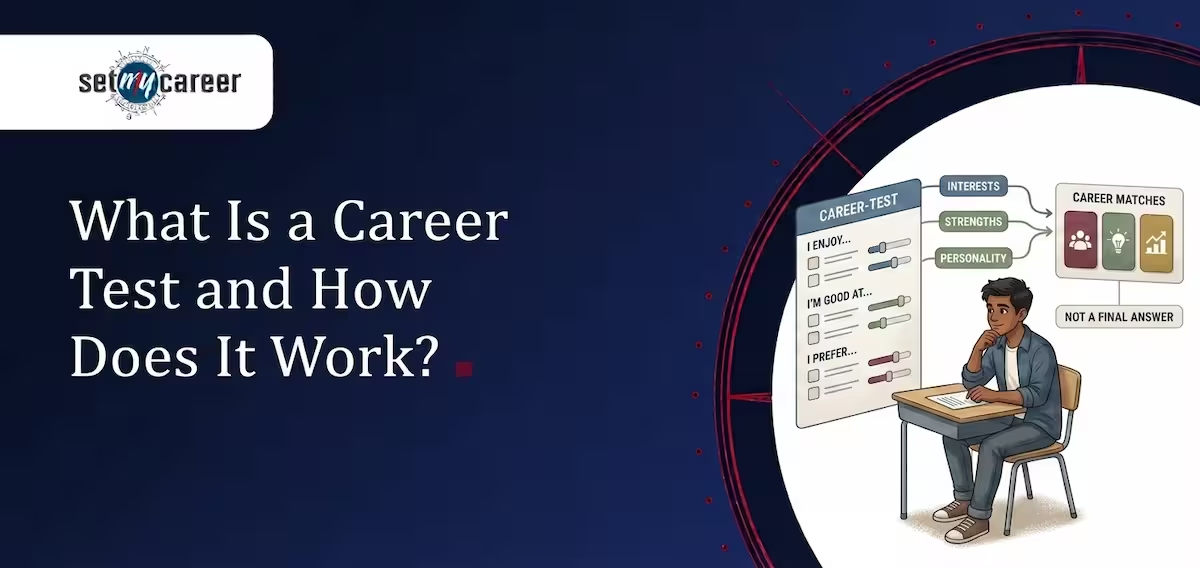
Choosing a profession can feel overwhelming when you lack a clear understanding of your own internal drivers. Career assessments are structured, scientifically developed tools designed to evaluate your unique psychological and cognitive profile. They measure a combination of your natural aptitudes, professional interests, behavioral traits, and workplace values to match you with highly compatible career trajectories.
These evaluations belong to a broader category of psychometric testing, which encompasses intelligence metrics, spatial reasoning, and personality profiling. Typically administered by certified career counselors, industrial psychologists, or trained educational professionals, these tests translate raw personal data into actionable career insights.
While often associated with high school or college students choosing their first major, modern career tests are equally valuable for mid-career professionals looking to pivot industries, individuals returning to the workforce, or executives seeking greater alignment in their current roles.
The Science Behind the Screen: How Do Career Tests Work?
Quality career tests are the product of decades of psychological research and occupational data analysis. Experts construct these assessments to measure highly specific traits and compare your responses against massive databases of normative data.
When you complete a standardized career assessment, the system analyzes your response patterns and cross-references them with the profiles of individuals who are demonstrably successful and satisfied in various professions. For instance, if your testing pattern closely mirrors the cognitive and behavioral patterns of successful civil engineers or financial analysts, the assessment flags those fields as high-potential matches.
Just as a medical diagnostic tool must be precisely calibrated to yield an accurate result, a reliable career test undergoes rigorous statistical refinement. Developers continuously test and update the questions to ensure they consistently measure what they claim to measure, providing you with empirically backed career guidance rather than generic suggestions.
Why You Need a Data-Driven Approach to Career Planning
It is incredibly difficult to evaluate your own career potential objectively. Our interests are heavily skewed by exposure, media representation, and personal biases.
Consider a student who excels at biology and naturally assumes they should become a physician. While an interest in human anatomy is necessary, the day-to-day reality of being a doctor requires exceptional emotional resilience, the ability to make high-stakes decisions under extreme fatigue, and a tolerance for highly structured, deeply regulated environments. If that student's personality profile actually favors creative autonomy and low-stress environments, medicine might lead to rapid burnout despite their academic capabilities.
Furthermore, well-intentioned advice from parents or peers is inherently flawed. Family members project their own lived experiences, generational workplace norms, and unfulfilled ambitions onto your career choices. A validated career test removes this emotional bias. It systematically analyzes multiple dimensions of your psyche, ensuring your final decision is grounded in objective compatibility rather than external pressure.
Who Should Take a Career Assessment?
Career confusion does not discriminate by age or experience level. A well-calibrated career test provides immense value to a wide variety of individuals, including:
- High School and College Students: Needing direction for college majors, internships, and entry-level career tracks.
- Mid-Career Professionals: Experiencing stagnation or burnout and looking to pivot into a more fulfilling industry.
- Workforce Returners: Parents or caregivers re-entering the job market who want to reassess their current skills and modern market opportunities.
- Corporate Leaders: Seeking to understand their management style and how to align their current trajectory with their long-term personal values.
The key is selecting an assessment normed for your specific life stage. A test designed to help a 16-year-old choose a college major will not provide the nuanced industry insights required by a 40-year-old marketing director looking to transition into tech.
Core Types of Career Tests: Finding Your Perfect Match
Career assessments are not one-size-fits-all. They evaluate different facets of your professional identity. A comprehensive career counseling process usually involves a combination of the following test categories.
1. Interest-Based Tests
Interest inventories focus entirely on what you naturally enjoy doing, independent of your current skill level. They identify intrinsic passions and hobbies, mapping them to occupational clusters. A common framework used here is the Holland Codes (RIASEC), which categorizes interests into Realistic, Investigative, Artistic, Social, Enterprising, and Conventional themes.
2. Personality-Based Assessments
Your behavioral traits dictate the type of work environment where you will thrive. Personality tests evaluate how you interact with others, process information, and handle stress. They reveal whether you are naturally suited for highly collaborative teamwork, isolated deep work, rigid corporate structures, or chaotic, fast-paced startup environments.
3. Aptitude and Cognitive Ability Tests
While interest tests ask what you want to do, aptitude tests evaluate what you are actually capable of doing. These assessments measure innate cognitive talents such as logical reasoning, numerical fluency, spatial awareness, and verbal comprehension. They highlight careers where your natural brainpower gives you a competitive advantage.
4. Values-Based Assessments
Perhaps the most overlooked element of career satisfaction is value alignment. These tests help you rank your non-negotiable workplace priorities. Do you value high financial compensation over work-life balance? Do you need a job that provides social impact, or are you driven by public recognition and job security? Understanding your core values prevents you from taking a job that looks great on paper but makes you miserable in practice.
Online vs. Offline Testing Environments
- Online Career Tests: Highly accessible and convenient. While many are free, the most accurate versions require a fee for full access to the data. It is critical to verify the scientific credibility of digital-only platforms.
- Offline/Proctored Tests: Usually administered in a clinical or educational setting by a certified counselor. These offer the highest level of accuracy, as the environment is controlled, and the results are immediately contextualized by a professional.
The Importance of Psychometric Properties: Standardized vs. Non-Standardized Tests
If you search for "career test" online, you will find millions of results ranging from clinical diagnostic tools to superficial ten-question quizzes. The difference between a helpful assessment and a dangerous one comes down to its psychometric properties.
A standardized career test is built upon two non-negotiable scientific pillars:
- Validity: Does the test actually measure what it claims to measure? If a test claims to measure mathematical aptitude, the results must directly correlate with mathematical performance.
- Reliability: Does the test produce consistent results? If you take the assessment on a Tuesday, and again three weeks later, a reliable test will yield highly similar profiles.
Non-standardized quizzes lack this empirical backing. Basing your college major or a major career pivot on an unverified online quiz is a significant risk.
Additionally, cultural norming is vital. A career test designed and normed exclusively for the corporate landscape in the United States may produce skewed results for a user navigating the job market in India or Europe. Always seek assessments that have been localized for your specific cultural and economic environment.
Actionable Tips: How to Get the Most Out of Your Career Test
To ensure your assessment yields accurate, usable data, keep these best practices in mind before you begin clicking through the questions:
- Verify the Source: Ensure the test is backed by psychological research and ideally administered by a certified organization or career counselor.
- Answer as You Are, Not as You Want to Be: The biggest mistake test-takers make is answering aspirationally. If you hate public speaking but think a successful manager should like it, do not mark that you enjoy it. Brutal honesty is required for accurate results.
- Go with Your Gut: Do not overthink the questions. Your first instinct is usually the most accurate reflection of your true personality and interests.
- Never Skip the Debrief: Raw data is useless without context. A psychometric profile is a starting point, not a mandate. Always review your results with a certified career counselor who can translate the data into real-world job titles, educational pathways, and market realities.
Conclusion: Turning Assessment Insights Into Career Action
A career assessment is a powerful diagnostic tool, but it is only the first step in a broader journey of professional discovery. By cutting through external noise and internal bias, these tests provide a factual baseline of your strengths, limitations, and intrinsic motivations.
Ultimately, a successful career is the intersection of what you excel at, what you genuinely enjoy, and what the market actively values. When you combine a scientifically validated career test with the strategic insights of a professional career counselor, you stop guessing about your future and start building a deliberate, fulfilling professional life.