




Quick Summary
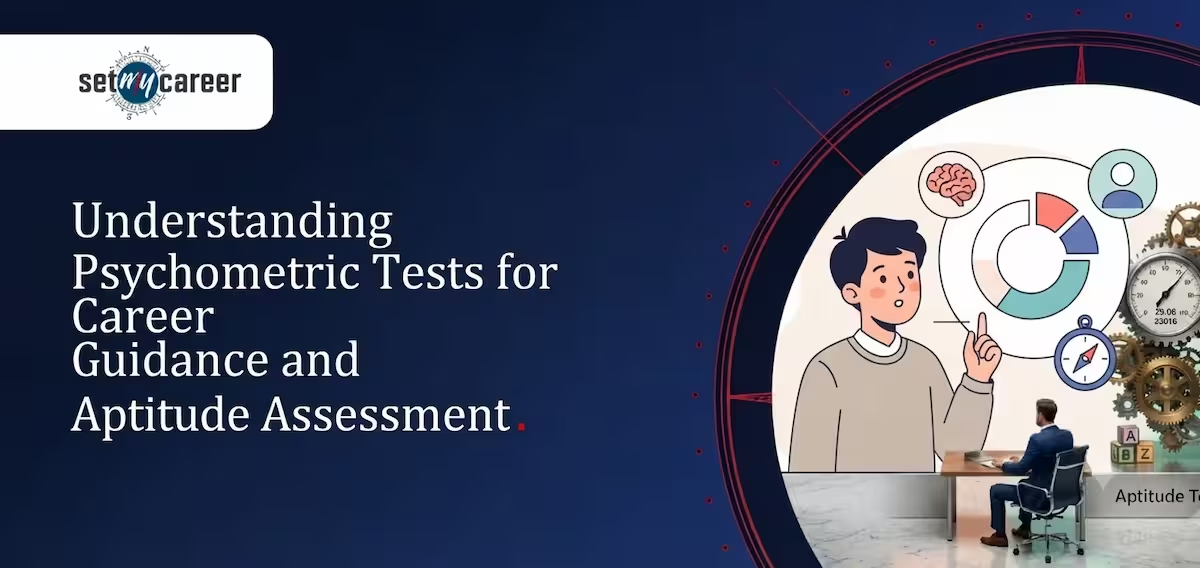
A scientifically validated psychometric test for career planning removes guesswork by aligning an individual's unique cognitive aptitude, behavioral tendencies, and occupational interests with real-world industry demands. By mapping natural strengths and personality traits, these professional assessments help students and working professionals make confident academic stream selections and structured career pivots. Utilizing scientifically validated tools like those at SetMyCareer pairs detailed data with expert counseling to build actionable roadmaps that prevent burnout and foster long-term professional fulfillment.
Introduction
Choosing a career path can feel overwhelming, whether you are a student exploring college majors, a parent trying to guide your child, or a professional looking for a meaningful transition. With thousands of career options available in 2026, relying on guesswork or peer pressure often leads to confusion. Taking a psychometric test for career planning acts as a reliable compass, helping you align your natural talents, personality, and interests with the right professional opportunities.
At SetMyCareer, we believe that your future should be shaped by clarity, not chance. A psychometric assessment is not a pass-or-fail exam; rather, it is a scientifically validated tool that maps your unique strengths and cognitive abilities. In this guide, you will learn how a psychometric test for career selection works, what insights it reveals, and how you can use this data to make confident, well-informed decisions. Let’s take the stress out of planning and build a clear, practical roadmap for your long-term success.
What is a Psychometric Test for Career Planning?
A psychometric test for career planning is a scientifically validated assessment designed to measure an individual's cognitive abilities, personality traits, and professional interests. This standardized tool provides objective data to help students and professionals align their natural strengths with suitable academic streams and long-term career pathways.
Unlike standard school exams that measure academic memory, a modern career suitability test evaluates how a person processes information, responds to challenges, and behaves in various work environments. These assessments utilize decades of psychological research to create an accurate profile of an individual's potential. By identifying core competencies early, individuals can avoid the trial-and-error approach to professional development, saving time, money, and emotional energy.
To understand the value of scientific evaluation, it helps to compare structured career assessments with informal, intuitive choices. The table below outlines the primary differences between these two approaches.
| Feature | Informal Self-Assessment | Scientific Psychometric Testing |
|---|---|---|
| Basis of Evaluation | Subjective feelings, peer influence, and current trends. | Standardized behavioral and cognitive metrics. |
| Reliability | Low; changes based on mood, age, and external pressure. | High; built on validated psychological frameworks. |
| Outcome Depth | Surface-level career ideas without actionable execution steps. | Multidimensional profiles with tailored pathways. |
The Core Components of Career Suitability Assessment
A comprehensive assessment does not rely on a single metric. To build a reliable professional profile, the system must evaluate multiple dimensions of an individual's psychology. This multidimensional analysis ensures that the resulting recommendations are realistic and sustainable over a long-term professional life.
A standardized career suitability test typically breaks down into three core investigative pillars:
- Cognitive Aptitude: This measures numerical, verbal, spatial, and logical reasoning skills to determine an individual's learning speed and problem-solving capacity.
- Behavioral Tendencies: This identifies natural communication styles, leadership potential, stress tolerance, and preference for teamwork or independent work.
- Occupational Interests: This highlights the tasks, projects, and work settings that naturally engage the individual, ensuring long-term motivation.
How Psychometric Tests Help Career Decision Making
A psychometric test helps career selection by removing guesswork and bias from the decision-making process. By evaluating analytical reasoning, work style preferences, and behavioral tendencies, these evaluations provide clear, data-driven recommendations that guide individuals toward educational paths and roles where they are most likely to succeed.
Understanding how psychometric tests help career growth requires looking at real-world transition points. High school students often struggle to choose between science, commerce, or humanities streams. College students frequently face uncertainty when selecting a specialization, while mid-career professionals often experience burnout because their current roles do not align with their core drivers. Scientific testing provides the clarity required to make these transitions smoothly and confidently.
The table below highlights how different demographics benefit from integrating psychometric testing into their planning cycles.
| User Demographic | Primary Career Challenge Solved | Actionable Decision Facilitated |
|---|---|---|
| High School Students | Confusion over academic stream selection. | Choosing the correct subject combinations for college. |
| College Undergraduates | Uncertainty regarding industry specializations. | Selecting internships and post-graduate pathways. |
| Working Professionals | Career stagnation, misalignment, or burnout. | Planning structured pivots to high-compatibility industries. |
Bridging the Gap Between Talent and Industry Demand
Modern job markets are dynamic and require specific behavioral competencies alongside technical skills. Standard educational curricula do not always highlight these requirements, leaving individuals unprepared for actual workplace demands. Professional evaluations act as a diagnostic tool that maps personal capabilities to market realities.
Using a structured evaluation helps bridge this alignment gap in several ways:
- Identifying Transferable Skills: Spotlighting cognitive strengths that can be applied across multiple emerging industries.
- Highlighting Developmental Needs: Revealing hidden skill gaps before they negatively impact professional performance.
- Enhancing Job-Role Compatibility: Aligning individual temperament with specific working cultures, such as collaborative environments or highly autonomous roles.
Types of Career Aptitude Tests and Assessments
Career aptitude tests assess specific cognitive strengths, such as numerical, verbal, and spatial reasoning, to determine suitability for different professions. These standardized metrics help identify an individual’s potential to acquire specialized skills, ensuring a logical match between natural intellectual strengths and occupational demands.
A holistic approach to career guidance looks beyond basic cognitive scores. While intellectual capability is important, long-term career satisfaction depends heavily on the alignment of personality traits and personal interests. For this reason, career counselors use a variety of specialized assessment models to gain a complete understanding of a person's profile.
Personality Assessment Career vs. Interest Inventory Test
To build a balanced career development plan, it is helpful to distinguish between how you work and what you enjoy doing. This distinction is clarified by comparing a personality assessment career evaluation with an interest inventory test, as each measures a distinct psychological layer.
The matrix below outlines how these two frameworks compare and how they function together during the assessment process.
| Assessment Type | What It Measures | Common Framework Used | Practical Application |
|---|---|---|---|
| Personality Assessment Career | Inherent behavioral styles, traits, and social preferences. | Five-Factor Model (Big Five) or similar profiles. | Determines culture fit and ideal working environments. |
| Interest Inventory Test | Preferences for specific activities and industries. | Holland Occupational Themes (RIASEC model). | Identifies roles and tasks that sustain daily motivation. |
Using these tools together offers several key benefits for long-term career satisfaction:
- Preventing Burnout: Ensuring that your daily work tasks match your natural energy reserves and motivational drivers.
- Clarifying Culture Fit: Matching personal communication patterns with the typical operating styles of specific industries.
- Guiding Skill Development: Highlighting soft skills that need enhancement based on your target professional profile.
Choosing the Best Psychometric Test for Career Success
Choosing the best psychometric test for career development requires selecting scientifically validated, reliable assessments that evaluate personality, interests, and abilities together. High-quality assessments provide comprehensive reports alongside professional guidance, enabling individuals to translate raw test scores into realistic, actionable developmental roadmaps.
With many online tests available, identifying high-quality assessments is critical. Many platforms offer quick personality quizzes, but these lack the scientific validity required for making significant life decisions. Selecting a validated resource, like the platform at SetMyCareer, ensures that the data driving your future is accurate and dependable.
Evaluating Paid vs. Free Psychometric Tests for Career Planning
While free psychometric tests for career exploration are widely accessible online, they often present limited data without scientific backing. These quick tools can be useful for initial curiosity, but they rarely offer the statistical validation or professional support needed to construct a secure professional strategy.
The table below highlights the differences between superficial web tools and professional, scientifically validated career testing services.
| Evaluation Metric | Free Online Assessments | Professional Psychometric Testing |
|---|---|---|
| Scientific Validation | Rarely validated; often based on outdated or simplified models. | Rigorous psychometric validation with high reliability scores. |
| Report Complexity | Generic, one-page summaries with broad suggestions. | Detailed, multidimensional insights covering multiple success factors. |
| Actionable Support | None; users must interpret complex psychological data on their own. | Paired with professional counseling to create structured plans. |
When searching for the best psychometric test for career growth, verify that the platform meets the following standards:
- Multi-Dimensional Assessment: The test should evaluate cognitive aptitude, personality, and interests simultaneously.
- Scientific Reliability: The underlying testing methodologies must be backed by modern psychometric research.
- Qualified Counselor Feedback: The results should be explained by an expert who understands the nuances of the current job market.
- Practical Action Steps: The final report must outline clear academic pathways or professional milestones.
Your Path to Clear Career Decisions
Choosing a career path is a significant milestone, and it is completely normal to feel unsure about which direction to take. A reliable psychometric test for career planning removes the guesswork by analyzing your unique strengths, personality traits, and natural aptitudes. Instead of relying on trial and error, you gain a clear, evidence-based map of where you are most likely to thrive and find long-term satisfaction.
Understanding yourself is the first and most important step toward professional fulfillment. When you align your natural talents with the right industry, you build a foundation for a successful and enjoyable career. Remember, you do not have to navigate these major decisions alone.
If you are ready to gain clarity and take control of your future, we are here to support you. Start your journey today by taking a scientifically validated psychometric test for career success with SetMyCareer. Let our expert counselors help you translate your results into a practical, step-by-step action plan for your future.