






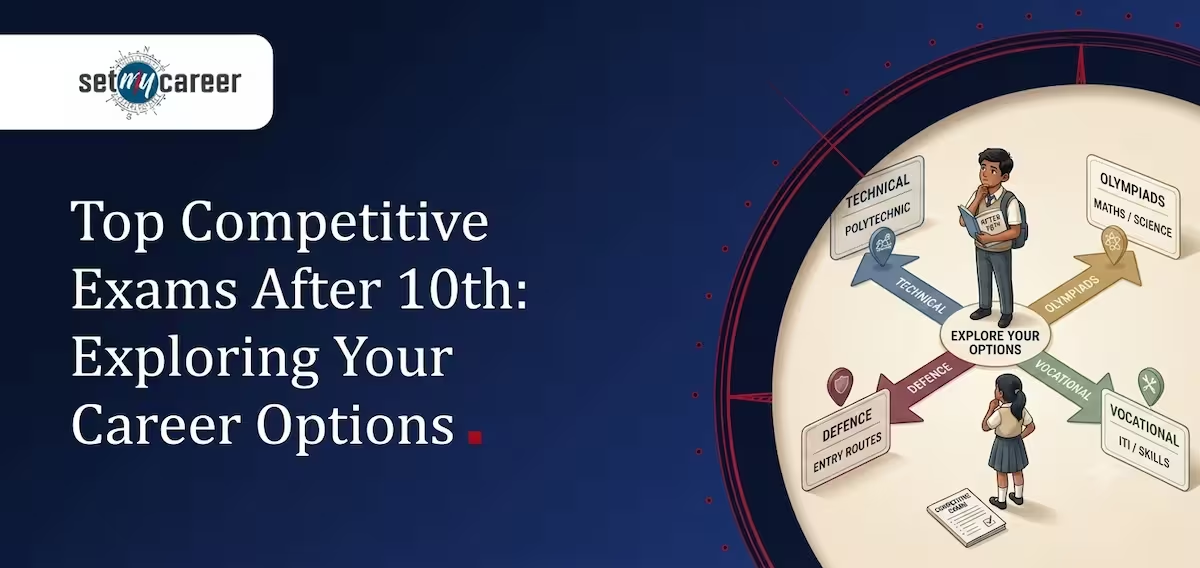
Picture this: You have just finished your 10th board exams, and for the first time, you have the freedom to decide what comes next. While most of your friends are weighing the traditional choices of Science, Commerce, or Humanities, you might be wondering if there is another path. Are there opportunities you can explore right now to gain a competitive edge?
A stream selector can help identify suitable competitive exams after 10th based on career goals.
What if you could step outside the standard academic route and unlock unique opportunities immediately? Taking competitive exams after 10th grade can open doors you might not have considered. From securing prestigious national scholarships to exploring early career placements in defense and technology, these examinations can build a powerful foundation for your future. Let’s explore the top competitive exams available after the 10th grade and how they can shape your academic trajectory.
List of Top Competitive Exams After 10th Grade
National Talent Search Examination (NTSE)
The NTSE is arguably the most prestigious national-level scholarship program in India. Conducted by the National Council of Educational Research and Training (NCERT), it aims to identify and nurture exceptionally talented students. The examination evaluates candidates across two primary areas:
- Mental Ability Test (MAT): Assesses logical reasoning, analytical thinking, and problem-solving skills.
- Scholastic Aptitude Test (SAT): Tests knowledge in mathematics, science, and social sciences.
Students who successfully clear both the state and national stages receive monthly scholarships that can fund their education up to the doctoral level in sciences and social sciences, or up to the postgraduate level for professional courses like medicine and engineering.
INSPIRE Scholarship for Higher Education (Formerly KVPY)
Historically, the Kishore Vaigyanik Protsahan Yojana (KVPY) was the premier exam for students wanting to pursue research careers in basic sciences. Recently, the government discontinued the standalone KVPY aptitude test, merging its fellowship opportunities into the broader INSPIRE (Innovation in Science Pursuit for Inspired Research) program. Today, students who wish to secure this highly coveted research scholarship can do so by ranking within the top 10,000 in exams like JEE or NEET, or by becoming NTSE scholars or International Olympiad medalists.
National and International Olympiads (NSO, IMO, IEO, NCO)
Olympiads are excellent platforms to test your conceptual knowledge against peers on a national or global scale. Conducted by organizations like the Science Olympiad Foundation (SOF), these exams help build a strong foundation for future competitive entrance tests. Key Olympiads include:
- National Science Olympiad (NSO): Designed for students who want to test their advanced understanding of physics, chemistry, and biology.
- International Mathematics Olympiad (IMO): A rigorous examination for those passionate about complex mathematical problem-solving.
- International English Olympiad (IEO): Focuses on language proficiency, grammar, and reading comprehension.
- National Cyber Olympiad (NCO): Targets students interested in information technology, computer science, and cybersecurity.
Scoring well in Olympiads not only strengthens your resume but often rewards top performers with cash prizes, medals, and international recognition.
Indian Army Soldier General Duty (GD) Exam
If you are passionate about serving the nation and prefer an early entry into the armed forces, the Indian Army Soldier General Duty recruitment is a viable path. This entry-level recruitment allows candidates who have completed their 10th-grade education to join the military. The rigorous selection process includes:
- A written examination testing general knowledge and basic sciences.
- A demanding physical fitness test to ensure combat readiness.
- A comprehensive medical evaluation.
Indian Air Force Group Y Exam (Non-Technical Trades)
Similar to the Army GD, the Indian Air Force offers opportunities for 10th and 12th-grade pass-outs to join through the Group Y examination. This track places recruits into administrative, logistics, and other vital non-technical roles that keep the Air Force functioning smoothly. The selection criteria involve:
- An online written test.
- A physical fitness evaluation.
- A detailed medical examination.
All India Entrance Examination for Scholarships (AIEES)
The AIEES is a targeted scholarship exam designed to financially support academically gifted students who wish to pursue higher education but may lack the necessary resources. It serves as a bridge for economically weaker students, offering financial assistance across various academic disciplines.
International General Knowledge Olympiad (IGKO)
Also conducted by the SOF, the IGKO moves beyond standard academic subjects to test a student's awareness of current affairs, historical events, and global developments. It is highly recommended for students aiming for future careers in civil services, law, or journalism.
All India Open Mathematics Scholarship Examination (AIMS Talent Exam)
The AIMS Talent Exam is specifically tailored for students with a strong aptitude for mathematics. It encourages logical thinking and mathematical reasoning, rewarding top scorers with scholarships and certificates of excellence.
Proven Tips and Strategies to Prepare for Competitive Exams
Succeeding in competitive exams requires a different approach than studying for traditional board exams. Here are actionable strategies to help you maximize your preparation:
Understand the Exam Pattern and Syllabus Deeply
Never dive into preparation blindly. Take the time to dissect the exact syllabus, the weightage of different subjects, and the marking scheme. Knowing whether an exam carries negative marking, for instance, will drastically change how you approach guessing answers during the test.
Create a Realistic, Consistent Study Plan
Time management is critical. Build a schedule that allocates more time to your weaker subjects while maintaining your strengths. Set daily and weekly milestones rather than vague goals. Consistency always outperforms short bursts of intense studying.
Rely on Authentic Study Materials
Stick to high-quality resources. NCERT textbooks should be your primary foundation for exams like NTSE. Once your foundational knowledge is solid, incorporate advanced reference books and previous years' question papers to understand the exact phrasing and difficulty of the exam.
Prioritize Mock Tests and Analyze Your Mistakes
Taking timed mock tests is the most effective way to build exam stamina. However, simply taking the test is not enough. Spend an equal amount of time analyzing your incorrect answers. Understanding why you got a question wrong prevents you from repeating the same mistake on the actual exam day.
Focus on Conceptual Clarity Over Rote Learning
Competitive exams are designed to test application, not memory. If you memorize a formula without understanding how it is derived, a slightly twisted question will trip you up. Focus on the "why" and "how" of a concept to tackle complex problems confidently.
Avoid Last-Minute Cramming
Cramming new information days before the exam only increases anxiety. Instead, rely on concise, handwritten notes for quick revisions during the final weeks. Trust the preparation you have done over the preceding months.
Maintain Your Physical and Mental Well-being
Your brain requires rest to consolidate information. A nutrient-rich diet, consistent sleep schedule, and regular physical activity will improve your memory retention and focus. Do not sacrifice sleep for extra study hours—it will inevitably backfire.
Conclusion
Your academic journey after the 10th grade is about far more than just picking a stream—it is an opportunity to explore your potential and carve out a unique path. Competitive exams offer a distinct advantage, whether your goal is to secure financial support for higher education, gain early entry into defense services, or build a robust academic profile for future college applications.
The key to success lies in staying informed, preparing strategically, and executing your study plan with confidence. If you are unsure which examination aligns best with your strengths, seeking out professional