




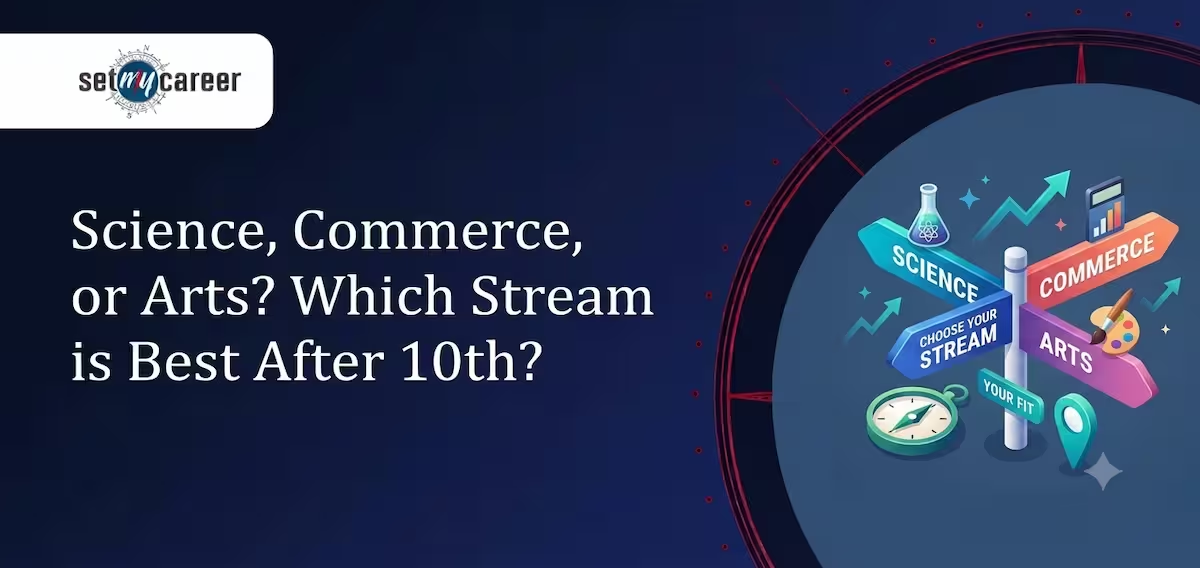
Clearing your 10th board exams is a major milestone, and taking a moment to celebrate your hard work is well deserved. However, right behind those results comes one of the most critical academic decisions of your high school life: choosing the right stream for Class 11 and 12. Whether you choose Science, Commerce, or Arts (Humanities), your choice sets the stage for your undergraduate options and eventual career path.
With parents, teachers, and peers offering differing opinions, it is completely normal to feel overwhelmed by questions like "Which stream has the most scope in India?" or "How do I know which stream actually fits my strengths?" Rather than treating stream selection as a high-pressure test, view it as a strategic first step toward mapping out your future. Every stream offers distinct opportunities, challenges, and long-term career growth. This guide breaks down the core subjects, career pathways, pros and cons, and decision-making criteria for each stream to help you make a confident, well-informed choice.
Detailed Breakdown of Science, Commerce, and Arts Streams
To choose the right path, you first need a clear understanding of what each stream actually entails. Each academic track requires a different learning style, cognitive approach, and commitment level.
Science Stream: Analytical Thinking and Technical Exploration
The Science stream focuses on understanding the physical, chemical, and biological mechanisms of the world. It is tailored for students who have a natural curiosity about how things work, enjoy quantitative problem-solving, and excel at logical reasoning.
Core Subject Combinations:
- PCM (Physics, Chemistry, Mathematics): Commonly chosen by students aiming for engineering, architecture, computer science, aviation, and data technology.
- PCB (Physics, Chemistry, Biology): Designed for students targeting medical sciences, dentistry, biotechnology, pharmacy, and allied healthcare fields.
- PCMB (Physics, Chemistry, Mathematics, Biology): A dual-focused track that keeps both engineering and medical avenues open, though it demands a rigorous study schedule.
- Electives: Computer Science, Information Technology, Biotechnology, Psychology, or Physical Education.
Ideal Student Profile: Students who enjoy hands-on experimentation, mathematical derivation, conceptual problem-solving, and continuous academic inquiry.
Inspiring Insight: Albert Einstein, whose theories revolutionized modern physics, famously struggled with rigid school environments and failed his initial entrance examination for the Swiss Federal Polytechnic. His journey proves that academic success in science is driven by persistent curiosity and deep conceptual interest rather than rote learning.
Commerce Stream: Business Dynamics, Finance, and Management
The Commerce stream centers on the financial, legal, and operational mechanics of the business world. It provides a foundational understanding of trade, economic markets, corporate governance, and financial management.
Core Subjects:
- Accountancy: The systematic recording, auditing, and analysis of financial transactions for individuals and corporations.
- Business Studies: Covers organizational behavior, corporate management, marketing strategies, human resources, and business operations.
- Economics: Studies micro and macroeconomic principles, market forces, fiscal policies, and global trade dynamics.
- Mathematics / Informatics Practices: Mathematics is strongly recommended for students aiming for finance, data analytics, or top-tier commerce colleges, though many boards offer non-math options.
Ideal Student Profile: Students who are intrigued by business news, enjoy working with numbers and financial data, possess logical reasoning skills, and want to understand how global markets function.
Inspiring Insight: Tech entrepreneur Elon Musk earned dual undergraduate degrees in Physics and Economics. Combining financial literacy with technical knowledge is often the key to building and scaling successful global ventures.
Arts & Humanities Stream: Social Sciences, Critical Thinking, and Creativity
The Arts and Humanities stream explores human culture, society, behavior, history, and creative expression. Far from being a "backup option," modern humanities is a vast, dynamic field that trains students in critical thinking, research methodology, and communication.
Core Subjects:
- History & Political Science: Examines past civilizations, global geopolitics, constitutional frameworks, and governance structures.
- Psychology & Sociology: Explores human cognition, mental processes, behavioral patterns, and social systems.
- Geography & Economics: Focuses on spatial distribution, environmental resource management, and social development metrics.
- Literature & Creative Disciplines: Languages (English, Hindi, regional or foreign languages), Fine Arts, Design, Journalism, and Mass Communication.
Ideal Student Profile: Students with strong reading, writing, and analytical skills who are passionate about social issues, human behavior, policy-making, law, or creative media.
Inspiring Insight: Renowned Mexican painter Frida Kahlo turned severe physical adversity and medical complications into world-renowned art. Her life highlights the power of the humanities and creative arts to turn personal perspective into lasting global impact.
Comparative Analysis: Advantages and Disadvantages of Each Stream
Every stream comes with its own rewards and demands. Evaluating these pros and cons objectively will help you gauge whether a stream aligns with your study habits and career expectations.
Science Stream
| Advantages | Disadvantages |
| Offers maximum career flexibility, as science graduates can transition into commerce, management, or humanities streams later. | Requires a heavy academic workload with demanding theoretical concepts and practical lab commitments. |
| Provides direct pathways to high-demand technical and medical roles, including engineering, medicine, AI, and research. | Intense competition for seats in top entrance exams like JEE and NEET can cause high academic stress. |
| Fosters strong analytical, mathematical, and logical problem-solving capabilities. | Leaves little room for non-STEM electives during Class 11 and 12 preparation. |
Commerce Stream
| Advantages | Disadvantages |
| Builds practical financial literacy, business acumen, and corporate understanding applicable across every industry. | Re-entry into core technical science fields (like engineering or medicine) is generally not possible after 12th. |
| Directly prepares students for prestigious professional certifications such as CA, CS, CMA, and CFA. | Key specialization areas (like quantitative finance or corporate accounting) require strong numerical and analytical skills. |
| Offers a balanced workload compared to Science, allowing time for skill-building, internships, or extra certifications. | Misconceptions persist about commerce being less rigorous than science, despite its challenging professional exams. |
Arts / Humanities Stream
| Advantages | Disadvantages |
| Develops exceptional written communication, qualitative analysis, research skills, and critical thinking. | Career trajectories are often less linear than technical streams, requiring proactive networking and skill specialization. |
| Prepares students effectively for competitive civil services exams (UPSC), law entrance tests (CLAT), and corporate PR/HR roles. | Some entry-level positions in humanities fields may offer lower initial starting pay compared to technical STEM roles. |
| Provides vast flexibility to combine diverse subjects based on individual creative and intellectual interests. | Outdated social bias still treats humanities as a secondary choice, despite expanding market demand. |
Essential Factors to Consider When Selecting Your Stream After Class 10
Making a decision based purely on peer choices or parental preference often leads to academic dissatisfaction. Use these structured criteria to evaluate your options objectively:
- Aptitude and Natural Strengths: Look at your consistent academic performance through Class 8 to 10. Do you genuinely excel at logical proofs and scientific concepts, or do you perform better in social sciences and language analysis? If you are having trouble evaluating your abilities objectively, using a scientifically designed stream selector test can analyze your personality, interests, and cognitive strengths to give you a clear recommendation.
- Genuine Subject Interest: Differentiate between scoring well in a subject and actually enjoying it. You might score high marks in math through memorization, but if you dislike solving equations, taking advanced math in Class 11 will feel like a chore.
- Long-Term Career Vision: Research specific job roles you see yourself doing in 5 to 10 years. If your goal is corporate law, civil services, or UX design, Arts or Commerce may be far more practical than Science.
- Academic Flexibility and Fallback Options: Consider how easily you can switch paths if your preferences change. The Science stream allows you to switch to commerce or arts degrees after Class 12, whereas moving from Arts to Science is generally not permitted by universities.
- Understanding College Eligibility Rules: Many competitive undergraduate programs (like B.Sc. Data Science, B.Com Honors, or Economics Honors at top universities) require Mathematics in Class 12. Check entry criteria early so you don't accidentally drop necessary subjects.
Comprehensive Career Pathways Across Science, Commerce, and Arts
To help you connect high school streams with future professional tracks, this detailed table highlights popular higher education paths and prospective career roles:
| Stream | Core Specialization Fields | High-Prospect Career Opportunities |
| Science | Medicine & Healthcare | Doctor (MBBS), Dentist (BDS), Pharmacist (B.Pharm), Physiotherapist, Medical Researcher |
| Engineering & Technology | Software Engineer, AI/ML Specialist, Civil Engineer, Aerospace Engineer, Robotics Developer | |
| Pure & Applied Sciences | Research Scientist, Astrophysicist, Biotechnologist, Data Scientist, Environmental Consultant | |
| Aviation & Allied Fields | Commercial Pilot, Merchant Navy Officer, Industrial Designer, Ethical Hacker | |
| Commerce | Accounting & Auditing | Chartered Accountant (CA), Cost Accountant (CMA), Forensic Auditor, Statutory Auditor |
| Finance & Banking | Investment Banker, Financial Analyst (CFA), Risk Manager, Stock Broker, Portfolio Manager | |
| Corporate Governance & Law | Company Secretary (CS), Corporate Lawyer, Tax Consultant, Compliance Officer | |
| Management & Marketing | Brand Manager, Human Resource Director, Supply Chain Manager, Digital Marketing Strategist | |
| Arts / Humanities | Legal & Administrative Services | Advocate/Litigator, Judicial Officer, Civil Servant (IAS/IPS/IFS), Legal Advisor |
| Behavioral & Social Sciences | Clinical Psychologist, Organizational Counselor, Sociologist, Policy Analyst, Anthropologist | |
| Media, Communication & PR | Investigative Journalist, PR Specialist, Content Strategist, Copywriter, Media Planner | |
| Design & Performing Arts | UI/UX Designer, Fashion Designer, Interior Architect, Animator, Film Director |
Conclusion: Making an Informed Decision for Your Future
Choosing your stream after Class 10 is an important milestone, but remember that no single stream guarantees success or limits your potential. High achievement in any field comes down to playing to your strengths, building relevant skills, and staying adaptable. Science, Commerce, and Arts each offer clear, rewarding paths to successful careers in today's job market.
Take the time to evaluate your natural aptitudes, explore career options, and speak with academic mentors. If you are still unsure which path fits your goals best, seeking professional career counselling after 10th can provide the clarity you need. Personalized assessment tools and one-on-one sessions with our career counselors at SetMyCareer can help you select your Class 11 stream with complete confidence.