






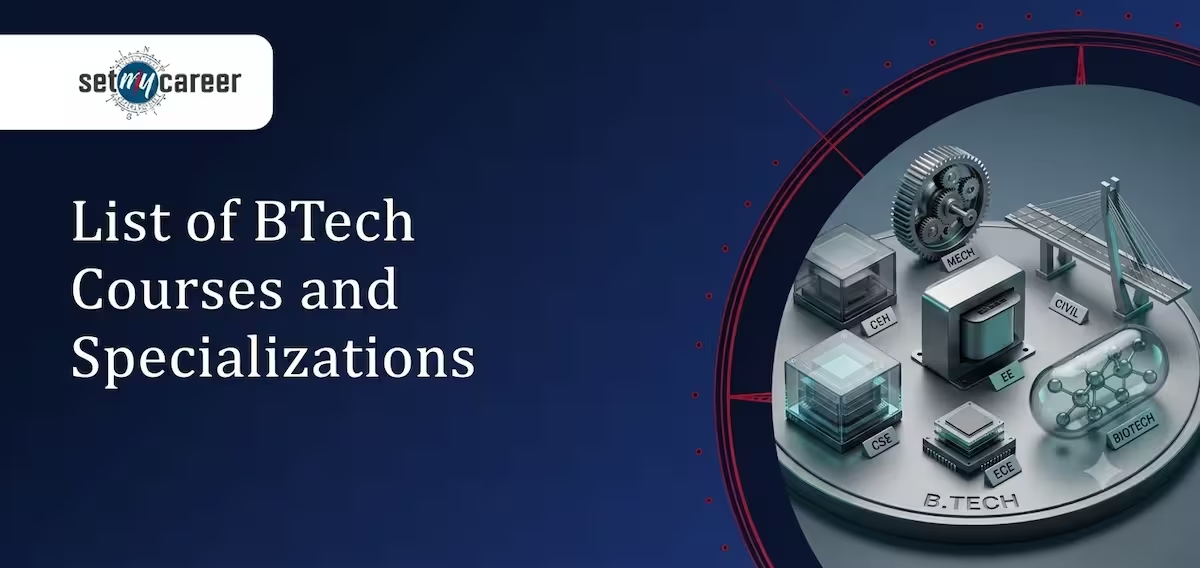
Selecting the ideal Bachelor of Technology (BTech) specialization is one of the most critical decisions an aspiring engineer will make. With technological advancements altering the global workforce, the engineering landscape has expanded far beyond traditional disciplines. Today’s students can choose from time-tested core branches as well as cutting-edge, specialized fields focused on artificial intelligence, renewable energy, and space exploration.
Making an informed choice requires a clear understanding of what each specialization entails, how the curriculum is structured, the difference between applied and theoretical degrees, and the long-term career prospects associated with each track. This guide offers a comprehensive breakdown of BTech degrees, major specializations, the BTech versus BE distinction, and prospective career pathways after graduation.
What is a BTech Degree? Understanding the Program Structure
A Bachelor of Technology (BTech) is a four-year professional undergraduate degree that emphasizes the practical application of engineering and scientific principles. Unlike purely academic science degrees, a BTech curriculum is engineered to bridge theoretical concepts with real-world technical execution.
Spread across eight semesters, BTech programs combine classroom lectures, intensive laboratory work, workshops, industrial visits, and mandatory capstone projects. Most accredited institutions follow a choice-based credit system (CBCS), allowing students to take elective subjects alongside core engineering modules. Admission into BTech programs generally requires completing secondary education with physics, chemistry, and mathematics (PCM), usually coupled with competitive entrance examinations such as JEE Main, JEE Advanced, or state-level engineering tests.
How to Choose the Best BTech Branch for Your Career Goals
With dozens of specializations available, picking the right branch depends on balancing your intrinsic interest, analytical strengths, and long-term industry demand. Selecting a branch solely based on current salary trends can backfire if you lack genuine interest in the coursework. Conducting an honest self-assessment of your mathematical aptitude, spatial reasoning, and problem-solving preferences is an essential first step.
Core and Traditional Engineering Specializations
Core engineering branches represent the foundational pillars of infrastructure, technology, and manufacturing. These streams offer broad versatility, allowing graduates to work across multiple sectors or specialize later in their careers.
- Computer Science and Engineering (CSE): Focuses on software development, algorithms, computer architecture, and computation theory. CSE remains a top choice due to its direct alignment with the software industry, cloud computing, and emerging software platforms.
- Electronics and Communication Engineering (ECE): Bridges hardware engineering and signal processing. Students study microprocessors, embedded systems, telecommunications, semiconductor technology, and circuit design.
- Electrical and Electronics Engineering (EEE): Covers power systems, electrical machinery, control systems, and power electronics. EEE engineers are central to power generation, smart grid deployment, and the growing electric mobility sector.
- Mechanical Engineering: Applies principles of physics and materials science to design, analyze, and manufacture mechanical systems. It provides foundational knowledge for robotics, automotive design, HVAC systems, and aerospace manufacturing.
- Civil Engineering: Concentrates on the planning, design, construction, and maintenance of structural infrastructure, including bridges, dams, highways, and urban buildings. Modern civil engineering increasingly incorporates sustainable building materials and smart city technologies.
- Information Technology (IT): Emphasizes the practical application of computing systems, network security, database administration, and enterprise software architecture, preparing students for immediate IT operations and software roles.
- Chemical Engineering: Merges chemistry, physics, and mathematics to design industrial processes for transforming raw materials into valuable products like pharmaceuticals, petrochemicals, plastics, and advanced synthetic materials.
Emerging and High-Growth Specialized Engineering Streams
As industries automate and adopt advanced technology, specialized BTech programs have emerged to meet targeted sector demands. These programs integrate interdisciplinary modules early in the degree.
- Artificial Intelligence and Data Science: Blends advanced mathematics, statistics, machine learning algorithms, and deep learning architectures to process massive datasets and build autonomous decision-making systems.
- Robotics and Automation Engineering: Combines mechanical design, electronic control systems, and software programming to engineer smart industrial robots, automated assembly lines, and autonomous systems.
- Aerospace and Aeronautical Engineering: Focuses on the aerodynamics, propulsion systems, avionics, and structural mechanics of aircraft, spacecraft, and defense hardware.
- Biomedical Engineering: Applies engineering mechanics and electronics to biology and medicine, enabling the development of diagnostic equipment, prosthetics, artificial organs, and medical imaging devices.
- Environmental Engineering: Combines environmental science, hydrology, and engineering principles to develop solutions for pollution control, waste management, water purification, and environmental policy compliance.
- Renewable and Energy Engineering: Focuses on clean energy technologies, including solar photovoltaic systems, wind turbines, battery storage systems, and sustainable grid integration.
- Automobile Engineering (EV Focus): Centers on vehicular design, drivetrain engineering, internal combustion systems, and modern electric vehicle (EV) battery architecture.
- Nanotechnology Engineering: Explores material manipulation at the atomic and molecular scale, driving innovation in microelectronics, bio-nanomaterials, and quantum computing devices.
- Agricultural and Food Engineering: Applies mechanical, civil, and biological engineering principles to food processing, soil preservation, automated farming machinery, and post-harvest technology.
- Geoinformatics Engineering: Utilizes Geographic Information Systems (GIS), satellite remote sensing, and spatial data modeling for urban planning, resource management, and disaster mitigation.
- Fire, Safety, and Industrial Hygiene Engineering: Teaches risk assessment, hazard management, industrial safety protocols, and emergency response infrastructure for heavy manufacturing and oil facilities.
- Marine and Naval Engineering: Deals with the design, construction, and operation of sea vessels, offshore platforms, marine propulsion systems, and oceanic infrastructure.
BTech vs. BE: Key Differences Explained
A common point of confusion for prospective engineering students is the distinction between a Bachelor of Technology (BTech) and a Bachelor of Engineering (BE). While both degrees are recognized as equivalent undergraduate engineering qualifications by regulatory bodies and employers worldwide, their pedagogical approaches differ slightly.
BTech programs tend to be more application-oriented and industry-focused. The curriculum frequently updates to incorporate contemporary tools, software, and industrial practices, placing significant emphasis on lab work, industrial training, and practical implementations. BTech degrees are most commonly offered by institutes of national importance, technological universities, and autonomous engineering colleges.
In contrast, BE programs traditionally place a stronger emphasis on theoretical fundamentals, mathematical proofs, and core scientific principles. The coursework provides a rigorous grounding in engineering theory, making it an excellent foundation for students who plan to pursue research, academia, or theoretical studies. BE programs are typically offered by traditional, non-autonomous universities with long-established academic faculties.
| Feature | Bachelor of Technology (BTech) | Bachelor of Engineering (BE) |
| Core Focus | Practical application, skill acquisition, and industrial technological tools. | Theoretical foundations, scientific concepts, and engineering principles. |
| Curriculum Structure | Dynamic and regularly updated to align with changing industry trends. | Concept-heavy, focusing on fundamental theories and mathematical modeling. |
| Pedagogical Style | Hands-on learning, industrial internships, lab experiments, and practical projects. | Lecture-oriented, theoretical problem-solving, and conceptual evaluations. |
| Institution Type | Primarily autonomous universities, IITs, NITs, and technological institutes. | Traditional state universities and affiliated, non-autonomous colleges. |
| Ideal Candidate | Students who prefer applied learning and immediate entry into industry roles. | Students interested in deep conceptual mastery, research, and academia. |
Career Opportunities After BTech: UG vs. PG Pathways
Graduating with a BTech opens diverse employment and higher education avenues. Depending on your professional vision, you can enter the workforce directly or pursue postgraduate specialization to accelerate your career trajectory.
Immediate Career Options After BTech (Undergraduate Level)
Direct entry into the job market allows graduates to build practical experience quickly. Key career verticals include:
- Software Development and IT Operations: Graduates across CSE, IT, ECE, and related disciplines often secure roles as software engineers, web developers, system analysts, cybersecurity associates, or cloud architects.
- Core Technical Engineering: Core engineering graduates work as project engineers, site supervisors, design analysts, and production managers in sectors like automotive manufacturing, construction, power generation, and chemical processing.
- Public Sector Undertakings (PSUs) and Government Organizations: Qualifying in competitive exams like GATE or specialized recruitment tests allows engineers to join premier public organizations, national research labs, defense research centers, and railway engineering departments.
- Technical Consulting and Analytics: Many management consulting firms and data analytics agencies hire BTech graduates as business analysts, technology consultants, and data analysts due to their strong quantitative and logical problem-solving skills.
- Technology Entrepreneurship: BTech graduates with innovative product concepts often launch tech startups, leveraging incubator ecosystems, seed funding, and technical skills to build commercial solutions.
Higher Education and Specialized Pathways (Postgraduate Level)
Pursuing postgraduate studies can significantly enhance technical depth, managerial competence, or global mobility.
- MTech / ME (Master of Technology / Engineering): A two-year advanced technical degree focusing on specialized research areas such as VLSI design, structural mechanics, artificial intelligence, or thermal engineering. Ideal for research and development (R&D) roles or academic careers.
- MBA (Master of Business Administration): A strategic choice for engineers who wish to transition into management, product leadership, corporate strategy, operations, or investment banking. The combination of a technical undergraduate degree and an MBA is highly valued in leadership pipelines.
- MS (Master of Science) Abroad: A popular option for students seeking international research exposure, access to global industry hubs, and specialized study in fields like robotics, data engineering, or sustainable systems engineering.
- Direct Ph.D. Pathways: Exceptional BTech graduates can apply directly for integrated Ph.D. programs at premier research universities, paving the way for careers in advanced industrial research, government laboratories, and higher education faculty positions.
Making the Right Choice for Your Engineering Future
Choosing the right BTech branch requires balancing your personal aptitudes with future market opportunities. Rather than following trends passively, take time to review program syllabi, evaluate institutional infrastructure, assess industry connection networks, and reflect on the day-to-day work environment you want after graduation.
Engineering remains one of the most versatile and impactful fields of study, giving you the tools to solve complex challenges, build vital infrastructure, and drive innovation. By conducting thorough research and aligning your academic path with your core strengths, you can lay a strong, future-proof foundation for a rewarding professional career.