




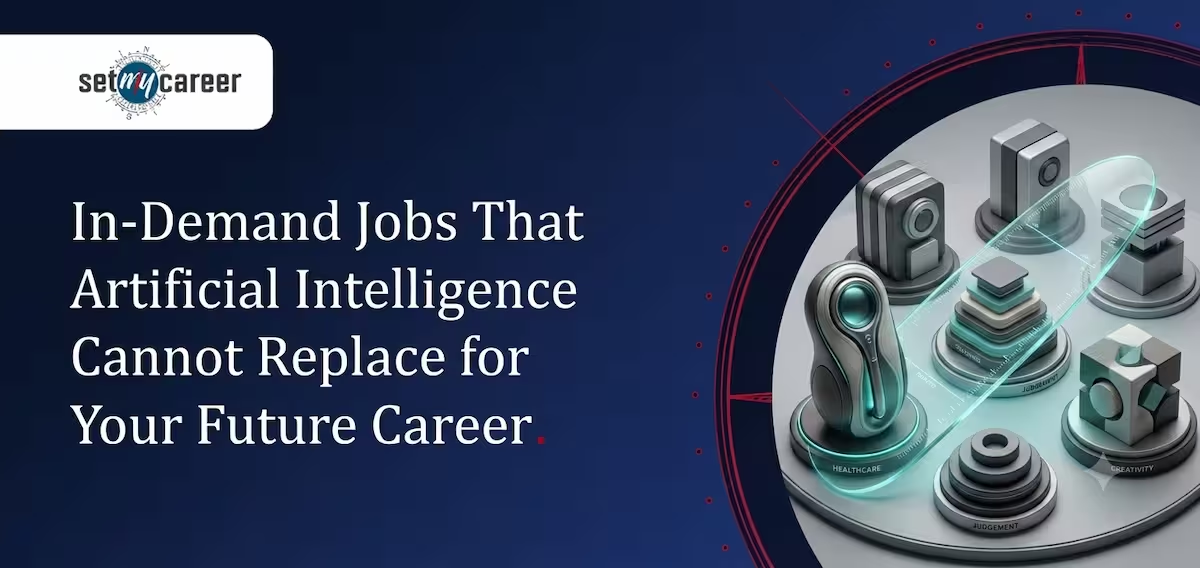
In a world where artificial intelligence seems to conquer a new industry every week, it is entirely normal to feel a growing sense of anxiety about job security. Every time a new language model or robotics breakthrough makes headlines, the same pressing question surfaces in the minds of professionals across the globe: Which jobs will eventually be replaced by AI?
Career counselling can help individuals focus on jobs that artificial intelligence cannot replace.
While it is absolutely true that automation is rapidly transforming the modern workplace, the narrative that machines will take over every existing career is fundamentally flawed. According to the World Economic Forum, while automation is projected to displace millions of repetitive roles by 2030, it is also expected to create millions of new jobs that rely heavily on human intelligence. There are numerous highly stable, lucrative careers standing strong against the wave of automation. These roles rely on complex human capabilities that artificial intelligence simply cannot replicate: deep empathy, original creativity, physical dexterity, and nuanced emotional connection.
If you are currently planning your career trajectory or considering a mid-life professional pivot, aiming for roles that prioritize these uniquely human soft skills is the smartest way to future-proof your livelihood. Let’s take an in-depth look at the specific, in-demand jobs that remain highly resistant to AI disruption, and why human workers will always hold the advantage in these fields.
Which In-Demand Careers Are Safe From AI Automation?
As technology rapidly advances, the dividing line between machine efficiency and human necessity becomes increasingly clear. While structured data processing and repetitive manual labor are easily handed over to algorithms, careers that require complex adaptability and situational judgment remain incredibly secure. Here are the primary industries where the human touch is entirely irreplaceable.
Healthcare Professionals and Medical Experts
The healthcare industry relies on a foundation of human trust. Doctors, nurses, and physical therapists provide far more than just clinical diagnoses and medical interventions; they offer profound empathy, read subtle body language, and support patients through deeply emotional crises.
While artificial intelligence is already proving to be a brilliant tool for analyzing medical scans or cross-referencing patient symptoms, it operates strictly as an assistant. An algorithm cannot hold a patient’s hand, deliver difficult news with compassion, or make split-second ethical decisions during a complex surgery. Because medical care is inherently intimate and deeply reliant on human connection, frontline healthcare roles will indefinitely remain some of the most secure jobs in the global economy.
Mental Health Counsellors and Social Workers
Navigating the complexities of the human mind requires a level of emotional depth that no machine can simulate. Mental health professionals—including clinical psychologists, grief counsellors, and social workers—rely heavily on active listening, intuition, and the ability to read between the lines during a patient session.
A therapist constantly adapts their approach in real-time based on a client's tone of voice, hesitation, or body language. A chatbot, no matter how advanced its natural language processing might be, lacks genuine lived experience and cannot build the authentic, trusting therapeutic alliance that is strictly necessary for patient recovery.
Skilled Tradespeople and Technicians
When most people think of AI-proof jobs, they imagine desk roles, but some of the most secure careers require getting your hands dirty. Skilled trades—such as electricians, plumbers, welders, and HVAC technicians—involve highly complex physical dexterity performed in entirely unpredictable environments.
While robots excel on a perfectly controlled factory assembly line, they are entirely useless when tasked with troubleshooting faulty wiring inside the cramped crawlspace of a 50-year-old building. Tradespeople must constantly adapt to unique spatial challenges, solve structural problems on the fly, and interact dynamically with the physical world. As global infrastructure continues to age and require complex maintenance, the demand for highly skilled manual trades will only continue to rise.
Education Professionals and Mentors
Teaching is far more complex than simply delivering facts to a room full of students. Exceptional educators, teachers, and corporate trainers act as mentors, motivators, and emotional anchors. They possess the unique ability to read a classroom, identify when a student is struggling with self-doubt, and dynamically adapt their teaching methods to suit different learning styles.
While educational software and AI tutors are excellent tools for personalized practice and grading multiple-choice exams, they cannot inspire a child, instill a lifelong love of learning, or navigate the complex social dynamics of a classroom. The mentorship and human interaction provided by educators remain absolutely vital to human development.
Creative Professionals and Artists
True creativity is born from the human experience—our struggles, our cultures, our emotions, and our unique perspectives. While generative AI models can effortlessly spit out a competent graphic design or write a grammatically perfect blog post, these outputs are ultimately just mathematical syntheses of existing data scraped from the internet.
Artists, authors, visionary designers, and filmmakers create work that resonates on a profound emotional level because it is rooted in original human thought. AI lacks the capacity for genuine originality, storytelling nuance, and cultural subtext. The tools of creation may evolve, but the demand for authentic human vision and artistic direction will never disappear.
Strategic Leadership and Executive Roles
Running a successful organization requires navigating highly ambiguous situations that do not have clear right or wrong answers. CEOs, department directors, and management consultants must balance data-driven insights with ethical judgment, company culture, and complex human resource negotiations.
Artificial intelligence is incredibly useful for providing executives with optimized data forecasts, but it cannot inspire a demotivated workforce, negotiate a delicate corporate merger, or take ethical responsibility for a company's public failures. Leadership requires social influence, emotional intelligence, and strategic vision—traits that are fundamentally exclusive to humans.
The AI vs. Human Capabilities Breakdown
To better understand why certain career paths are safer than others, it helps to look at exactly where artificial intelligence excels compared to where human beings naturally dominate.
Conclusion: Securing Your Future in an Automated World
As we transition deeper into a highly automated, AI-driven economy, the most valuable asset you can bring to the job market is your humanity. While algorithms will inevitably take over data entry, basic administration, and repetitive analysis, they cannot replicate the nuanced warmth of a nurse, the strategic foresight of a great leader, or the adaptive ingenuity of a master electrician.
Future-proofing your professional life is not about trying to compete with machines on speed or efficiency; it is about leaning heavily into the soft skills and complex physical capabilities that machines cannot touch. By focusing your career planning on roles that require deep empathy, creative innovation, and strategic decision-making, you can secure a fulfilling and highly stable professional future. For personalized guidance on navigating this technological shift and finding the perfect resilient career path for your unique strengths, reach out to our professional career experts today.
| Capability | Artificial Intelligence | Human Professionals |
| Data Processing | Analyzes millions of data points in seconds with flawless mathematical accuracy. | Slower processing, but capable of understanding the nuanced context behind the numbers. |
| Physical Labor | Thrives in highly structured, predictable, and repetitive environments (e.g., factory floors). | Excels in unpredictable, dynamic environments requiring fine motor skills and spatial awareness. |
| Problem Solving | Strictly follows pre-programmed rules and struggles with unprecedented anomalies. | Highly adaptable; capable of thinking outside the box to solve completely novel problems. |
| Communication | Generates logical, grammatically correct text, but lacks genuine empathy and tonal nuance. | Reads body language, understands cultural subtext, and builds deep emotional trust. |