



Quick Summary
Making a successful career transition doesn't mean starting from scratch; instead, you can leverage your valuable transferable skills and professional maturity to pivot into a rewarding new field. By mapping out your strengths, closing key knowledge gaps with a targeted upskilling strategy, and strategically rebranding your resume, you can confidently secure mid-to-senior level positions within a structured 3-to-12-month timeline. At SetMyCareer, our expert counsellors are here to support you with personalized, data-driven insights, empowering you to navigate your unique professional journey with complete clarity and confidence.
Introduction
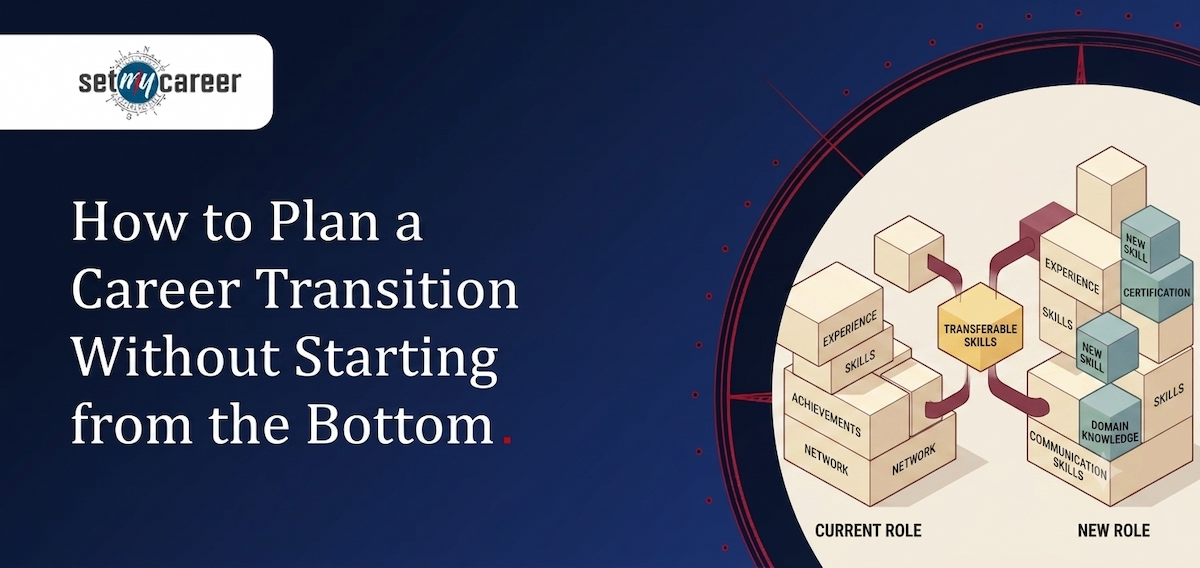
Thinking about a major career change can feel incredibly daunting, especially when you have already spent years building your professional identity. The fear of losing your hard-earned progress, taking a massive pay cut, or starting over as an entry-level employee often keeps talented professionals stuck in jobs that no longer fulfill them. However, making a successful career transition does not mean you have to throw away your past experience and climb back up from the very bottom of the ladder.
At SetMyCareer, we believe that your professional journey is cumulative. The communication, leadership, and problem-solving skills you have developed over the years are highly valuable assets that can set you apart in any new field. In this guide, we will show you how to map out your transferable skills, address specific knowledge gaps, and strategically position yourself for mid-to-senior level roles in your target industry.
Whether you are planning to pivot your professional path in 2026 or are just starting to explore your options, this step-by-step approach will help you navigate your journey with clarity and confidence. You can successfully transition to a rewarding new career without sacrificing the professional standing you have worked so hard to achieve.
What is a Career Transition?
A career transition is the process of shifting from one professional role, industry, or field of expertise to another. This strategic move involves aligning existing professional experiences, acquiring targeted new competencies, and repositioning your professional brand to match the operational demands of a new target market.
Deciding to shift directions is a natural evolution in your professional life. Changing business environments, emerging technologies, and personal growth often drive the need for a new direction. Instead of starting from scratch, a strategic shift allows you to carry forward your professional maturity, project management skills, and industry insights into a new space.
Understanding the different types of shifts is highly useful when planning your next steps. The structural differences between pivot types determine how much retraining and rebranding you will require.
| Transition Type | Core Objective | Primary Focus Area | Average Timeline |
|---|---|---|---|
| Functional Pivot | Changing roles within the same industry | Leveraging industry-specific knowledge | 3 to 6 Months |
| Sector Pivot | Keeping the same role but changing industries | Adapting to a new business environment | 4 to 8 Months |
| Complete Structural Shift | Changing both role and industry | Full professional repositioning and retraining | 6 to 12 Months |
SetMyCareer emphasizes that a structured plan must address both the practical and psychological aspects of making a change. By breaking down the process into manageable phases, professionals can reduce uncertainty and approach the market with confidence.
- Focus on alignment between your values and your daily tasks.
- Value accumulated wisdom instead of assuming you must start from zero.
- Approach the market with objective data rather than guesswork or panic.
Successful Career Transition Steps: A Strategic Blueprint
Executing a shift requires a step-by-step approach that removes the guesswork from your journey. Relying on sheer willpower or random applications rarely works. Instead, professionals must systematically analyze their abilities, address skill gaps, and rebuild their outward-facing professional identity to match market needs.
Step 1: Transferable Skills Identification
The foundation of any successful career transition steps is thorough transferable skills identification. These are the core abilities—such as stakeholder management, resource allocation, and analytical thinking—that remain highly valuable regardless of your job title or industry. By documenting these competencies, you establish a baseline of value that prospective employers will appreciate.
| Legacy Field Capability | Core Business Function | Target Field Application |
|---|---|---|
| Classroom management & teaching | Stakeholder management & instruction | Corporate training & development |
| Customer service & issue resolution | Problem-solving, communication & empathy | Customer Success Management |
| Academic research & data curation | Analytical synthesis & documentation | Market intelligence analyst |
Step 2: Designing an Upskilling Strategy
Once you identify your existing strengths, you must design a targeted upskilling strategy. Rather than committing to lengthy, expensive degree programs, focus on closing specific technical gaps that hiring managers expect you to have. This targeted approach shows employers that you are proactive and ready to contribute immediately.
- Identify specific technical tools or certifications required in the job descriptions of your target field.
- Leverage micro-credentials and short-term certificate courses to demonstrate immediate domain knowledge.
- Build a portfolio of mock projects or freelance work to provide proof of your new capabilities.
- Connect with professional mentors who can guide you on which learning paths carry the most weight in the market.
Step 3: Executing Resume Rebranding
Your resume must act as a forward-looking business proposal rather than a historical archive. Through comprehensive resume rebranding, you translate your past accomplishments into the language of your future employers. Highlighting achievements that demonstrate adaptability, leadership, and quantitative results will help your application pass through automated screening systems and catch the attention of recruiters.
- Revise your professional summary to focus on structural competencies rather than niche past tasks.
- Group your achievements under functional headings that match the keywords used in target job descriptions.
- Quantify your results, demonstrating how your management of budgets, teams, or processes translates to business growth.
- Emphasize cross-functional collaboration and adaptable problem-solving milestones.
Managing a Mid Career Switch Without Starting Over
To execute a mid career switch without starting over, focus on your high-level business capabilities such as leadership, budget management, and strategic planning. By positioning yourself as a business problem solver rather than a technical specialist, you can secure equivalent mid-to-senior level roles in your target field.
Many professionals delay a mid career switch because they fear losing their status, benefits, or professional credibility. This concern is valid, but it is manageable. Senior professionals possess highly developed soft skills, systems-level thinking, and operational maturity that junior applicants simply do not have. SetMyCareer helps you present your background in a way that helps organizations see you as an immediate asset capable of leading teams and making strategic decisions.
| Professional Competency | Legacy Interpretation | Target Field Positioning |
|---|---|---|
| Leadership & Team Management | Directing specific departmental operations | Scaling cross-functional teams and managing diverse stakeholders |
| Budgeting & Resource Allocation | Tracking department-specific expenses | Optimizing operational budgets and driving cost efficiencies |
| Project Delivery | Completing domain-specific projects on schedule | Applying agile methodologies to manage risk and execute structural deliverables |
A strategic approach to senior transitions avoids entry-level postings entirely. Instead, the focus shifts to business outcomes, structural improvement, and resource management.
- Seek internal mobility options within your current company to transition to a new department or function.
- Offer consulting or advisory services to build hands-on experience and credible case studies in the target field.
- Target mid-tier or boutique firms where decision-makers value versatile, seasoned professionals over narrow specialists.
- Build direct relationships with decision-makers through professional networking, emphasizing structural business outcomes over tactical certifications.
How to Make Career Transition Decisive and Practical
A successful career transition requires aligning your natural aptitudes with real-world market demands through a structured step-by-step action plan. By utilizing objective career assessments, setting clear learning milestones, and engaging with industry mentors, you can minimize financial risks and secure your desired role with high confidence.
Decisive action based on objective metrics is far more reliable than relying on instincts alone. To execute successful career transition steps, professionals must maintain a structural timeline and monitor milestones systematically. This keeps the process manageable and helps maintain momentum when learning new concepts.
| Phase | Operational Focus | Key Milestones | Estimated Duration |
|---|---|---|---|
| Phase 1: Assessment & Discovery | Identification of transferable skills and structural market alignment | Career roadmap finalization | Weeks 1 to 4 |
| Phase 2: Competency Building | Execution of targeted upskilling strategy | Micro-credentials and portfolio completion | Weeks 5 to 16 |
| Phase 3: Market Rebranding | Professional resume rebranding and professional network outreach | Redesigned profiles and direct conversations | Weeks 17 to 24 |
Tracking progress against clear indicators prevents the feeling of being overwhelmed and ensures that daily efforts yield tangible professional results.
- Weekly target outreach to professionals currently working in your target industry.
- Mastery of at least one major technical tool or software platform relevant to your target role each month.
- Adjustments made to your resume for each specific job application to ensure alignment with target keywords.
- Active participation in industry-specific discussion forums, workshops, or professional association events.
Successfully Navigating Your Career Transition
Making a career transition does not mean erasing your hard-earned experience or throwing away years of dedication. By identifying your transferable skills, addressing targeted knowledge gaps, and strategically reshaping your professional narrative, you can step into a new field at a level that respects your past achievements. You are not starting over from scratch; you are simply building a new path on top of the solid foundation you have already established.
It is completely natural to feel uncertain about making a major professional shift. Change requires courage, but with a realistic roadmap and clear direction, you can minimize risks and move forward with clarity. You deserve a career that truly aligns with your strengths, interests, and long-term goals, and you have the power to make that change happen.
If you are ready to plan your career transition but want personalized support to ensure you land on your feet, we are here to help. At SetMyCareer, our experienced career counsellors provide the data-driven insights and step-by-step guidance you need to make your next move with confidence. Book a consultation session today, and let us help you map out your journey to a more fulfilling professional life.