





Quick Summary
Deciding on the right courses after 12th is a major milestone, and choosing between high-paying pathways in science, commerce, and arts or practical diploma programs can feel overwhelming. At SetMyCareer, we help you simplify this journey by aligning your natural strengths with high-demand industry skills using scientific assessments. By combining your personal interests with our data-driven career counselling, you can confidently map out a secure, rewarding, and high-paying professional future.
Introduction
Finishing school is a major milestone, but figuring out your next steps can feel overwhelming. With so many pathways open to you, deciding on the right courses after 12th is about more than just picking a subject—it is about building a secure and rewarding future. It is completely natural to feel anxious about making the right choice, especially when you want to balance your personal interests with the realistic goal of securing a high-paying career.
At SetMyCareer, we believe that a successful career starts with clarity and reliable, data-driven planning. You do not have to rely on guesswork or follow the crowd. This guide is designed to help you navigate your options for 2026 and beyond, breaking down the top-paying fields across science, commerce, and arts. We will help you understand how to align your natural strengths with high-demand skills that employers are actively looking for.
By the end of this article, you will have a clear, step-by-step approach to evaluating different courses after 12th based on current industry trends, entry-level salaries, and long-term growth potential. Let's explore your options together and take a confident first step toward a successful professional journey.
Understanding Your Higher Education Options After 12th
What are the primary career paths after school?
Career paths after school include undergraduate degree programs, professional certifications, and vocational diplomas. These educational options shape the professional journey, allowing students to match their academic background with growing industries. Making an informed choice early helps secure stable employment and long term financial success.
Selecting the right path after secondary school requires looking closely at various educational avenues. The modern job market is highly diverse, offering routes that suit theoretical thinkers as well as hands-on, practical learners. Finding the sweet spot between academic preparation and industry needs ensures a smooth transition into the working world.
Several higher education options exist for students today, depending on their background and future objectives:
- Undergraduate Degree Programs: Traditional three to four-year paths providing comprehensive subject knowledge.
- Professional Degree Courses: Specialized programs designed around specific industries, such as law, medicine, or architecture.
- Vocational and Diploma Courses: Shorter, highly focused training options designed to build technical skills quickly.
- Integrated Programs: Combined undergraduate and postgraduate paths that save time and offer continuous study.
By mapping out these categories, students can begin evaluating where their natural skills align and how to structure their learning journey for maximum career preparedness.
High Salary Courses After 12th Science
What are the top-paying technical and medical courses?
High salary courses after 12th science focus on engineering, medical sciences, data technology, and biotechnology. These fields offer strong starting packages due to high industry demand for specialized technical expertise. Choosing these programs helps students build financially rewarding careers in rapidly expanding global industries.
Science graduates have a vast range of options that lead to exceptionally rewarding careers. Technology, healthcare, and research development are expanding rapidly, increasing the demand for skilled professionals. Opting for the right high salary courses after 12th science requires assessing whether your strengths lie in biological systems, programming logic, engineering structures, or mathematical modeling.
To help visualize these directions, consider the primary career paths after school within the science stream listed in the table below:
| Course Name | Average Duration | Core Focus Areas | Entry-Level Salary Range |
|---|---|---|---|
| B.Tech / B.E. (Computer Science & AI) | 4 Years | Software, Machine Learning, Data Structures | INR 6,00,000 - 15,00,000 |
| MBBS / BDS (Medical Sciences) | 5.5 Years | Clinical Medicine, Anatomy, Healthcare Systems | INR 8,00,000 - 18,00,000 |
| B.Sc. in Data Science / Analytics | 3 Years | Statistical Analysis, Big Data, Programming | INR 5,00,000 - 10,00,000 |
| B.Tech in Biotechnology | 4 Years | Genetics, Bioprocess Engineering, Pharmaceuticals | INR 4,50,000 - 8,50,000 |
These professional paths require serious academic commitment, but the long term rewards are significant. In addition to technical expertise, these careers reward analytical thinking, systematic problem-solving, and continuous learning.
Best Professional Courses After 12th Commerce and Arts
Which non-science fields offer the strongest career growth?
The best professional courses after 12th commerce and arts highlight financial management, corporate law, design, and digital marketing. These programs provide practical industry skills that translate into competitive salaries. Students entering these fields benefit from diverse job roles across corporate and creative sectors.
Students from commerce and arts streams have access to highly lucrative paths that match technical precision with human-centric skills. Organizations rely heavily on corporate strategists, financial experts, and creative directors to expand operations. Identifying the best professional courses after 12th in these domains requires analyzing how commerce and creative arts intersect with modern businesses.
The business landscape favors individuals who can blend analytical skills with communication. Here are the leading avenues for commerce and arts students:
- Financial Advisory and Audit: Roles in chartered accountancy and corporate finance that protect company assets.
- Corporate Law and Governance: Ensuring corporate policies match national legal and ethical frameworks.
- Strategic Management: Leading company growth, human resources, and operational frameworks.
- Creative Brand Communication: Designing media strategies, digital campaigns, and user interfaces.
| Professional Course | Duration | Primary Skills Developed | Target Industry Sector |
|---|---|---|---|
| Chartered Accountancy (CA) | 4-5 Years | Taxation, Financial Auditing, Accounting | Corporate Finance, Banking |
| Five-Year Integrated LLB (e.g., BA LLB) | 5 Years | Constitutional Law, Corporate Litigation | Legal Firms, Corporate Houses |
| Bachelor of Business Administration (BBA) | 3 Years | Management, Marketing, Operations | MNCs, Startups, Retail |
| Bachelor of Design (B.Des) | 4 Years | UX/UI, Communication Design, Aesthetics | Tech Companies, Creative Agencies |
Many of these paths offer rapid promotion cycles. Students who combine their undergraduate degree programs with industry-recognized certifications often gain a distinct advantage when applying for leadership positions early in their careers.
Diploma Courses vs. Undergraduate Degree Programs
How do vocational paths compare to traditional degrees?
Diploma courses focus on immediate practical training and shorter durations, making them ideal for quick job entry. Undergraduate degree programs offer comprehensive theoretical knowledge and broader career progression over three to four years. Selecting between them depends on career speed and academic depth goals.
Choosing between short term training and standard degree courses is a critical point of decision for many high school graduates. The right choice depends heavily on budget, immediate employment goals, and long term career outlook. While degree programs construct a deep intellectual base, diploma paths prioritize immediate technical capability.
| Feature / Parameter | Diploma Courses | Undergraduate Degree Programs |
|---|---|---|
| Typical Duration | 6 Months to 2 Years | 3 to 4 Years |
| Curriculum Focus | Practical, job-specific skill acquisition | Comprehensive theory and conceptual learning |
| Admission Criteria | Direct entry based on board marks | Competitive entrance exams or merit lists |
| Average Cost | Highly affordable / low investment | Moderate to high financial commitment |
| Career Trajectory | Immediate entry-level job placements | Broader opportunities and leadership growth |
For individuals looking to start earning quickly or pivot into a niche sector, short term diplomas offer high efficiency. Look at these highly sought-after diploma options that yield strong market demand:
- Digital Marketing: Focuses on search engine optimization, content strategy, and paid ads management.
- Web Development and Coding: Builds skills in front-end development, backend databases, and script writing.
- Hotel and Hospitality Management: Prepares individuals for customer-facing operations, event planning, and culinary management.
- Graphic Design and Animation: Develops skills in visual layout softwares, rendering, and vector graphics.
Evaluating personal circumstances, financial flexibility, and immediate career goals will guide you toward the most logical educational format.
How to Choose Courses After 12th
What steps ensure an aligned career choice?
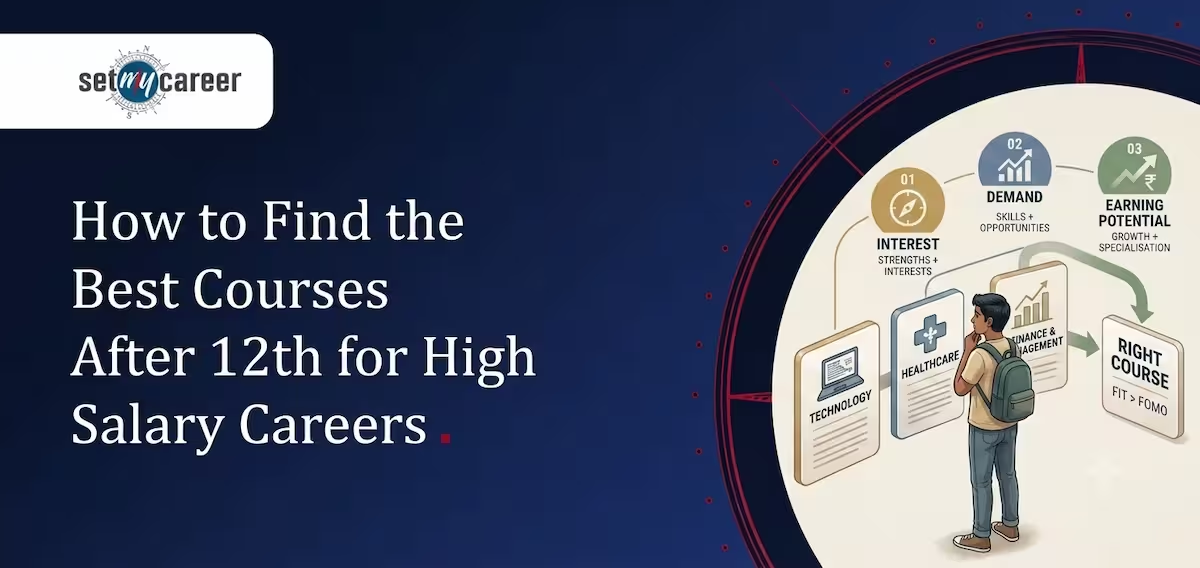
How to choose courses after 12th requires evaluating personal aptitude, examining job market trends, and mapping long term goals. Utilizing career assessments helps match skills with modern industry roles. This methodical approach reduces uncertainty and ensures high satisfaction in the chosen professional field.
The choice made at this stage sets the baseline for the entire professional journey. Avoid relying purely on peer pressure, parental expectation, or passing trends. Instead, a structured, scientific approach to evaluating options prevents future dissatisfaction and helps secure the ideal career match.
| Evaluation Step | Actionable Task | Expected Outcome |
|---|---|---|
| 1. Self-Assessment | Conduct aptitude, personality, and interest tests | Clear understanding of natural strengths |
| 2. Market Analysis | Research sector growth and hiring trends | Identify resilient, high-demand fields |
| 3. Financial Planning | Compare course fee structure with expected ROI | Avoid unnecessary debt and secure good starting salaries |
| 4. Expert Guidance | Speak with certified career mentors | Eliminate bias and validate choices with data |
Following a systematic decision framework can dramatically improve confidence. Consider this clear path when determining how to choose courses after 12th:
- Assess Aptitude and Strengths: Use scientific career assessments to discover what tasks align with cognitive strengths.
- Identify Potential Career Paths: Map out several options that fit personality profiles rather than selecting just one target course.
- Analyze Industry Projections: Study which sectors are expanding to ensure the chosen path will remain relevant for decades.
- Consult Experienced Counsellors: Engage with mentors who analyze educational data daily to clarify doubts and resolve disputes.
By treating career selection as a deliberate, research-driven project, students protect their time and resources, stepping onto an educational path that leads directly to both personal fulfillment and economic stability.
Conclusion: Choosing Your Best Path After 12th
Selecting the right courses after 12th is one of the most significant decisions you will make. While aiming for a high-salary career is a smart and practical goal, the most rewarding path is one that connects your natural strengths with real industry demand. A successful, lucrative career is built on a foundation of genuine interest and a willingness to develop highly valued skills.
It is completely normal to feel overwhelmed by the sheer volume of choices available to you right now. You do not have to navigate this critical transition alone. Taking the time to evaluate your options carefully today will save you years of uncertainty tomorrow, giving you the confidence to step into your college years with a clear plan.
If you are ready to turn confusion into a clear roadmap, expert guidance can help. At SetMyCareer, we partner with you to identify your unique potential and match you with the best courses after 12th for a bright, high-paying future. Reach out to us today to book your personalized career counselling session and take the first step toward a successful career with confidence.