



Quick Summary
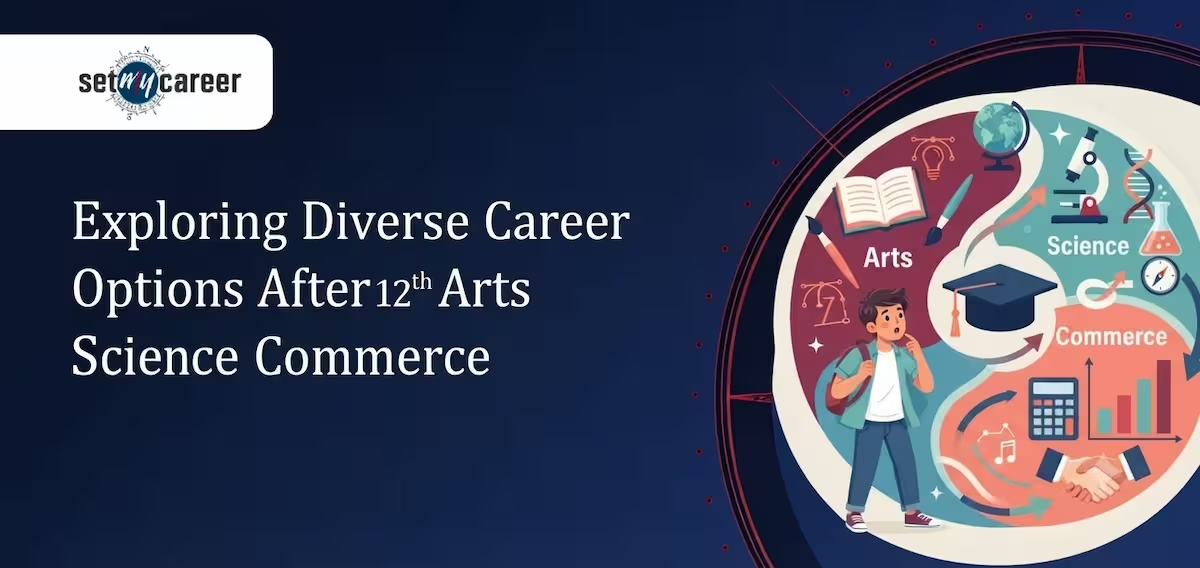
Completing your 12th-grade exams is a major milestone, and exploring diverse career options after 12th across Science, Commerce, and Arts is the first step toward a bright future. Whether you want to pursue high-paying professional courses, explore hands-on vocational training, or enter emerging fields like AI and FinTech, the key is matching your unique strengths with real-market opportunities. Through personalized career counselling and structured guidance, SetMyCareer is here to help you make informed decisions so you can step into your professional journey with absolute confidence.
Introduction
Finishing your 12th-grade exams is a major milestone, but it often brings a wave of anxiety about what comes next. With so many pathways open, finding the right career options after 12th can feel overwhelming. Whether you studied Arts, Science, or Commerce, you are likely facing pressure from all sides to make the perfect decision. It is completely normal to feel unsure, but this is also an exciting opportunity to shape your future around your genuine strengths and interests.
At SetMyCareer, we believe that there is no single right path, but rather the path that is right for you. In this guide, we break down the most rewarding career options after 12th across all three major streams. We will help you look beyond traditional choices to discover modern industries, emerging career fields for 2026, and practical educational routes. You will gain a clear, realistic understanding of how your choice of stream connects to long-term professional growth and success.
Deciding on your future does not have to be a stressful guessing game. By equipping yourself with accurate information and reliable guidance, you can make a decision that you and your family feel completely confident about. Let us explore your options together and take the first step toward a successful, fulfilling career journey.
Understanding Your Stream Specific Careers After 12th
What are the best career options after 12th Science?
The best career options after 12th Science include engineering, medicine, data science, biotechnology, and agricultural science. Students can pursue professional degrees like B.Tech, MBBS, or B.Sc. in emerging fields, which lead to high-paying roles in research, healthcare, technology development, and environmental management sectors.
The Science stream offers diverse pathways categorized under PCM (Physics, Chemistry, Mathematics) and PCB (Physics, Chemistry, Biology). These choices cater to analytical minds interested in technological innovation, medical research, and scientific development. Understanding these pathways helps students align their academic choices with industry requirements.
- PCM Track: Focuses on logic, spatial reasoning, computational mathematics, and physical sciences.
- PCB Track: Emphasizes life sciences, biochemical systems, diagnostics, and physiological studies.
- PCMB Option: Provides dual flexibility, allowing entry into biomedical engineering or computational biology.
For those pursuing stream specific careers, matching technical skills with practical education paths ensures a smooth transition into the modern workforce. The following table highlights prominent Science pathways, courses, and estimated initial salaries.
| Career Area | Recommended Degree | Average Entry Salary (Estimated) |
|---|---|---|
| Software Engineering | B.Tech in Computer Science / BCA | INR 5,00,000 - 8,00,000 per annum |
| Clinical Medicine | MBBS / BDS / BAMS | INR 6,00,000 - 9,00,000 per annum |
| Data Analysis & Statistics | B.Sc. in Data Science / Mathematics | INR 4,50,000 - 7,00,000 per annum |
| Biotechnology Research | B.Tech or B.Sc. in Biotechnology | INR 3,50,000 - 5,50,000 per annum |
What are the best career options after 12th Commerce?
The best career options after 12th Commerce center on finance, accountancy, business management, and corporate law. Pursuing professional courses like Chartered Accountancy, Bachelor of Commerce, or Bachelor of Business Administration prepares students for rewarding roles in financial analysis, investment banking, tax consultancy, and corporate governance.
Commerce serves as the foundation of global business and economic systems. Students choosing this stream develop a strong understanding of financial markets, corporate structures, trade laws, and economic policies. These analytical skill sets are highly valued across both corporate environments and startup ecosystems.
- Analytical Thinking: Evaluating financial statements, investment portfolios, and corporate tax liabilities.
- Regulatory Competence: Understanding corporate law, audit standards, and trade compliance.
- Strategic Planning: Formulating business operational budgets, forecasting market trends, and assessing financial risks.
Commerce students can pursue traditional professional credentials or modern business management degrees. These credentials provide the core competencies required to manage organizational capital, lead cross-functional teams, and advise businesses on long-term growth and compliance matters.
What are the best career options after 12th Arts?
The best career options after 12th Arts encompass design, journalism, psychology, law, and civil services. Students can opt for Bachelor of Arts, Bachelor of Fine Arts, or integrated law programs, leading to diverse professional paths in media, corporate communication, public policy, and creative industries.
The Arts and Humanities streams offer versatile career opportunities that emphasize critical thinking, creative problem-solving, and emotional intelligence. In a corporate landscape increasingly influenced by user experience, human behavior, and visual branding, Arts graduates are in high demand across public and private sectors.
| Arts Career | Recommended Course | Industry Fit |
|---|---|---|
| Corporate & Civil Law | Integrated BA LLB (5 Years) | Legal Firms, Corporate Compliance, Judiciary |
| UI/UX & Graphic Design | Bachelor of Design (B.Des) | Tech Startups, Creative Agencies, IT Firms |
| Clinical Psychology | BA / B.Sc. in Psychology | Healthcare, Rehabilitation, Corporate Wellness |
| Media & Public Relations | BJMC (Journalism & Mass Comm) | Broadcasting, Corporate Relations, Digital Media |
These diverse options demonstrate that the Arts stream is no longer limited to traditional academic research, but offers dynamic paths that lead to active, high-impact professions.
High-Growth Higher Education Paths and Professional Courses
What are the best courses after 12th for high-paying jobs?
The best courses after 12th for high-paying jobs include B.Tech in Computer Science, Integrated MBA, Bachelor of Computer Applications, and specialized finance degrees. These programs offer strong industry alignment, practical training, and robust placement opportunities in rapidly expanding sectors like technology, corporate leadership, and financial management.
Choosing the right higher education paths requires evaluating both personal interest and the long-term viability of the field. Many students today opt for professional courses that combine theoretical concepts with practical application, helping them enter the job market with ready-to-use skills.
| Course Name | Duration | Career Outcomes |
|---|---|---|
| Integrated BBA + MBA | 5 Years | Business Manager, Management Consultant, Brand Manager |
| B.Sc. in Cybersecurity | 3 Years | Security Analyst, Forensic Consultant, Network Engineer |
| B.Des in Product Design | 4 Years | Product Designer, Usability Analyst, Creative Director |
| Bachelor of Actuarial Science | 3 Years | Risk Analyst, Actuary, Investment Advisor |
These integrated and specialized courses bridge the gap between classroom learning and real-world application. By choosing programs that incorporate mandatory internships and project work, students gain the practical experience needed to secure competitive employment opportunities.
Exploring Vocational Training After 12th and Skill-Based Routes
What to do after 12th if you prefer hands-on training?
Students preferring hands-on training after 12th can pursue vocational training, diploma programs, and technical certifications. These highly focused pathways in areas like digital marketing, hospitality, web development, and industrial trades offer direct entry into the workforce through rapid skill acquisition and practical apprenticeship opportunities.
Vocational training after 12th has become a popular and effective alternative to traditional multi-year degree programs. These pathways focus on specialized skills, allowing students to skip lengthy academic theory and learn practical techniques that employers actively seek.
- Direct Industry Alignment: Curriculums designed in collaboration with corporate partners to ensure immediate employability.
- Shorter Preparation Windows: Programs typically range from six months to two years, allowing quicker career entry.
- Cost-Effective Education: Significantly lower financial investment compared to traditional four-year degrees.
- Experiential Learning: Emphasis on internship components, workshop activities, and laboratory simulations.
For those wondering what to do after 12th, choosing a skill-focused pathway like graphic design, financial accounting softwares, culinary arts, or logistics management can lead to rewarding professional opportunities in a relatively short timeframe.
Future Career Paths After 12th: Emerging Fields for 2026 and Beyond
How to choose the right career path using structured guidance?
Choosing the right career path requires a structured evaluation of personal aptitude, interests, and industry trends. Utilizing scientific psychometric assessments, expert career counselling, and market analysis helps students transition from academic education to successful professional roles with clear long-term growth and high job satisfaction.
The job market is shifting rapidly due to advances in artificial intelligence, green technology, and digital-first business models. Preparing for future career paths after 12th means identifying industries that are expected to grow significantly over the next decade.
| Emerging Field | Skills Required | Target Job Role |
|---|---|---|
| Renewable Energy | Resource Management, Environmental Law | Sustainability Analyst, Wind/Solar Project Manager |
| FinTech (Financial Tech) | Blockchain Basics, Algorithmic Trading | Digital Payments Consultant, Risk Auditor |
| Artificial Intelligence | Natural Language Processing, Python | AI Prompt Specialist, Machine Learning Technician |
| E-Commerce Logistics | Supply Chain Management, Inventory Control | Operations Manager, Supply Chain Coordinator |
Selecting from the many available career options after 12th can feel overwhelming. To make a confident decision, students can follow a systematic checklist that balances personal strengths with real-world market demands.
- Aptitude Profiling: Identify cognitive strengths, numerical reasoning, verbal skills, and logical flow.
- Interest Mapping: Align academic choices with activities that sustain personal engagement and curiosity.
- Industry Growth Forecasting: Verify if the chosen sector is expanding, stable, or faces automation risks.
- Financial and Practical Feasibility: Assess the educational costs, duration, and geographic location of institutions.
By using structured research, seeking reliable career guidance, and evaluating personal strengths, students can make informed decisions that pave the way for long-term professional success.
Choosing Your Path with Confidence
Completing your school education is a significant milestone, and exploring the vast array of career options after 12th can feel both exciting and overwhelming. Whether your background is in Arts, Science, or Commerce, the decisions you make now will lay the foundation for your professional journey. It is completely natural to feel uncertain, but remember that this is your opportunity to build a path that truly excites you.
The most rewarding career choice is one that matches your personal strengths, interests, and long-term goals. Instead of simply following popular trends, take the time to evaluate your unique skills and understand where your passions lie. The job market values specialized skills and adaptability across all streams, opening up diverse avenues that allow you to build a successful future on your own terms.
You do not have to navigate this transition alone. At SetMyCareer, we are here to help you gain clarity and make informed decisions. Through personalized guidance and expert career counselling, we can help you identify the best career options after 12th tailored to your unique potential. Book a session with our advisors today and take the first confident step toward a rewarding future.