




Quick Summary
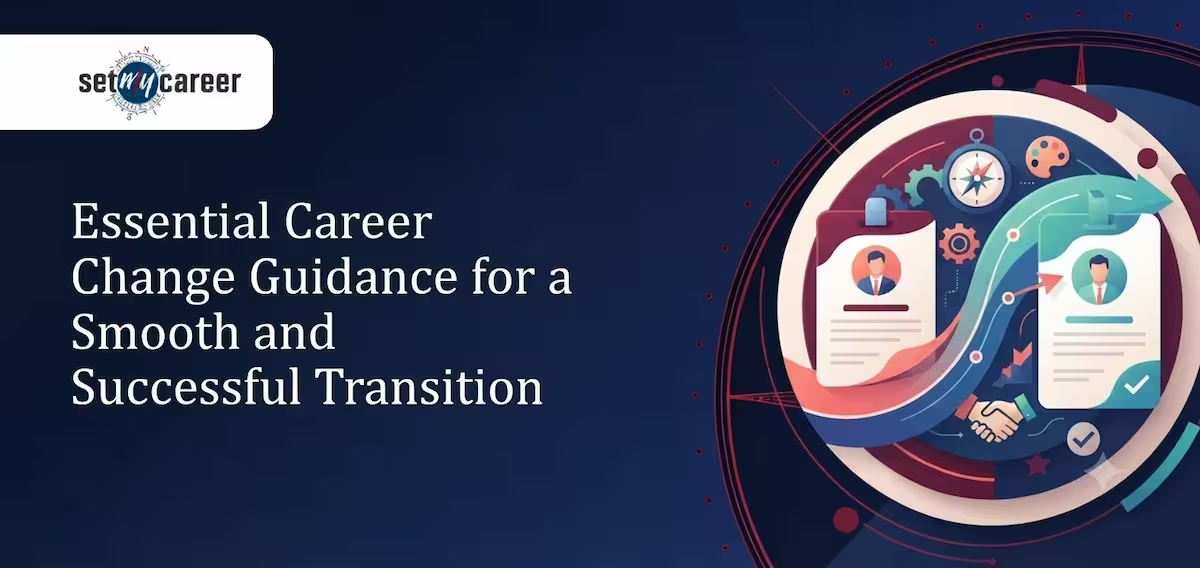
Making a mid-career change doesn't mean starting over; it is an exciting opportunity to map your valuable transferable skills to dynamic new industries. By securing a baseline of six to nine months of living expenses and pursuing targeted upskilling programs, you can confidently bridge any skill gaps without sacrificing your financial stability. Navigating this shift is much easier with a structured four-phase transition plan, and the expert team at SetMyCareer is ready to provide the personalized guidance you need to take your next professional step with absolute confidence.
Introduction
Switching paths in your professional journey can feel daunting, whether you are trying to align your work with your true passions or seeking better growth opportunities. If you feel unfulfilled in your current role or uncertain about how to take the next step, you are not alone. Re-evaluating your goals is a natural part of long-term growth, and making a pivot does not mean starting over from scratch.
Navigating a major switch requires a thoughtful strategy rather than quick fixes. With structured career change guidance, you can clearly identify your transferable skills, explore dynamic job market trends for 2026, and choose a path that truly fits your personal strengths and life goals. A successful transition is built on self-discovery and practical planning, helping you move forward with clarity and confidence.
This guide offers actionable insights to help you manage every stage of your transition smoothly. You will learn how to evaluate your career readiness, bridge potential skill gaps, frame your past experience for new industries, and make a shift without sacrificing your stability. Let us work together to turn your career ambitions into a realistic, step-by-step plan.
Evaluating Your Readiness for a Mid-Career Switch
What Are the Key Indicators That Point to a Necessary Career Shift?
Key indicators pointing to a necessary career shift include persistent lack of engagement, stagnant professional growth, chronic misalignment with organizational values, and recurring interest in external industries. When daily tasks no longer build meaningful skills or offer long-term advancement, structured planning becomes essential for long-term satisfaction.
Understanding the distinction between temporary job burnout and a genuine need for a mid career switch helps professionals make rational, timing-appropriate decisions. Often, workplace frustration stems from localized management friction or temporary workload inflation rather than an inherent incompatibility with the entire field. Professional career change guidance emphasizes evaluating core job functions, personal values, and long-term trajectory before initiating a full transition.
When evaluating readiness, professionals should analyze specific operational factors across their current working environment:
- Skill Plateauing: Routine assignments no longer stretch intellectual capacity or build market-relevant capabilities.
- Value Disconnect: The organization's mission, ethics, or operational priorities conflict with personal standards.
- Industry Deceleration: The broader market sector shows structural decline, limited funding, or shrinking hiring volume.
- Unrealized Aptitude: Personal strengths in leadership, analytical thinking, or strategic planning remain completely unutilized.
Assessing Personal Financial and Professional Stability
Evaluating financial readiness is a primary requirement before embarking on changing career paths. A structured transition often involves temporary income adjustments, training expenses, or entry-level compensation bands in a new field. Establishing a clear financial baseline safeguards against hasty decisions driven by monetary pressure.
| Assessment Category | Stable Baseline Criteria | Action Item for Transitioning Adults |
|---|---|---|
| Emergency Liquidity | 6 to 9 months of fixed living expenses saved | Isolate capital in high-yield liquid accounts prior to resignation |
| Upskilling Budget | Dedicated allocation for certifications and programs | Calculate exact tuition and assessment costs before enrolling |
| Professional Bandwidth | 10 to 15 hours weekly available for study and research | Audit current weekly schedules to reclaim non-essential hours |
Mapping Your Transferable Skills to New Opportunities
How Do Transferable Skills Facilitate a Career Shift?
Transferable skills facilitate a career shift by translating established capabilities—such as project management, data analysis, team leadership, and client negotiation—into functional assets required by target industries. Re-framing existing expertise demonstrates immediate value to prospective employers without requiring candidates to begin their careers from zero.
Many working adults undercount their current expertise because they view their qualifications exclusively through industry-specific vocabulary. Effective career change guidance for adults involves breaking down previous job responsibilities into universal business capabilities. For instance, an educator managing classroom logistics and curriculum delivery possesses core skills directly applicable to corporate training, instructional design, and program management.
Identifying Core Competencies Across Industries
A structured audit helps candidates isolate universal skill sets and align them with expanding sectors. Utilizing career change advice for professionals ensures that hard and soft skills are systematically categorized to match contemporary job market expectations.
| Originating Field | Demonstrated Competency | Target Industry Application |
|---|---|---|
| Higher Education / Teaching | Stakeholder Communication & Learning Design | Corporate Talent Development & Instructional Tech |
| Financial Auditing | Quantitative Analysis & Risk Assessment | Data Analytics & Operations Management |
| Retail Store Operations | Supply Chain Coordination & Team Management | Logistics Planning & Customer Success Leadership |
| Engineering & Software QA | Process Optimization & Technical Problem Solving | Product Management & Technology Consulting |
Framing Past Achievements for Targeted Roles
Rebuilding a professional brand requires positioning past accomplishments through the lens of the target domain. Rather than listing historical duties, professionals must highlight measurable outcomes, problem-solving methodologies, and leadership capability.
- Translate Technical Terminology: Replace niche, company-specific acronyms with standardized industry frameworks.
- Quantify Historical Impact: Focus on revenue generated, costs reduced, processes optimized, or teams scaled.
- Re-align Resumes and Profiles: Position relevant transferable capabilities at the top of application materials.
- Develop Functional Artifacts: Build case studies or portfolios that prove capability in the prospective domain.
Bridging the Skill Gap: Up-skilling Strategies for 2026
What Is the Most Effective Way to Bridge Career Skill Gaps?
The most effective way to bridge career skill gaps involves targeted learning programs, industry-recognized micro-credentials, and practical hands-on projects aligned with market demand. Evaluating specific job descriptions allows professionals to acquire high-priority competencies efficiently without completing unnecessary or redundant academic coursework.
As economic sectors evolve, continuous learning becomes a key element of job transition planning. Implementing proven career pivot strategies requires candidates to differentiate between background knowledge and essential operational tools needed for day-one performance.
Evaluating Short-Term Credentials versus Advanced Degrees
Choosing between short-term certifications, intensive bootcamps, and full university degrees depends heavily on industry standards, financial resources, and available time commitments. Working adults must select educational pathways that provide maximum market credibility within realistic timeframes.
| Educational Pathway | Time Commitment | Best Suited For | Market ROI & Impact |
|---|---|---|---|
| Industry Micro-Certifications | 1 to 3 Months | Targeted tool mastery (e.g., Cloud, Analytics, CRM) | Rapid resume enhancement at minimal expense |
| Professional Bootcamps | 3 to 6 Months | Immersive technical pivots (e.g., Coding, Data Science) | High practical application with portfolio output |
| Postgraduate Degrees | 1 to 2 Years | Regulated or executive fields (e.g., Healthcare, Law, Executive MBA) | Long-term institutional credibility and executive networking |
Leveraging Practical Projects and Experiential Learning
Theoretical knowledge alone rarely satisfies hiring managers in competitive job markets. Securing a new position requires practical proof of execution through real-world applications.
- Pro Bono Consulting: Offer analytical or strategic support to non-profits or small businesses to build verified experience.
- Open-Source & Collaborative Projects: Participate in public repositories or community initiatives to demonstrate team collaboration.
- Independent Case Studies: Analyze existing business problems within target industries and publish structured solution proposals.
Executing a Risk-Managed Job Transition Plan
How to Change Career Path Without Sacrificing Financial Stability?
Changing career paths without sacrificing financial stability requires building a six-month transition reserve, pursuing upskilling opportunities while maintaining current employment, and testing new industries through freelance assignments or advisory projects. This phased strategy ensures steady revenue while developing necessary competencies for direct entry into targeted sectors.
Executing a structured transition minimizes personal and financial risk. Relying on professional career guidance helps working adults construct a multi-phase framework that balances daily workplace responsibilities with strategic, forward-looking repositioning activities.
Structuring Your Timeline for Changing Career Paths
A realistic transition plan unfolds over several structured phases, allowing professionals to evaluate progress, adjust strategies, and maintain consistency.
| Transition Phase | Duration | Primary Objectives | Key Deliverables |
|---|---|---|---|
| Phase 1: Discovery & Audit | Weeks 1 – 4 | Self-assessment, market research, and skill auditing | Target industry shortlist & financial budget |
| Phase 2: Upskilling & Branding | Weeks 5 – 16 | Credential completion and functional resume development | Updated LinkedIn profile & practical portfolio |
| Phase 3: Strategic Outreach | Weeks 17 – 24 | Informational interviews, networking, and exploratory applications | Active industry network & internal referrals |
| Phase 4: Execution & Onboarding | Weeks 25+ | Formal interviews, contract negotiation, and career launch | Signed offer letter & structured onboarding plan |
Networking and Strategic Positioning in New Sectors
Cold applications through online job boards often yield lower conversion rates for career changers because algorithms favor linear work histories. Strategic positioning relies on personal connections, warm introductions, and demonstrating clear industry insight.
- Informational Interviews: Connect with mid-level and senior professionals in target fields to gather operational insights without directly asking for employment.
- Industry Association Engagement: Join recognized professional bodies, attend regional conferences, and participate in industry-specific webinars.
- Content Curation and Publishing: Share insights, summary reports, or analytical commentary on professional platforms to establish domain interest.
- Targeted Referral Generation: Engage with former colleagues who have successfully navigated similar transitions to secure internal application referrals.
Empowering Your Career Transition
Changing your career path is a significant milestone, and it is completely normal to feel a mix of excitement and uncertainty. A successful transition is not about making a sudden leap; it is about taking intentional, well-planned steps toward a role that truly aligns with your strengths and passions. By seeking professional career change guidance, you equip yourself with the strategy, market insights, and confidence needed to navigate this shift smoothly.
You do not have to figure out this next chapter alone. At SetMyCareer, our experienced mentors are here to help you assess your transferable skills, explore viable industries, and build a clear, actionable roadmap. Contact us today to schedule your personalized career counseling session and take the first step toward a fulfilling new professional journey.