




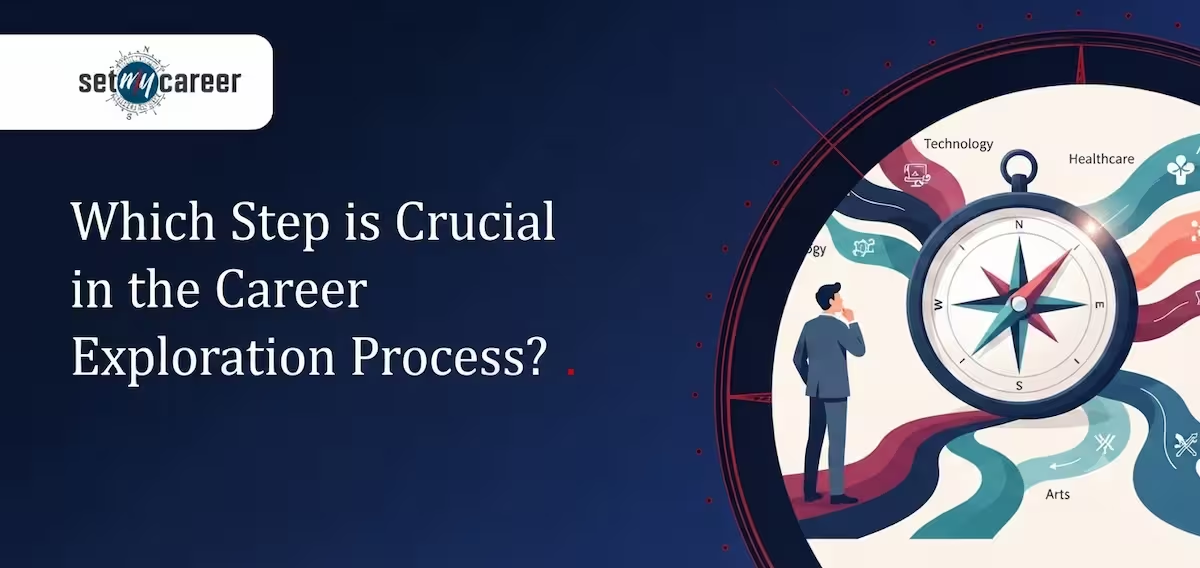
Navigating the modern professional landscape can feel overwhelming. With an endless supply of career paths, advice columns, and conflicting opinions, it is easy to succumb to decision paralysis. Yet, beneath all the noise, one specific phase of career development is frequently overlooked, even though it serves as the foundation for everything else.
If you are feeling unfulfilled or directionless, you might be tempted to jump straight into researching job openings or updating your resume. However, without first establishing the right context, you are essentially building a house without a blueprint. In this guide, we will identify the most vital step in the career exploration process, explore why it is non-negotiable for long-term success, and explain how it integrates with effective career management and strategic planning.
Defining the Career Exploration Process
Before identifying the most critical step, it is helpful to establish what career exploration actually entails. At its core, career exploration is a proactive process of discovery. It involves investigating which professional trajectories align with your intrinsic interests, personal values, specific skills, and long-term objectives.
Effective exploration isn't just about reading job descriptions or checking salary benchmarks. It involves a deep dive into educational prerequisites, industry growth potential, and the tangible realities of day-to-day work. However, you can research every industry on the planet and still feel lost if your starting point is misaligned.
The Most Crucial Step: Self-Assessment
The single most important step in the career exploration process is self-assessment.
Many professionals bypass this stage because it feels intangible or slow, but skipping it is the primary reason people end up in roles that leave them drained. No amount of market research, networking, or job hunting can compensate for a lack of internal clarity. Without self-assessment, your career decisions are essentially guesswork, heavily influenced by external trends or societal pressure rather than your own internal compass.
A rigorous self-assessment requires you to answer fundamental questions:
- What are my core values? Do you prioritize stability, creativity, autonomy, or high impact?
- What are my "flow" states? What activities cause you to lose track of time because you are naturally engaged?
- What is my ideal environment? Do you thrive in structured corporate settings, fast-paced startups, or independent freelance work?
- What are my non-negotiables? These are the boundaries you are unwilling to cross, regardless of salary or title.
When you have clear, honest answers to these questions, you stop chasing roles that look good on paper and start pursuing opportunities that provide genuine, sustainable fulfillment.
The Importance of Career Planning: Creating a Roadmap
Once self-assessment has provided the "why," career planning provides the "how." Planning is the mechanism that translates your self-knowledge into a concrete strategy.
A robust career plan serves several essential functions:
- Structure for Ambition: It converts vague aspirations into measurable milestones.
- Alignment: It ensures your daily efforts serve your long-term vision, preventing the "drift" that occurs when we accept jobs just because they are available.
- Risk Mitigation: By clearly defining your criteria for success, you drastically reduce the likelihood of falling into roles that are fundamentally unsuited to your personality or professional goals.
Career planning is not a one-time activity for graduates. It is a cyclical process that remains valuable whether you are entering the workforce, mid-career, or nearing retirement.
Career Management vs. Career Planning: The Synergy
While often used interchangeably, career planning and career management serve different, highly complementary functions:
- Career Planning is the strategic phase. It involves setting long-term goals and outlining the logical steps—education, skill acquisition, experience—required to reach them.
- Career Management is the tactical, ongoing phase. It is about how you navigate the day-to-day realities of your work life. This includes refining your goals as you gain experience, learning new skills to remain competitive, and knowing when to pivot based on changing industry demands.
When you combine both, you build a career that is both intentional and adaptable. You are not just pushing forward; you are steering the ship with purpose.
Aligning with Your Career Goals
When you understand your preferences, capabilities, and values, defining your career goals becomes intuitive. These goals act as your "North Star," providing clarity during times of transition or uncertainty.
Your career goals should be personal and reflective of what success looks like to you, not what others expect. Examples might include:
- Transitioning into a mission-driven, non-profit sector.
- Securing a leadership role that emphasizes mentorship and team building.
- Achieving a specific income bracket that supports a desired lifestyle.
- Mastering a specialized technical niche that offers high autonomy.
The sooner you set these goals, the more effectively you can filter out opportunities that do not serve your long-term success, allowing you to focus your energy on the path that actually matters.
Making Informed Career Decisions
Once you have a handle on your personal direction, the challenge shifts to career decision-making. Making an informed choice involves more than looking at the pros and cons of a job offer.
Effective decision-making requires:
- Comparative Analysis: Understanding the tradeoffs between different industries or roles.
- Qualification Assessment: Being realistic about the gap between your current skills and what the role requires.
- Long-Term Alignment: Asking whether a potential role will help you develop the attributes you need for your next move, not just your current one.
Sound decisions are a byproduct of self-awareness and thorough research. If you have neglected the self-assessment phase, your decision-making will inevitably lack the necessary context to be truly effective.
Setting Development Goals for Work
Growth is rarely accidental; it is the result of intentional effort. As you map out your career, identify the specific development goals that will act as force multipliers for your professional life.
These might include:
- Soft Skills: Sharpening emotional intelligence, public speaking, or cross-functional communication.
- Hard Skills: Pursuing certifications in emerging technologies or project management methodologies.
- Networking: Actively building a circle of peers and mentors who can offer industry insights and support.
- Strategic Knowledge: Deepening your understanding of your specific market or business ecosystem.
By treating professional development as a core component of your career plan, you ensure that you are constantly "future-proofing" your skill set, making you an asset in any environment.
The Career Planning Process: A Holistic Approach
Everything discussed—from introspection to skill acquisition—is part of a cohesive cycle. The most effective professionals view career planning as an ongoing loop rather than a linear task. This process typically looks like this:
- Self-Assessment: Identifying your values, strengths, and constraints.
- Exploration: Researching industries and roles that align with your findings.
- Goal Setting: Defining measurable, meaningful career objectives.
- Decision Making: Evaluating opportunities through the lens of your established goals.
- Development: Taking action to bridge skill gaps and grow professionally.
- Adaptation: Reviewing progress and adjusting the plan based on feedback and market shifts.
Following this framework gives you a sense of agency and confidence that carries you through every stage of your professional life.
Conclusion
To return to the primary question: What is the most crucial step in the career exploration process? It is, without question, self-assessment. It is the foundation upon which every other professional choice rests. When you combine this clarity with disciplined career management, strategic planning, and intentional development goals, you stop drifting and start building.
Whether you are at the very beginning of your journey or considering a radical pivot, the most productive way to move forward is to first look inward. The right answers regarding your future rarely come from external sources; they begin with the right questions you ask yourself.