





Dreaming of studying, working, or migrating abroad? Then you are likely aware that the International English Language Testing System (IELTS) is the gold standard for proving English proficiency worldwide. Accepted by over 12,500 organizations across 140 countries—including top universities, immigration authorities, and professional bodies—a strong IELTS band score is often the master key to unlocking your global ambitions.
While preparing for a high-stakes exam can feel intimidating, achieving your target band score within a 90-day window is entirely manageable. Most universities and visa categories require an overall band score between 6.5 and 7.5. With a structured study strategy, targeted skill-building, and consistent practice, you can transform three months into a complete preparation cycle. This comprehensive guide breaks down the exact step-by-step roadmap to get you test-ready in 90 days.
Is IELTS Difficult? Understanding the Real Challenge
The short answer? IELTS is not inherently difficult, but it is unforgiving of poor strategy. The exam does not test obscure vocabulary or complex grammatical rules designed to trick you. Instead, it measures your practical ability to communicate, comprehend, and articulate ideas in real-world English environments.
Candidates often struggle not because their English is weak, but because they fail to master the test mechanics. Here is why candidates sometimes score lower than expected:
- Unfamiliarity with Question Types: Tasks like "True/False/Not Given" in Reading or describing complex data trends in Academic Writing Task 1 require specific approaches that standard English classes do not teach.
- Strict Time Constraints: Reading three dense passages containing 40 questions in 60 minutes leaves very little time for hesitation.
- Assessment Criteria Ignorance: Many test-takers do not know that Writing and Speaking are graded on four distinct band descriptors, including Lexical Resource and Coherence.
If English is part of your daily routine—through reading news, writing emails, listening to podcasts, or conversing at work—you already have a strong foundation. However, bridging the gap between conversational fluency and test-day performance requires deliberate practice under timed conditions.
Which Is Easier: IELTS or TOEFL? A Detailed Comparison
The debate over whether IELTS or the Test of English as a Foreign Language (TOEFL) is easier comes down to your personal learning style, communication habits, and technical preferences. Both assess the core skills—Listening, Reading, Writing, and Speaking—but their execution differs significantly.
| Feature | IELTS | TOEFL iBT |
| Accent Variety | Mix of British, Australian, New Zealand, and American accents | Predominantly North American accents |
| Speaking Format | One-on-one interview with a human examiner | Recorded responses spoken into a microphone |
| Reading Style | Mix of academic texts, journalistic articles, and diagrams | Long, purely academic passages with multiple-choice questions |
| Writing Interface | Choice between handwritten (paper) or typed (computer) | Exclusively typed on a computer keyboard |
| Test Options | Paper-based and Computer-delivered options available | Fully computer-based format |
Why Many Candidates Prefer IELTS Over TOEFL
For many test-takers, IELTS feels more accessible for several distinct reasons:
- Natural Speaking Environment: Sitting across from a certified examiner feels like an authentic conversation. You can ask for clarification if you do not understand a question in Part 3. In contrast, speaking into a microphone while surrounded by room noise in a TOEFL test center can induce anxiety.
- Passage Variety: IELTS Reading incorporates short graphs, diagrams, and diverse text formats alongside long articles. TOEFL focuses heavily on dense, university-level textbook passages.
- Flexible Test Delivery: If you write faster by hand than you type, the paper-based IELTS provides a distinct advantage over TOEFL's mandatory typing setup.
Ultimately, neither test is objectively "easier." If you thrive in American academic environments and prefer typing, TOEFL is a viable choice. If you prefer international accent diversity, direct human interaction, and varied question formats, IELTS is usually the stronger option.
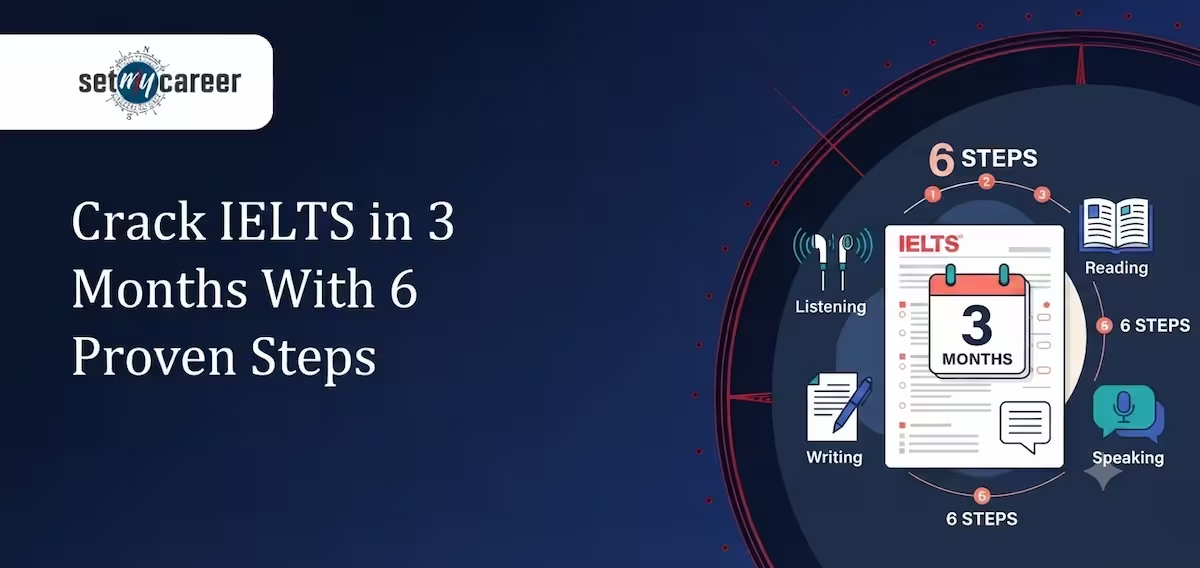
6 Steps to Crack IELTS in 3 Months
To go from diagnostic assessment to test-day confidence in 90 days, you need a disciplined, phased approach. Here is your six-step framework for success.
Step 1: Understand the Test Format and Assessment Criteria
Before buying prep books or attempting practice tests, spend time analyzing the exam layout. IELTS consists of four modules taken in the following structure:
- Listening (30 minutes + transfer time): 40 questions split across 4 audio recordings featuring native speakers.
- Reading (60 minutes): 40 questions across 3 long passages featuring descriptive, factual, and analytical texts.
- Writing (60 minutes): 2 tasks. Task 1 requires describing visual data or writing a letter (150 words); Task 2 requires a formal discursive essay (250 words).
- Speaking (11–14 minutes): A 3-part structured interview evaluating fluency, vocabulary, grammar, and pronunciation.
Crucially, download the official public IELTS Band Descriptors for Writing and Speaking. Knowing exactly how examiners grade your tasks—such as evaluating Task Achievement, Coherence and Cohesion, Lexical Resource, and Grammatical Range and Accuracy—gives you an immediate edge over candidates who simply write without a rubric.
Step 2: Create a Structured 90-Day Study Plan
Consistency beats intensity every time. Studying two hours daily for three months produces far better results than cramming eight hours a day in the final fortnight. Organize your 90 days into three clear phases:
Month 1: Diagnostic Assessment & Foundation Building
- Take an initial untimed practice test to determine your baseline band score and identify weak areas.
- Build a active vocabulary bank by learning 10 to 15 contextual words daily, focusing on academic collocations and topic-specific vocabulary (e.g., environment, technology, education).
- Consume high-quality English media daily—listen to BBC podcasts, read articles from The Economist or National Geographic, and watch documentaries.
- Master fundamental grammar structures, specifically complex sentences, passive voice, and conditional clauses.
Month 2: Sectional Mastery & Speed Development
- Begin timed sectional practice for Reading and Listening to improve processing speed.
- Learn proven reading methodologies like skimming for gist, scanning for specific keywords, and identifying paraphrase patterns.
- Draft at least two Writing Task 1 and Task 2 essays weekly, focusing on paragraph structure and cohesive devices.
- Record your voice while answering Speaking cue cards (Part 2) to analyze hesitation, pronunciation, and pacing.
Month 3: Full-Length Simulation & Refinement
- Complete two full-length, back-to-back mock tests each week under strict exam conditions (no phone interruptions, strict timing).
- Keep an Error Log to track recurring mistakes in Reading and Listening (e.g., singular/plural errors, spelling mistakes, misreading instructions).
- Focus heavily on fine-tuning time allocation for Writing (20 minutes on Task 1; 40 minutes on Task 2).
Step 3: Master Each Section with Targeted Strategies
Generic study habits will not yield an 8.0 band score. You need section-specific tactical adjustments.
Listening: Active Tracking and Synonym Awareness
- Predict Answers: Use the 30 seconds before each audio track to read the questions and underline key nouns. Predict whether the answer requires a date, place, name, or number.
- Beware of Distractors: Audio tracks frequently feature speakers correcting themselves (e.g., "We will meet at 3 PM... oh wait, let's make it 4 PM"). Always wait for the final clarification.
- Track Synonyms: The audio rarely uses the exact words written on your question paper. Listen for paraphrased concepts rather than verbatim keywords.
Reading: Skimming, Scanning, and Question Mapping
- Don't Read Every Word: Skim the passage in 2 minutes to understand the core narrative of each paragraph. Then, scan for specific details matching the questions.
- True / False / Not Given Mastery: Remember: True means the statement directly matches the text. False means the text directly contradicts the statement. Not Given means the passage neither confirms nor denies the claim. Never make logical assumptions beyond what is explicitly written.
- Manage Your Time: Spend no more than 18 minutes on Passage 1, 20 minutes on Passage 2, and 22 minutes on Passage 3, as difficulty increases progressively.
Writing: Clear Structure and Data Accuracy
- Task 1 (Academic): Always write an explicit Overview Paragraph summarizing key trends or high/low points. Never list every single data point—group data logically.
- Task 2 (Essay): Use a clear 4-paragraph structure: Introduction (Paraphrase Prompt + Thesis Statement), Body Paragraph 1 (Main Point + Explanation + Example), Body Paragraph 2 (Second Point + Explanation + Example), and Conclusion.
- Prioritize Accuracy: Using rare vocabulary incorrectly will lower your score. It is far better to use precise, clear language with flawless grammar than complex words placed awkwardly.
Speaking: Natural Coherence and Elaboration
- Avoid Memorized Responses: Examiners quickly identify and penalize memorized scripts. Speak naturally, as if conversing with a respected colleague.
- Use the "PPF" Strategy: When answering Part 1 or Part 3 questions, extend your responses by framing them around the Past, Present, or Future (e.g., "In the past, I used to... but nowadays...").
- Embrace Natural Pauses: Instead of using vocal fillers like "um" or "ah," use natural discourse markers like "That's an interesting question," or "To be completely honest..." to gather your thoughts.
Step 4: Take Mock Tests Under Real Conditions
Knowledge alone does not guarantee success; exam stamina does. Sitting for nearly three hours while maintaining razor-sharp focus requires physical and mental preparation.
Utilize official materials, such as the Cambridge IELTS Academic or General Training Practice Tests (Books 11 to 19). When taking a mock test:
- Sit at a quiet desk with no reference materials or dictionaries.
- Enforce hard cutoffs for timing—stop writing the second the timer hits 60 minutes.
- Complete Listening, Reading, and Writing in one continuous session without taking breaks.
After completing a test, spend at least one hour reviewing your mistakes. Did you miss a question due to a vocabulary gap, a misread instruction, or simple fatigue? Identifying the root cause of your errors prevents them from recurring on test day.
Step 5: Master Time Management and Test-Day Mechanics
Small operational mistakes can cost you half a band score. Pay meticulous attention to these details:
- Read the Word Count Limits: If a reading instruction states "NO MORE THAN TWO WORDS," writing three words results in an automatic zero for that question, even if the information is accurate.
- Transfer Answers Carefully: If taking the paper-based test, ensure your handwriting is completely legible. Capitalize all answers in Reading and Listening to avoid errors with proper nouns.
- Never Leave Blanks: There is no negative marking in IELTS. If you are unsure of an answer in Reading or Listening, make an educated guess before time runs out.
Step 6: Maintain Consistency and Language Immersion
To score high in Speaking and Writing, your brain needs to process thoughts directly in English rather than translating from your native language. Surrounding yourself with English throughout your 90-day prep cycle builds this instinct naturally:
- Change your phone and computer display languages to English.
- Narrate your daily activities aloud in English when you are alone to build verbal spontaneity.
- Join online study groups or pair up with an IELTS study partner to conduct mock speaking sessions and exchange constructive feedback.
Conclusion: Your Roadmap to IELTS Success
Cracking the IELTS in three months is not about luck—it is about systematic preparation, understanding the assessment criteria, and executing a daily routine. By familiarizing yourself with the test layout, following a phased 90-day plan, practicing under realistic conditions, and refining your weakness through targeted analysis, walking into the test center with complete confidence becomes second nature.
Your target band score is fully within reach. Set your study schedule today, commit to daily practice, and take the first decisive step toward unlocking your global career and academic opportunities!