



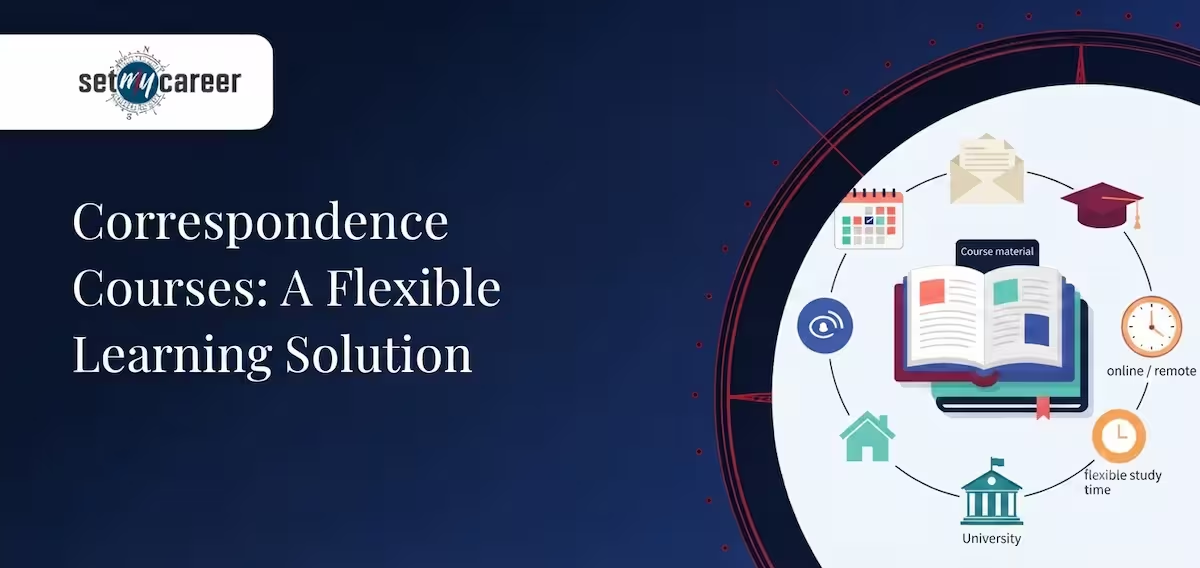
Imagine earning a university degree from the comfort of your home, studying on your own schedule, and balancing your education with work, family, or personal commitments. Welcome to the world of correspondence courses. Also known as distance education or Open and Distance Learning (ODL), these programs allow students to pursue formal academic qualifications without attending daily on-campus classes.
Through physical study kits delivered by mail or comprehensive digital learning portals, correspondence programs offer a structured, self-paced academic framework. Whether you are a working professional aiming for a promotion, a stay-at-home parent re-entering the workforce, or a student seeking an affordable higher education pathway, distance learning provides a practical way to gain market-relevant skills without pausing your life.
What is a Correspondence Course? Understanding Distance Education
A correspondence course is an academic program designed for remote learning, where the physical presence of the student in a classroom is not required. Historically relying on printed textbooks and assignments sent via postal mail, modern correspondence education in India has evolved into a blended model managed by the Distance Education Bureau (DEB) under the University Grants Commission (UGC).
Today’s distance programs combine comprehensive Self-Learning Material (SLM) with digital resources, including recorded video lectures, online discussion forums, and virtual assignment portals. Universities conduct periodic weekend Personal Contact Programs (PCP) at local study centers to offer academic counseling, clarify doubts, and facilitate practical sessions. Students submit assignments periodically and appear for term-end examinations (TEE) at designated centers, ensuring that the academic rigor mirrors traditional degree programs.
Key Benefits of Pursuing a Correspondence Degree
Higher education in India is increasingly competitive, and traditional on-campus seats at premier institutions are limited. Distance education bridges this gap by offering a flexible, recognized, and accessible alternative. Here is why millions of students choose correspondence learning each year:
- Unmatched Schedule Flexibility: You control your study hours. Whether you study early in the morning, late at night, or on weekends, distance education allows you to learn at a pace that fits your personal and professional schedule.
- Exceptional Cost-Effectiveness: Correspondence programs generally cost a fraction of traditional on-campus degrees. By eliminating expenses related to daily commutes, hostel accommodation, and campus fees, distance learning makes higher education financially sustainable.
- No Career Interruption for Working Professionals: You do not need to quit your job to earn a degree. Working while studying enables professionals to apply new knowledge immediately in the workplace while earning a salary and accumulating valuable work experience.
- Equal Legal Recognition: As per UGC regulations, degrees earned through UGC-DEB-approved distance education institutions hold equal academic value and legal standing as traditional degrees for higher studies and government employment.
- Geographic Inclusivity and Accessibility: Students living in tier-2, tier-3 cities, or rural regions can enroll in top national universities without relocating to major metro cities.
How to Apply for a Correspondence Course in India: A Step-by-Step Guide
Enrolling in a distance learning program is a straightforward, largely digital process. Following a systematic approach ensures that your degree remains valid and recognized throughout your career.
- Verify UGC-DEB Approval: Before applying, check the official UGC-DEB portal to ensure the university and the specific program hold valid recognition for distance education for the current academic session.
- Select an Aligned Program: Review the curriculum, specialization options, and assessment methods to ensure the course matches your long-term career goals.
- Review Eligibility Criteria: Confirm that you meet the minimum academic qualifications, such as required subject combinations or minimum aggregate percentages.
- Complete the Online Application: Visit the official distance education portal of your chosen university, register your profile, and complete the application form accurately.
- Upload Required Documentation: Submit scanned copies of your academic mark sheets, identity proof (such as Aadhaar card), passport-sized photographs, and relevant certificates.
- Pay the Program Fees: Pay the admission and processing fees through secure online channels provided on the official university portal.
- Receive Confirmation and Study Material: Once your documents are verified, the university issues an Enrollment/Registration Number and grants access to the online student portal while dispatching printed study kits to your registered address.
Eligibility Criteria for Distance Education Programs
One of the key strengths of correspondence education is its inclusive admission framework. While entry requirements vary slightly between institutions, standard guidelines apply across course levels:
Undergraduate (UG) Programs
Candidates must have completed 10+2 (Higher Secondary Education) from a recognized central or state board. Some specialized streams, such as B.Sc. in Information Technology or Computer Applications, may require specific subjects like Mathematics or Computer Science in senior secondary school.
Postgraduate (PG) Programs
Applicants must hold a recognized Bachelor’s degree in a relevant discipline from a UGC-recognized university. Certain professional programs, such as distance MBA or MCA, may require a minimum aggregate score (typically 50%) or relevant work experience.
Diploma and Vocational Certification Courses
Eligibility requirements for short-term diplomas are flexible. Some skill-based programs accept candidates who have passed 10th or 12th grade, while specialized postgraduate diplomas require a foundational graduate degree.
Correspondence Courses vs. Traditional On-Campus Degrees
Understanding the key structural differences between distance education and full-time campus programs helps you select the format that best fits your learning style and life circumstances.
| Parameter | Correspondence / Distance Learning | Traditional On-Campus Degrees |
| Learning Environment | Self-paced, home-based learning supported by digital tools and weekend contact sessions. | Classroom-based instruction with mandatory daily attendance requirements. |
| Cost & Tuition | Significantly lower tuition fees; minimal commuting and housing expenses. | Higher tuition fees along with campus maintenance, transportation, and living costs. |
| Time Commitment | Highly flexible; easily adaptable around work or family commitments. | Rigid timetable requiring full-time daily physical presence. |
| Peer Interaction | Periodic interaction via online forums, study groups, and weekend sessions. | Daily face-to-face interaction, campus events, and collaborative group work. |
| Practical Exposure | Relies on self-directed projects, virtual labs, and periodic weekend practicals. | Continuous access to physical laboratories, workshops, and campus facilities. |
| Government Recognition | Equal validity for public employment when offered by UGC-DEB approved institutions. | Standard national recognition across all public and private sectors. |
Common Challenges in Distance Education (and How to Overcome Them)
While correspondence courses offer distinct advantages, succeed in a distance learning environment requires self-reliance and planning. Here is how to navigate potential hurdles effectively:
- Managing Procrastination: Without fixed daily class schedules, it is easy to delay reading assignments. Solution: Build a personal study timetable, allocate dedicated hours each week, and set personal deadlines for completing study modules.
- Reduced Classroom Interaction: Learning independently can sometimes feel isolating. Solution: Attend weekend Personal Contact Programs (PCP), join official online discussion forums, and form local peer study groups with fellow students.
- Balancing Work and Study: Managing professional duties alongside academic workloads can cause stress. Solution: Break long study modules into smaller daily tasks and keep your family or employer informed about upcoming examination schedules.
- Navigating Employer Perception: Some traditional recruiters may still favor on-campus degrees for entry-level roles. Solution: Build a strong portfolio of real-world projects, highlight practical certifications, and emphasize the discipline required to earn a degree while working.
Top UGC-DEB Approved Universities for Distance Education in India
Choosing an accredited university ensures that your degree holds long-term value. Below are several premier public and private universities in India known for quality distance education:
- Indira Gandhi National Open University (IGNOU): The world’s largest open university, offering hundreds of UGC-approved undergraduate, postgraduate, diploma, and certificate programs backed by extensive national student support networks.
- School of Open Learning, University of Delhi (DU SOL): A premier choice for humanities and commerce programs, granting degrees that mirror the standards of Delhi University.
- Institute of Distance and Open Learning, University of Mumbai (IDOL): Highly regarded for undergraduate and postgraduate commerce, arts, and management degrees across Maharashtra and Western India.
- Directorate of Distance Education, Annamalai University: One of India’s established distance education providers, offering diverse streams in arts, science, and management.
- Symbiosis Centre for Distance Learning (SCDL): A premier private institute specializing in industry-aligned postgraduate diplomas in business management, IT, and corporate administration.
- Dr. B.R. Ambedkar Open University (BRAOU): A pioneering open university focused on delivering accessible, low-cost higher education with regional study centers.
- Sikkim Manipal University Distance Education (SMU-DE): Recognized for structured digital learning systems, technology programs, and business management credentials.
- Karnataka State Open University (KSOU): Offers a broad range of humanities, commerce, and science programs designed for working professionals and rural learners.
- Tamil Nadu Open University (TNOU): Focuses on inclusive vocational, diploma, and degree programs tailored for skill development and employment readiness.
- Amity University Online: Features modern digital platforms, interactive learning modules, and career support services for business and technology programs.
Popular Streams and Types of Distance Education Programs
Distance education spans almost every major academic discipline, allowing learners to tailor their studies to specific career trajectories.
General Academic Programs
These foundational degrees provide broad academic knowledge and serve as strong preparation for competitive examinations, civil services, or higher research:
- Undergraduate: Bachelor of Arts (B.A. in English, History, Political Science, Economics), Bachelor of Commerce (B.Com in Accounting, General Commerce), Bachelor of Science (B.Sc. in Mathematics, Physics).
- Postgraduate: Master of Arts (M.A. in Psychology, Sociology, Public Administration), Master of Commerce (M.Com in Finance, Banking), Master of Science (M.Sc. in Mathematics, Environmental Science).
Professional and Management Programs
Designed to accelerate career advancement and develop practical leadership competencies:
- Business & Management: Bachelor of Business Administration (BBA) and Master of Business Administration (MBA) with specializations in Finance, Human Resource Management, Marketing, and Operations.
- Information Technology: Bachelor of Computer Applications (BCA) and Master of Computer Applications (MCA) focusing on software engineering, database management, and system administration.
- Education & Law: Bachelor of Education (B.Ed., subject to specific teaching experience criteria) and specialized postgraduate diplomas in Business Law or Cyber Law.
Vocational and Skill-Based Certifications
Short-term, specialized programs focused on building immediate job-ready skills:
- Media & Communication: Diplomas in Journalism, Public Relations, and Digital Marketing.
- Finance & Corporate Services: Certificates in Financial Accounting, Investment Banking, and Supply Chain Management.
- Technology & Security: Certifications in Web Development, Data Analytics, and Information Security.
Conclusion: Empowering Your Academic and Career Journey
Correspondence courses have transformed higher education from a rigid, location-dependent commitment into a flexible, accessible pathway for continuous learning. By breaking down geographic and financial barriers, distance education empowers students and working professionals to gain recognized qualifications on their own terms.
To make the most of your distance learning journey, select an accredited university, stay disciplined with your study schedule, and actively apply your knowledge. With the right program, a correspondence course can serve as a powerful catalyst for your personal growth and professional advancement.