






Securing a rewarding career in India today requires much more than simply earning a university degree and broadcasting generic resumes across online job boards. As technological innovations and macroeconomic shifts redrawn the boundaries of traditional business, entry-level graduates face severe employability challenges, while seasoned professionals encounter sudden career plateaus, structural stagnation, or displacement.
The core issue extends far beyond a simple scarcity of vacant positions. The true challenge lies at the intersection of critical skill mismatches, obsolete job-hunting methodologies, and reactive career planning. Many ambitious individuals inadvertently bottleneck their professional growth by walking traditional paths that no longer offer the stability or financial upside they once did. To insulate yourself against these shifts, you must diagnose the structural drivers of employment volatility in India and systematically equip yourself with the strategies needed to break through the noise and claim high-paying, future-proof roles.
The Structural Drivers of Unemployment in India (And How to Pivot)
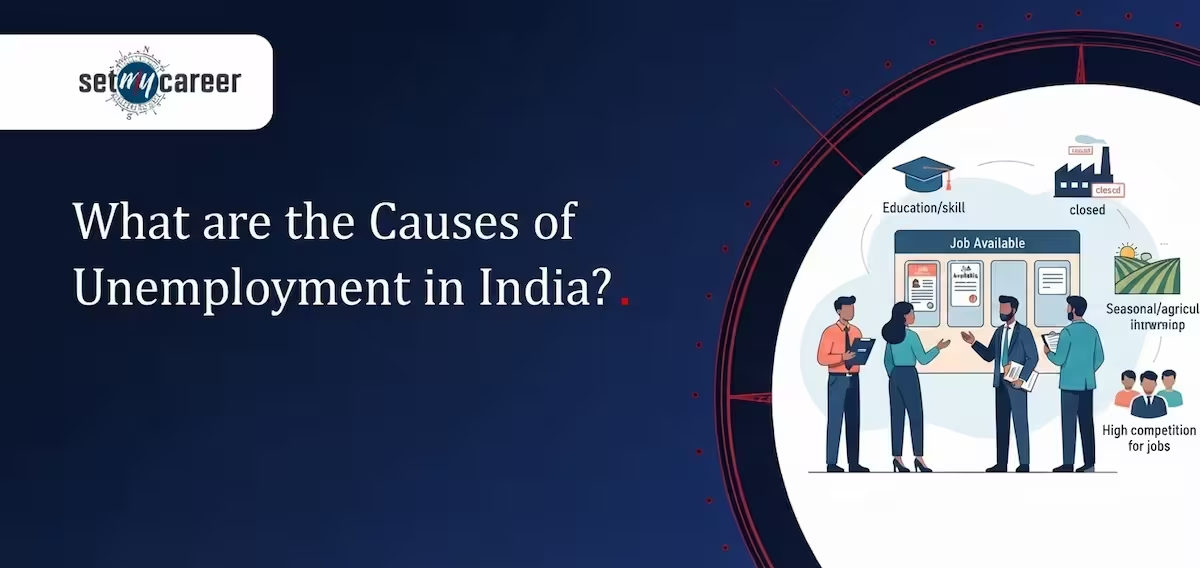
1. The Disconnect Between Academic Theory and Industrial Application
The foundational framework of higher education across the country remains heavily anchored in historical theory, often neglecting the immersive, practical training required in a contemporary corporate environment. This disconnect creates a massive capability gap. Every year, thousands of individuals graduate with credentials in engineering, business administration, or the liberal arts, yet corporations consistently report an inability to find talent capable of managing modern, data-driven workflows.
How this limits your trajectory:
- Graduates spend months navigating long interview cycles only to discover their academic knowledge does not translate into functional operational capabilities.
- Traditional generalist tracks face hyper-saturation, intensifying competition for a dwindling pool of entry-level positions.
- Highly lucrative, specialized niches suffer from a severe talent shortage because the academic pipeline remains slow to integrate emerging disciplines.
Your Strategic Countermeasures:
- Prioritize industry-demanded specializations—such as business intelligence, statistical modeling, or cloud architecture—early in your educational planning.
- Proactively close your knowledge gaps by securing recognized professional certifications, executing live industry projects, and participating in technical bootcamps.
- Engage with expert career advisors to decode market metrics and align your academic focus with sectors showing sustained capital investment.
2. The Acceleration of Automation and Tech-Driven Displacement
Digital transformation and artificial intelligence are systematically altering human resource deployment. Routine administrative tasks, manual data processing, basic client support, and legacy clerical functions are rapidly being automated. Conversely, market valuations are skyrocketing for professionals who can build, secure, and optimize these automated ecosystems.
How this limits your trajectory:
- Professionals anchored in execution-level, repetitive tasks face severe risk of role elimination.
- Hiring authorities are screening aggressively for digital literacy, leaving individuals with stagnant skill sets at a major disadvantage during recruitment.
- Sunrise sectors are expanding rapidly, but the lack of an intentional transition framework keeps many workers trapped in declining fields.
Your Strategic Countermeasures:
- Develop human-centric, high-leverage capabilities that software cannot easily replicate, such as cross-functional leadership, complex problem-solving, and advanced negotiation.
- Execute a deliberate pivot toward tech-resilient sub-verticals, including cybersecurity infrastructure, predictive data analytics, and user experience design.
- Continuously update your technical resume with functional competencies in enterprise tools, cloud computing platforms, and structural query languages like SQL.
3. Macro-Competition and the Volume Trap
India’s demographic dividend means millions of ambitious individuals enter the employment pool simultaneously every year. Because the volume of applicants holding standard business or technical degrees is exceptionally high, standard screening processes have become hyper-exclusive, frequently dropping highly capable candidates based on arbitrary algorithmic filters.
How this limits your trajectory:
- Relying solely on your diploma leaves you grouped with thousands of identical profiles, reducing your selection probability.
- Due to immediate financial pressures, many talented individuals accept underemployment, stepping into low-paying roles unrelated to their long-term potential.
- Mid-career professionals face continuous downward salary pressure from younger, digitally native cohorts willing to execute tasks at lower price points.
Your Strategic Countermeasures:
- Architect a unique personal brand on professional networks like LinkedIn, positioning yourself as a thought leader in your specific domain.
- Target highly specialized, niche career segments where the talent pool is small, effectively eliminating macro-competition.
- Leverage professional mentorship to access the hidden job market—securing interviews through strategic internal referrals before positions are publicly listed.
4. Cyclical Economic Volatility and Sector Vulnerability
Macroeconomic adjustments, global supply chain re-alignments, and industry-specific contractions can trigger abrupt hiring freezes or corporate downsizings. Sectors tied heavily to consumer discretionary spending—such as traditional retail, legacy manufacturing, and travel logistics—are historically the first to experience friction during market contractions.
How this limits your trajectory:
- Traditional job hunting becomes highly stressful during economic downcycles due to compressed corporate budgets.
- Relying on a single, centralized income stream leaves your household financially exposed to sudden corporate restructuring.
- Sudden market corrections can render hyper-localized skills obsolete overnight if an industry undergoes rapid consolidation.
Your Strategic Countermeasures:
- Monetize your secondary competencies by building an independent consulting or specialized freelancing portfolio to diversify your income.
- Anchor your primary career in high-stability, baseline sectors like healthcare systems, digital enterprise infrastructure, or core financial technologies.
- Maintain high professional agility, upskilling continuously so you can transition laterally into adjacent markets if your primary sector contracts.
Overcoming the Experience Deficit: Transforming Portfolios from Empty to Authoritative
A primary paradox fresh job seekers face is the classic dilemma: securing a role requires prior experience, but gaining experience requires an initial role. Bypassing this bottleneck requires moving away from the passive belief that experience can only be granted by a full-time employer.
| The Experience Gap | The Practical Operational Reality | The Strategic Human Solution |
| Shallow Resume Profiles | Recruiters spending seconds on initial resume reviews discard profiles that only list academic coursework without application. | Build a public portfolio showcasing self-directed case studies, deep open-source contributions, or highly technical volunteer projects. |
| Absence of Corporate Etiquette | Organizations hesitate to absorb the high onboarding costs and training timelines associated with unprimed graduates. | Secure multiple micro-internships, participate in corporate hackathons, or complete virtual work experience programs hosted by global firms. |
| Isolated Professional Networks | Applying blindly through job portals detaches your profile from the human internal advocates who accelerate hiring. | Use your undergraduate years to shadow working professionals, conduct informational interviews, and join local chapters of professional associations. |
Modernizing the Search: Moving Beyond Outdated Recruitment Tactics
Relying exclusively on the mass distribution of generic resumes across massive job boards is a highly inefficient methodology. Modern corporate talent acquisition relies heavily on automated tracking systems (ATS), keyword optimization, semantic relevance, and internal employee referral programs. To stay competitive, your job acquisition strategy must match the sophistication of contemporary recruitment infrastructure.
- Deconstruct the Algorithmic Filter: Audit the job descriptions of your target roles to discover recurring core competencies. Weave these precise NLP entities and technical keywords naturally into your resume to ensure it passes automated screenings.
- Optimize Your Digital Interface: Treat your LinkedIn profile as a dynamic, inbound lead generation landing page. Ensure your headline states your specific value proposition, your about section outlines quantifiable business metrics you have moved, and your activity feed reflects consistent engagement with modern industry trends.
- Master the Psychology of Negotiation: Reframe the interview process from an interrogation into a collaborative business consultation. Deploy the STAR framework (Situation, Task, Action, Result) to articulate your achievements, and use data-backed market benchmarks to confidently negotiate your true value.
Conclusion: Taking Command of Your Career Trajectory
Navigating structural employment challenges requires shifting from a passive mindset to a highly proactive strategy. Securing professional and financial stability is no longer about finding an open job vacancy; it is about maintaining continuous relevance in a rapidly changing market. By diagnosing your skill gaps early, shifting away from generic job hunting, and anchoring your career in sectors driving real economic growth, you insulate your trajectory from sudden disruption.
Treat your career path as an evolving business venture that requires regular audits, strategic capital investments, and continuous development. The choices you make to upgrade your skills and expand your professional community today will determine whether your career simply survives or truly thrives tomorrow. If you are ready to remove the guesswork from your next pivot and build a roadmap tailored to your highest potential, the senior advisors at SetMyCareer are here to provide the psychometric testing, market clarity, and elite coaching you need to claim your professional future with absolute certainty.