






Whether your aim is to accelerate your career, improve your physical health, establish stronger daily habits, or simply refine your personal development, setting clear goals is critical. Goals help channel your energy, sustain motivation, and provide a measurable way to track your progress over time.
However, an effective strategy requires recognizing that not all goals are created equal. Some objectives can be crossed off your list in a matter of weeks, while others demand years of sustained, strategic effort. Understanding the fundamental differences between short-term and long-term goals—and knowing how to integrate them—is the key to turning ambition into reality.
In this guide, we will explore both types of goals, demonstrate how they complement one another, and help you construct a practical, actionable system that systematically moves you closer to the life you envision.
What Are Short-Term Goals?
Short-term goals are immediate, highly actionable objectives that you can accomplish in the near future—typically ranging from a few days to a few months. These are your "quick wins." They are the manageable milestones that create momentum and provide tangible evidence that you are actively moving forward.
The primary advantage of short-term goals is their accessibility. Because they are realistic and achievable within a compressed timeframe, they offer frequent, satisfying moments of completion. This regular influx of dopamine and accomplishment is exactly what prevents burnout and keeps you engaged in the broader process.
Why Short-Term Goals Matter (Practical Examples)
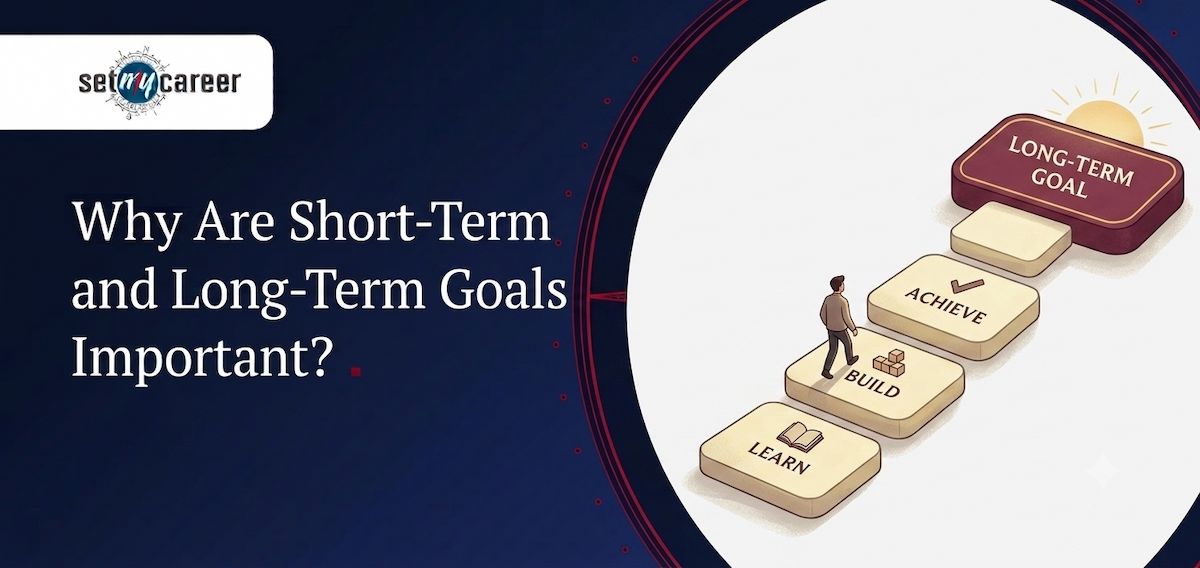
Think of short-term goals as the structural building blocks for your grandest ambitions. On their own, they might appear insignificant, but when stacked consistently, they generate massive compound results. If you want to transform your physical health, you don't start by running a marathon; you start by committing to three workouts this week. If you want to achieve financial independence, you begin by setting aside $50 this month.
Here are several highly actionable short-term goals you can implement immediately:
- Incorporate Daily Movement: Commit to walking for 15 minutes every day this week to improve circulation and clear your mind.
- Optimize Hydration: Replace your afternoon caffeine or sugary beverage with a glass of water for three consecutive days.
- Initiate Micro-Savings: Automatically transfer $20 from your next paycheck into a dedicated savings account.
- Declutter Your Environment: Choose one specific area—your desk, a single closet, or your digital desktop—and thoroughly organize it this weekend.
- Acquire a Micro-Skill: Dedicate 20 minutes to watching a tutorial on a specific, useful topic, such as mastering a new Excel formula, basic investing principles, or a simple recipe.
- Nurture Relationships: Send a message or schedule a brief call with a friend or colleague you have not connected with recently.
- Improve Sleep Hygiene: Attempt to turn the lights out exactly 30 minutes earlier than usual for five nights in a row.
- Implement a Digital Curfew: Disconnect from your phone and social media platforms for one full hour before your scheduled bedtime.
What Are Long-Term Goals?
Long-term goals represent the ultimate vision you hold for your future. These are the profound, high-impact objectives that genuinely matter to your overall life trajectory. They are not tasks you will check off next week or even next year; they require significant time, often spanning several years or even decades to fully realize.
A long-term goal might involve earning an advanced degree, securing an executive position in your field, launching a scalable business, achieving total debt freedom, or purchasing a home. These ambitions reside in the background of your daily life, serving as the ultimate destination for your current efforts.
Achieving a long-term goal requires intense patience, resilience, and strategic planning. While the finish line may feel distant, the incremental steps you take today are the only mechanism that will eventually get you there.
Why Long-Term Goals Matter (Real-Life Milestones)
Without a defined long-term target, it is incredibly easy to fall into a state of professional and personal drift. When daily tasks become monotonous, you might find yourself wondering, "Why am I actually doing this?" Long-term goals provide the necessary context. They remind you that there is a highly desirable outcome waiting at the end of your current struggle.
They are the reason you continue to show up, particularly on days when progress feels agonizingly slow or difficult. Furthermore, your long-term goals do not have to be rigidly defined immediately. They simply need to be a compelling focal point that gives your current actions meaning and direction.
Common examples of substantial long-term goals include:
- Purchasing real estate or a primary residence.
- Starting, scaling, and successfully managing an independent business.
- Achieving total elimination of student loans or consumer debt.
- Completing extensive international travel to multiple continents over a decade.
- Building a robust emergency fund equivalent to six months of living expenses.
- Developing recognized, elite-level expertise in a highly specialized professional skill.
- Designing a sustainable, long-term work-life balance that prevents burnout.
It is entirely normal for long-term goals to evolve as you mature and gain new experiences. However, even as they shift, they consistently provide vital direction and purpose to your overarching strategy.
How Short-Term and Long-Term Goals Work Together
The most effective achievers do not view these goal types in isolation. Instead, they utilize short-term goals as the direct, tactical stepping stones required to reach their long-term, strategic vision. When you reverse-engineer a massive goal into small, daily actions, the impossible suddenly becomes entirely manageable.
Here is how to map this synergy effectively:
- Long-Term Goal: Launch a successful, independent consulting business.
- Short-Term Goals: Complete a specific business management course, draft a formal business plan by the end of the quarter, save $5,000 for initial operational funding, and secure two informational interviews with industry mentors.
- Long-Term Goal: Eradicate all student loan debt within exactly 10 years.
- Short-Term Goals: Audit all current expenses to create a strict monthly budget, automate an extra $100 payment toward the principal balance every month, secure a side gig to increase cash flow, and commit to a six-month freeze on acquiring any new consumer debt.
- Long-Term Goal: Travel to 10 different countries over the next five years.
- Short-Term Goals: Open a dedicated, high-yield travel savings account, apply for or renew necessary passports and visas this month, draft a rough itinerary for the first destination, and utilize an app to learn 50 basic phrases in the target language.
- Long-Term Goal: Become a recognized industry mentor for young professionals.
- Short-Term Goals: Officially join a recognized corporate mentoring program, offer to review two junior colleagues' resumes this month, share one piece of actionable career advice weekly on LinkedIn, and schedule recurring monthly check-ins with a designated mentee.
The critical takeaway is alignment. Your short-term actions must actively feed into your long-term aspirations. This unbroken connection is the exact mechanism that fuels sustainable progress and keeps you on the right path.
Proven Strategies to Accelerate Your Career Goals
If your primary focus is professional advancement, applying this dual-goal framework is highly effective. Use these proven strategies to expedite your career trajectory:
- Deconstruct the Overwhelm: Never look at a massive career leap all at once. Break it down into the smallest possible actions, starting with mastering just one new software tool or reading one industry-specific book this month.
- Commit to Continuous Upskilling: Relying on outdated knowledge is a fast track to stagnation. Actively seek out expert-led training. For example, explore how platforms like SetMyCareer provide targeted guidance and resources that translate directly into upward mobility.
- Cultivate a Strategic Network: In the professional world, visibility is often as important as capability. People hire individuals they know and trust. Prioritize connecting with industry peers, attending relevant conferences, and establishing relationships with senior mentors. It consistently yields results.
- Document Your Wins (A "Brag Document"): Do not wait for an annual review to remember what you accomplished in February. Keep a running, detailed log of your professional achievements, positive client feedback, and completed projects. This data is invaluable during salary negotiations.
- Maintain Strategic Flexibility: Modern career paths are rarely linear. It is perfectly acceptable, and often necessary, to pivot into an adjacent field or take a lateral role to learn a new skill. Prioritize staying intensely curious and open to unexpected avenues for growth.
Conclusion
Mastering your life's trajectory requires a dual approach. Short-term goals provide the necessary urgency and daily productivity to keep you moving, while long-term goals supply the overarching vision that keeps you dreaming big and aiming high. Together, they form a highly resilient, powerful system for guaranteed personal and professional growth.
The time for vague aspirations has passed. Grab a notebook or open your preferred planning app, and begin formalizing your objectives. Map out your ultimate destination, and then ask yourself the most important question: What exact, measurable action can you take today that brings you one step closer to the future you demand?