





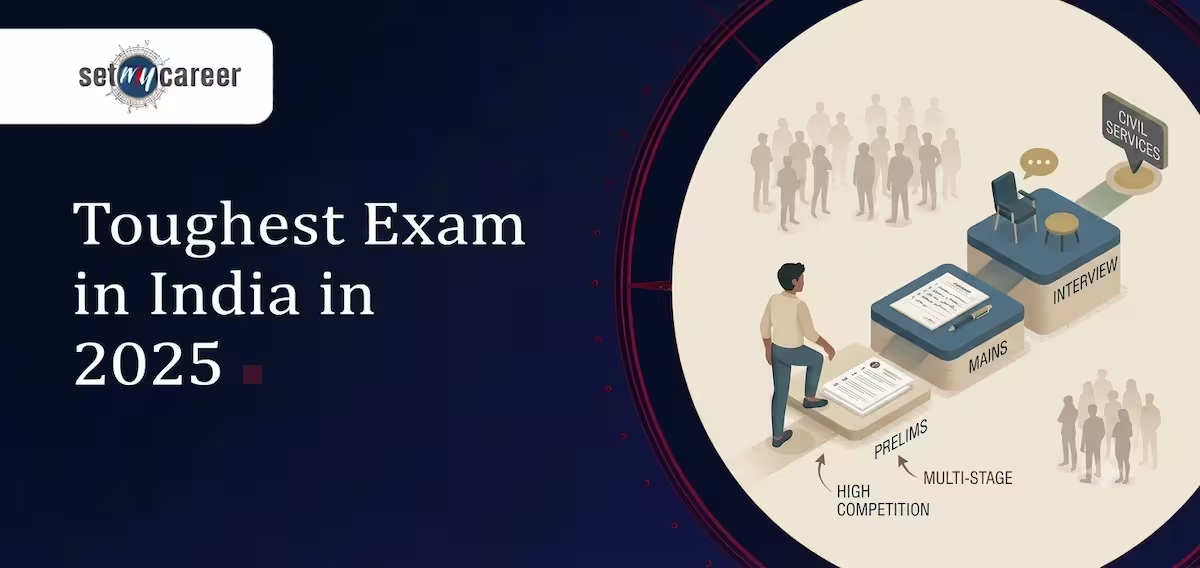
Taking a competitive exam in India is a monumental undertaking. From engineering and medical entrance tests to top-tier government recruitment exams, millions of candidates spend years preparing for a fraction of available seats. The sheer volume of applicants combined with highly rigorous testing standards creates an environment of intense competition.
Career counselling can help students prepare strategically for the toughest exams in India 2025.
But which is genuinely the toughest exam in India in 2025? Determining the absolute hardest test requires looking beyond just the pass rates. We need to factor in syllabus depth, exam structure, psychological pressure, and the quality of competition. Let’s break down the most difficult examinations in the country, explore exactly why they are so challenging, and outline what it takes to actually clear them.
Toughest Exams in India in 2025
India hosts several of the world's most demanding competitive assessments. Below is a detailed breakdown of the exams that consistently test the limits of even the brightest candidates.
UPSC Civil Services Examination (CSE)
The Union Public Service Commission (UPSC) CSE is widely regarded as the ultimate test of endurance and knowledge in India. Serving as the gateway to prestigious administrative roles like the IAS, IPS, and IFS, this exam demands mastery over a massive range of subjects, including history, polity, economics, ethics, and current affairs.
- Stages: Preliminary (objective), Mains (nine descriptive papers), and the Personality Test (interview).
- Preparation Time: 1 to 2 years of dedicated, full-time study.
- Success Rate: Approximately 0.1% to 0.2%.
- Primary Challenges: A seemingly limitless syllabus, highly unpredictable question patterns, and the mental stamina required to sustain focus over a year-long testing cycle.
IIT-JEE (Joint Entrance Examination – Advanced & Main)
For aspiring engineers, the IIT-JEE is an unavoidable hurdle. It is the sole gateway to the prestigious Indian Institutes of Technology (IITs). Only the top 2.5 lakh scorers from JEE Main qualify to sit for JEE Advanced, making the final stage an assembly of the country's best analytical minds.
- Stages: JEE Main (screening) followed by JEE Advanced.
- Preparation Time: 2 years of rigorous coaching and self-study, typically starting in Class 11.
- Success Rate: Less than 2% overall admission rate for IIT seats.
- Primary Challenges: Questions that require multi-layered conceptual thinking rather than rote memorization, punishing negative marking, and extreme peer competition.
NEET (National Eligibility cum Entrance Test)
NEET is the single, unified entrance examination for medical colleges across India. With over 23 lakh students regularly competing for a limited number of government MBBS seats, the pressure is immense. Accuracy and speed are critical, as students must answer a massive volume of questions within a strict time limit.
- Stages: A single-stage, pen-and-paper examination.
- Preparation Time: 1 to 2 years, often involving multiple attempts.
- Success Rate: Around 4% to 5% for all medical seats, but less than 2.5% for premier government colleges.
- Primary Challenges: High cut-off scores driven by massive applicant volumes, strict negative marking, and the need for flawless recall in Biology, Chemistry, and Physics.
CA (Chartered Accountancy) Exam
Conducted by the Institute of Chartered Accountants of India (ICAI), the CA examination is infamous for its low pass percentages. Unlike college entrance exams, this is a professional certification that demands deep technical expertise in corporate law, taxation, auditing, and financial reporting.
- Stages: Foundation, Intermediate, and Final, along with a mandatory practical articleship.
- Preparation Time: 3 to 5 years minimum.
- Success Rate: Typically hovers between 10% and 15% for students clearing both groups in the Final stage.
- Primary Challenges: A highly exhaustive syllabus, complex financial problem-solving, and the grueling challenge of balancing intense studies with practical workplace training.
GATE (Graduate Aptitude Test in Engineering)
GATE serves a dual purpose: it is required for admission into postgraduate programs (M.Tech) at elite institutions like IITs and IISc, and it is the primary recruitment tool for high-paying jobs in Public Sector Undertakings (PSUs).
- Stages: Single-stage computer-based test.
- Preparation Time: 6 months to 1 year of focused technical review.
- Success Rate: Around 15% to 18% qualify, but securing a PSU job or top IIT seat requires being in the top 1%.
- Primary Challenges: Requires a profound understanding of core undergraduate engineering subjects and advanced mathematical applications.
CLAT (Common Law Admission Test)
For students aiming to enter the prestigious National Law Universities (NLUs), CLAT is the ultimate barrier. Rather than testing memorized facts, CLAT evaluates a candidate’s comprehension, reading speed, and logical reasoning abilities under extreme time constraints.
- Stages: Single-stage comprehension-based exam.
- Preparation Time: 6 months to 1 year.
- Success Rate: Less than 4% to 5% for the top-tier NLUs.
- Primary Challenges: Extensive reading passages that test legal aptitude, critical reasoning, and high-level English proficiency within a very tight time limit.
NDA (National Defence Academy) Exam
For individuals aspiring to serve as officers in the Indian Army, Navy, or Air Force, the NDA exam is a highly unique challenge. It goes beyond academics, testing physical endurance, leadership potential, and psychological resilience.
- Stages: Written examination followed by a rigorous 5-day SSB (Services Selection Board) Interview.
- Preparation Time: 1 year of academic study combined with physical conditioning.
- Success Rate: Approximately 1% to 2%.
- Primary Challenges: The SSB interview is notoriously difficult, filtering out candidates who lack the specific psychological and physical traits required for military leadership.
UGC-NET (University Grants Commission – National Eligibility Test)
Determining eligibility for university-level Assistant Professor roles and Junior Research Fellowships (JRF), UGC-NET requires deep subject matter expertise. It tests teaching aptitude, research methodology, and postgraduate-level conceptual knowledge.
- Stages: Single-stage exam with two papers.
- Preparation Time: 6 months to 1 year of postgraduate-level study.
- Success Rate: Roughly 6% to 7% overall.
- Primary Challenges: A highly specialized syllabus that demands strong analytical skills and advanced research aptitude.
Which Amongst These is the Toughest?
Determining a single "toughest" exam depends entirely on how you measure difficulty. Are you looking at the volume of applicants, the complexity of the questions, or the psychological endurance required?
Despite these variables, the UPSC Civil Services Examination (CSE) is widely considered the absolute hardest exam in India. Its syllabus covers almost every facet of human knowledge, the testing cycle spans an entire year, and the final selection rate is painfully low. However, exams like IIT-JEE Advanced, CA, and NEET are equally terrifying in their own specific domains. While UPSC tests breadth of knowledge and administrative temperament, JEE tests analytical depth, and CA tests technical endurance. Ultimately, each of these assessments demands unwavering dedication, strategic execution, and immense perseverance.
What Makes an Exam the Toughest in India?
The reputation of these exams is not just built on hype. Several structural factors combine to make them incredibly difficult to crack:
- Exceptionally Low Success Rates: Exams like UPSC CSE and the CA Final routinely see pass rates below 5%, meaning the vast majority of well-prepared candidates will inevitably face rejection.
- Vast and Evolving Syllabuses: Unlike standard academic tests, many of these exams feature open-ended syllabuses. For instance, UPSC requires an understanding of dynamic current affairs, while CA frequently updates its taxation and corporate law requirements.
- Fierce Competition: With millions of highly capable aspirants competing for a strictly capped number of seats or positions, the margin for error is essentially zero.
- Complexity of Questions: Modern competitive exams have moved away from direct questions. They now feature assertion-reasoning formats, multi-concept problems, and negative marking to severely penalize guesswork.
- Exhaustive Multiple Stages: Many top-tier exams require candidates to prove themselves multiple times. Clearing a written test is often just the beginning, followed by descriptive mains, practical applications, or intense psychological interviews.
Is It Possible to Crack the Toughest Exam?
Absolutely. While the statistics can seem intimidating, these exams are entirely beatable. Every year, thousands of candidates successfully secure their dream seats and jobs. Success in these arenas rarely comes down to sheer intellect alone; it is overwhelmingly the result of disciplined execution.
Candidates who succeed treat their preparation like a full-time job. They do not just read extensively; they analyze past trends, identify their weak points, and master the art of taking the test itself. Success in high-stakes testing is about smart work, psychological resilience, and outlasting the competition.
Strategies to Crack Tough Exams
If you are stepping into the arena of India's most difficult exams, you need a bulletproof approach. Here are the core strategies used by top rankers:
- Develop a Granular Study Plan: Do not just set monthly goals. Break your syllabus down into weekly and daily targets to ensure consistent progress without last-minute panic.
- Prioritize Active Practice Over Passive Reading: Reading a textbook is comfortable, but taking mock tests is where real growth happens. Regularly solve previous years' papers under strict, timed conditions to build exam-day stamina.
- Master Time Management: You must learn how to allocate your study hours efficiently, prioritizing high-weightage subjects and complex concepts when your focus is sharpest.
- Stay Obsessively Updated: For exams like UPSC, CLAT, or banking assessments, current affairs are critical. Read reputable newspapers daily and integrate current events into your core subject knowledge.
- Seek Quality Guidance: You do not have to reinvent the wheel. Leverage the experience of mentors, specialized coaching programs, and peer study groups to course-correct when you hit a plateau.
- Protect Your Physical and Mental Health: Burnout is the biggest threat to a long-term aspirant. Maintain a balanced diet, exercise regularly, and schedule strategic breaks to keep your mind sharp.
- Cultivate Relentless Self-Belief: You will face bad mock test scores and days of intense self-doubt. Confidence, perseverance, and a refusal to quit are what ultimately separate successful candidates from the rest.
Conclusion
Preparing for any of India's most demanding exams is a transformative experience. Whether you are aiming for the civil services, a seat at an IIT, or a professional qualification like a CA, the journey will test your intellectual limits and your emotional endurance. Instead of being intimidated by the low success rates, view them as an opportunity to build unparalleled discipline and analytical skills.
If you are ready to target one of these challenging tests, the best time to begin is now. Start by thoroughly understanding your exam's syllabus, build a realistic timeline, and maintain consistency day in and day out. Should you need help navigating your academic path or choosing the right backup strategies, SetMyCareer is here to provide the expert guidance you need to reach your professional goals.