






"Oh, you're studying humanities? But what about your career?"
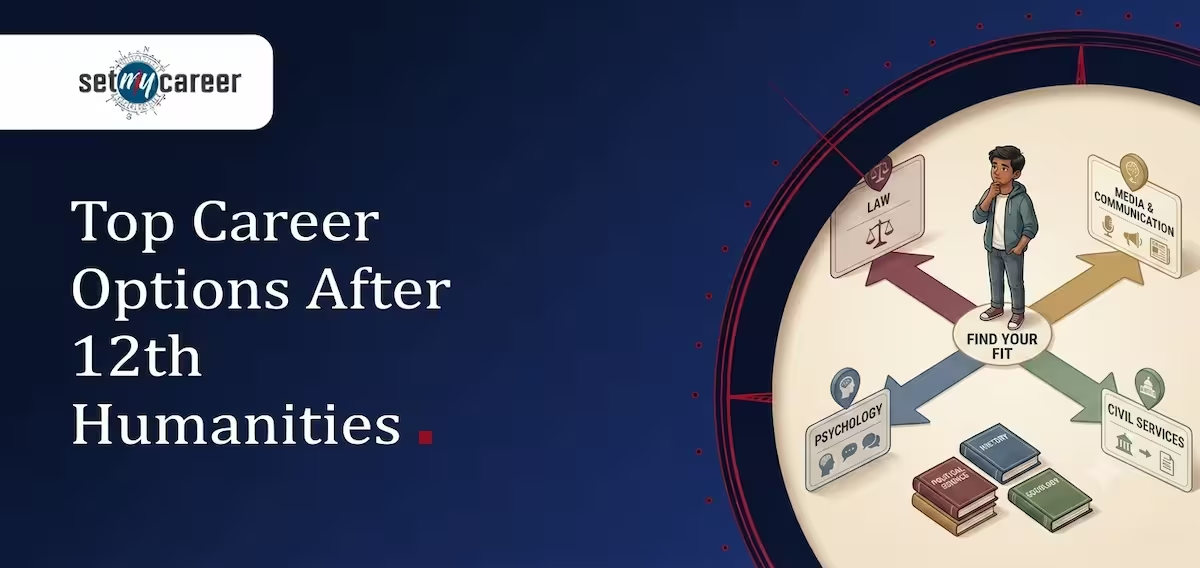
Humanities students have diverse career options after 12th ranging from law to social sciences.
If you chose the arts or humanities stream after 10th grade, chances are you have encountered some variation of this skeptical reaction. In many academic and family circles, choosing humanities still draws unsolicited advice or concerned looks from people who assume that stable, high-paying careers belong exclusively to science or commerce graduates. A persistent cultural myth suggests that the arts stream leads only to limited academic roles or low-paying jobs.
The reality of the modern global economy tells a completely different story.
Choosing humanities opens doors to a vast array of high-impact, strategic, and financially rewarding professions. The core competencies developed through a humanities education—critical thinking, persuasive communication, qualitative research, ethical reasoning, and cultural literacy—are precisely the skills modern employers find hardest to automate. As technology and artificial intelligence continue to transform workplaces, the ability to analyze human behavior, interpret complex socio-economic contexts, and communicate effectively has become a top-tier professional asset.
If you are currently evaluating professional courses after 12th humanities, you are standing before a broad landscape of opportunity. Whether you lean toward traditional fields like corporate law and educational leadership, or you are drawn to dynamic domains like user experience research, public policy, and digital brand strategy, your background gives you a distinct advantage. Let's look at how your humanities education can serve as the foundation for a successful, future-proof career.
Top Professional Courses and Career Paths After 12th Humanities
Selecting the right degree after senior secondary school requires balancing your natural interests with long-term industry demand. Here is a detailed look at the most robust undergraduate programs and career avenues available to humanities students.
1. Integrated Law Programs (BA LLB)
A career in law offers immense prestige, intellectual challenge, and long-term financial growth. Pursuing a 5-year integrated law program right after 12th grade—such as a BA LLB—combines foundational humanities subjects like political science, sociology, and history with rigorous legal education. National Law Universities (NLUs) and top private law schools across the country provide excellent placement opportunities in corporate firms, litigation practices, and regulatory bodies.
2. Psychology and Behavioral Sciences
As public awareness around mental health expands alongside corporate investments in consumer psychology, trained behavioral specialists are in high demand. An undergraduate degree in Psychology or Applied Psychology lays the groundwork for clinical practice, organizational consulting, and research. With further specialization, psychologists work in hospitals, educational institutions, corporate HR departments, and private practices.
3. Mass Communication, Journalism, and Digital Media
The media landscape has evolved far beyond traditional print and broadcast networks. A Bachelor of Arts in Mass Communication or Journalism prepares you to navigate multi-platform media environments, strategic corporate communications, public relations, and digital publishing. Graduates thrive as investigative journalists, news editors, PR specialists, media strategists, and corporate communications managers.
4. Economics and Financial Analytics
Economics is far from being a discipline reserved strictly for commerce students. A BA in Economics offers a powerful blend of qualitative logic and quantitative analysis, making it one of the most versatile degrees in the humanities stream. It opens direct pathways into corporate finance, market research, risk management, banking, and government policy planning.
5. Sociology and Public Policy
If you want to address large-scale social challenges, analyze demographic shifts, or shape governmental frameworks, Sociology and Public Policy are ideal disciplines. A degree in sociology trains you to conduct qualitative social research, analyze cultural trends, and evaluate community development programs. Sociologists play vital roles in non-governmental organizations (NGOs), international development agencies, think tanks, and civil services.
6. Hotel Management and Hospitality (BHM)
For students interested in global business operations, service management, and international trade, a Bachelor of Hotel Management (BHM) offers practical exposure to global hospitality standards, event architecture, and luxury brand management. The program opens doors to management careers in luxury hotel chains, airline operations, cruise lines, and event management firms worldwide.
7. Education, Teaching, and Pedagogy
Education remains one of the most stable and respected professions. Completing an integrated BA B.Ed or pursuing a BA in Education followed by a Master's degree prepares you for roles in teaching, curriculum design, educational technology, and school administration. Educational institutions actively seek educators who possess strong subject mastery alongside deep empathetic communication skills.
8. Digital Content Strategy and Copywriting
Modern businesses rely heavily on strategic storytelling to build brand identity and engage customers. Humanities graduates excel in content strategy, copywriting, and brand management because they understand narrative structure, language, and audience psychology. These roles bridge creative writing with strategic digital marketing across tech companies, advertising agencies, and corporate media teams.
9. Film, Theatre, and Creative Production
If you have a talent for visual storytelling and dramatic literature, degrees in Film Production, Performing Arts, or Screenwriting prepare you for technical and creative leadership roles across streaming platforms, film studios, production houses, and theater networks.
While many of these sectors offer high starting salaries, long-term career growth depends on continuous learning and acquiring specialized skills. Your humanities background provides the intellectual agility needed to adapt as industries transform. (Note: For students exploring multi-stream options, there are also lucrative high-salary courses after 12th science without NEET that lead to strong analytical and technical careers.)
High-Salary Jobs in Humanities: Busting the Pay-Scale Myth
Contrary to outdated assumptions, a background in humanities can lead directly to top-tier compensation packages. When paired with targeted specializations, advanced degrees, or practical industry experience, arts graduates regularly secure influential executive and advisory positions.
| Career Role | Core Focus & Responsibilities | Key Humanities Skill Applied |
| Corporate Lawyer | Advising businesses on commercial contracts, mergers, acquisitions, intellectual property, and regulatory compliance. | Textual analysis, logical argument construction, and persuasive drafting. |
| Marketing Manager / CMO | Overseeing brand strategy, consumer research, marketing campaigns, and market positioning. | Deep comprehension of human behavior, cultural nuances, and narrative strategy. |
| Management Consultant | Analyzing organizational inefficiencies, restructuring business operations, and advising C-suite executives. | Structured problem-solving, qualitative research, and critical thinking. |
| Human Resources Director | Managing talent acquisition, organizational development, workplace culture, and executive leadership pipelines. | Empathy, conflict resolution skills, and understanding of group dynamics. |
| Public Relations Director | Handling corporate reputation, crisis communications, media relations, and brand messaging. | Strategic messaging, crisis management, and persuasive written communication. |
| Political & Policy Analyst | Evaluating legislative proposals, analyzing geopolitical trends, and advising government bodies or research think tanks. | Historical awareness, institutional analysis, and policy research. |
| International Relations Specialist | Managing cross-border diplomatic relations, global trade policies, and multinational corporate strategy. | Geopolitical context, multi-cultural fluency, and diplomatic negotiation. |
| Executive Coach | Advising corporate executives and business leaders on leadership development, performance, and organizational management. | Interpersonal communication, psychological insights, and active listening. |
Conclusion: Building a Fulfilling Career with Humanities
Choosing your path after 12th humanities is a powerful step toward a dynamic professional life. With a broad selection of traditional and emerging disciplines available, success relies on aligning your choices with your natural strengths, professional goals, and personal values.
You do not have to navigate these important decisions alone. Professional assessment tools and expert guidance can provide clarity on market trends, course selection, and university admissions. Take the time to evaluate your options thoughtfully, build relevant skills, and move forward with clarity.
Ready to chart a confident path toward your professional goals? Explore personalized academic roadmaps and expert career guidance with SetMyCareer to take your next step toward a bright future.