






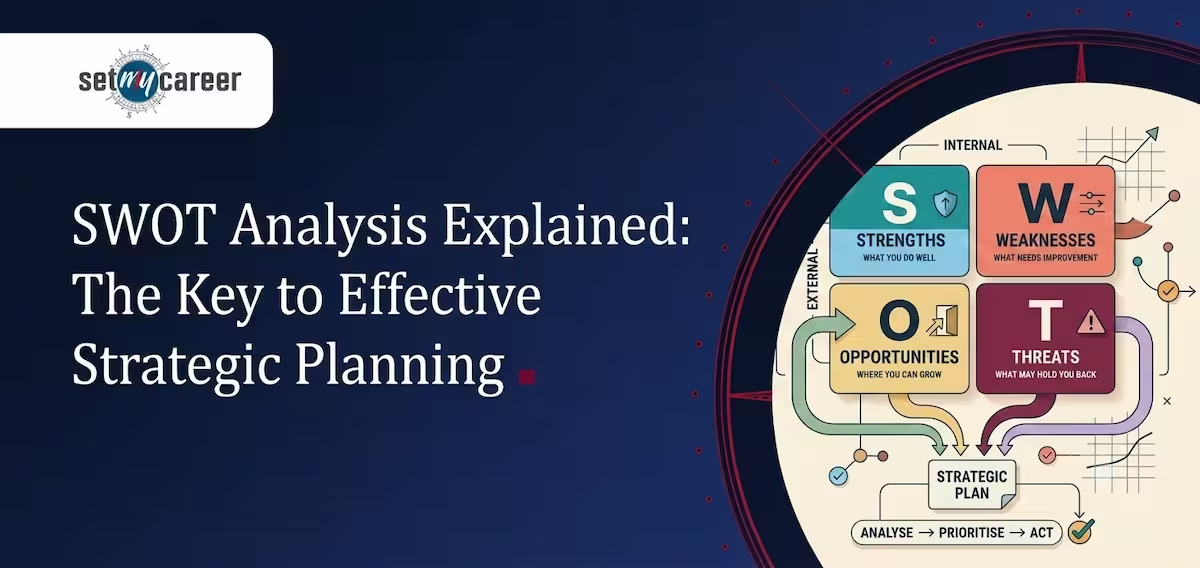
We have all faced critical crossroads moments in our careers or businesses. Whether you are weighing competing job offers, considering a massive industry pivot, or deciding whether to launch a new product line, it is incredibly easy to experience analysis paralysis. When you are overwhelmed by competing priorities and unpredictable variables, a SWOT analysis serves as a strategic anchor.
Career counselling often uses SWOT analysis to help individuals assess their career options.
By systematically assessing your Strengths, Weaknesses, Opportunities, and Threats, you can break down complex, high-stakes situations into clear, actionable insights. Instead of relying on gut feelings, you create a personalized roadmap that helps you navigate uncertainty with objective confidence. Here is how this foundational strategic framework can fundamentally transform your decision-making process.
What is a SWOT Analysis? A Breakdown of the Framework
A SWOT analysis is a highly effective strategic planning tool designed to give you a comprehensive understanding of your current situation. Widely used in corporate strategy, entrepreneurship, and personal career development, the acronym stands for Strengths, Weaknesses, Opportunities, and Threats.
The framework is divided into two distinct categories: internal factors (things you can control) and external factors (things occurring in the broader environment). Here is how the four quadrants break down:
- Strengths (Internal): These are the areas where you naturally excel or hold a distinct advantage. This could include specialized technical skills, exclusive industry resources, a strong professional network, or a highly recognizable brand identity. Strengths are your core assets.
- Weaknesses (Internal): These are the internal limitations or knowledge gaps that might hold you back. Identifying weaknesses—such as a lack of leadership experience, limited financial capital, or outdated software knowledge—requires brutal honesty. Acknowledging them is the first step toward improvement.
- Opportunities (External): These are external chances you can capitalize on to achieve growth. Opportunities might look like an emerging market trend, a sudden shift in consumer behavior, a new networking platform, or the rollout of new industry technologies.
- Threats (External): Threats encompass the external challenges that could derail your plans. This might include aggressive new competitors, impending economic downturns, sudden shifts in regulatory laws, or technological disruptions that make your current skills obsolete.
By mapping out these four dimensions, you move away from abstract worries and generate a clear, categorized picture of exactly where you stand and what variables require your immediate attention.
Why is SWOT Analysis Essential for Strategic Career and Business Planning?
A SWOT analysis is far more than a simple brainstorming exercise; it is an essential diagnostic tool for continuous improvement and long-term planning. Here is why integrating this framework is critical for your growth:
1. Objective and Clear Decision-Making
When faced with a major career transition or a business pivot, emotions often cloud our judgment. A SWOT analysis acts as an objective filter. By forcing you to write down the tangible realities of your situation, it removes the emotional weight from the equation. For instance, when you proactively ask yourself what your specific weaknesses are, you gain the clarity needed to choose a path that either mitigates those flaws or relies heavily on your proven strengths.
2. Smarter Resource Allocation
Time, energy, and capital are finite resources. Knowing exactly where your competitive advantages lie allows you to invest those resources where they will yield the highest return. If your analysis reveals that you have incredible product development skills but severely lack digital marketing expertise, you know exactly where to allocate your budget. You can focus your energy on creating the product while hiring an external agency to handle the marketing, maximizing your overall impact.
3. Proactive Risk Management
Industries change rapidly, and resting on your laurels is a guaranteed way to fall behind. By consistently evaluating external threats, you shift from a reactive mindset to a proactive one. If your SWOT analysis highlights that a new artificial intelligence tool could threaten your current job function, you can immediately begin upskilling to stay ahead of the curve. Identifying threats early neutralizes their potential impact.
4. Fosters Team Alignment and Communication
If you are leading a business or managing a department, a well-structured SWOT analysis serves as a powerful unifying document. It provides a shared reference point that breaks down departmental silos and encourages transparent conversations. When an entire team collectively understands the organization's unique strengths and glaring vulnerabilities, it fosters a culture of collaborative problem-solving and mutual support.
5. Establishes a Baseline for Progress Tracking
A strategic plan is never truly finished. Treat your SWOT analysis as a living document. By revisiting it every quarter or bi-annually, you can measure tangible growth. You might notice that a skill gap previously listed under "Weaknesses" has successfully moved to the "Strengths" column, or that a former "Threat" has evolved into an "Opportunity." Continuous assessment ensures you remain agile and on the right track.