






Imagine this scenario: you have been putting in the hours, making steady progress in your current role, and suddenly, you hit a career plateau. Meanwhile, your peers seem to be leapfrogging into leadership positions or pivoting into lucrative new sectors. At this crossroads, a familiar question inevitably pops up: “Should I get an MBA?”
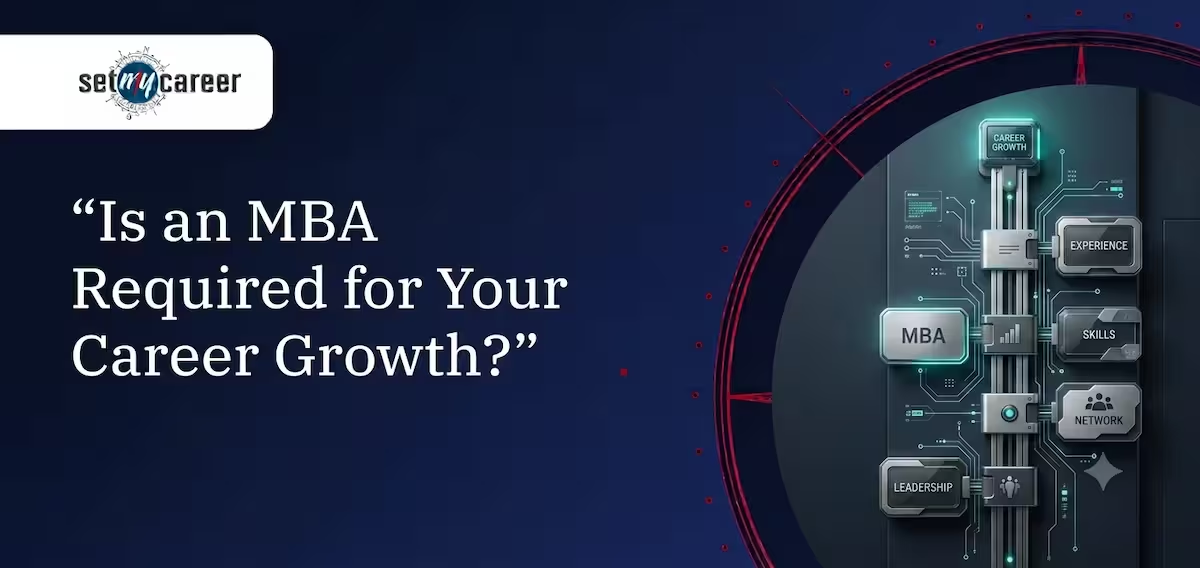
Determining if an MBA is required affects career options after graduation for management roles.
If this resonates with you, you are definitely not alone. Thousands of mid-level professionals reach this exact junction, wondering if a Master of Business Administration degree is the golden ticket to executive leadership. But is it absolutely necessary to advance, or are there alternative, highly effective ways to climb the corporate ladder? Let’s break down the reality of pursuing an MBA with clarity, honesty, and strategic insight.
Is an MBA Worth It? Examining the Bigger Picture
When people envision an MBA program, they typically picture high-stakes networking events, global strategy meetings, and a substantial salary bump. While those outcomes are entirely possible, the complete picture is far more nuanced.
Career Progression is No Longer a Linear Ladder
Modern career paths resemble complex webs rather than traditional corporate ladders. Professionals frequently pivot across industries, take on hybrid roles, or build parallel income streams. Consequently, the necessity of an MBA heavily depends on your specific target industry.
If your ambition points toward management consulting, investment banking, or C-suite roles in legacy Fortune 500 companies, a top-tier MBA provides a distinct competitive advantage. However, in rapidly evolving sectors like technology, digital design, media, or nonprofit work, upward mobility is often dictated by tangible skills, portfolio quality, and measurable impact rather than a formal degree.
“An MBA is like a lever—it helps immensely, but only if you already know what you want to lift.” – Former Business School Dean
Selecting an In-Demand MBA Specialization
If you decide that business school is the right move, choosing the optimal area of focus dictates your future marketability. General management degrees are still highly respected, but specialized knowledge often commands a premium in today's job market.
Here are several of the most sought-after MBA specializations currently driving corporate hiring:
- Business Analytics: Ideal for professionals who excel at translating complex data models into strategic corporate decisions.
- Corporate Finance: Remains a highly lucrative path for those targeting investment banking, private equity, or corporate financial strategy.
- Digital Marketing: Essential for navigating consumer behavior, growth marketing, and brand strategy in an online-first economy.
- Operations & Supply Chain Management: Increasingly vital as global enterprises seek to optimize complex, cross-border logistics.
- Sustainability & ESG (Environmental, Social, and Governance): A rapidly expanding field as corporations face strict regulatory mandates and consumer pressure to adopt green practices.
Aligning your specialization with projected market demand—rather than personal interest alone—drastically improves your long-term return on investment.
Calculating MBA ROI Beyond the Salary Bump
Financial compensation is a major driver for applicants, and graduates from reputable business schools frequently see salary increases ranging from 40% to over 60% post-graduation. Yet, the actual returns extend well beyond your baseline compensation.
A quality MBA program delivers:
- A holistic understanding of cross-functional business operations.
- Tested frameworks for high-level strategy and crisis leadership.
- Lifelong access to an exclusive, globally distributed alumni network.
- The structured confidence required to tackle ambiguous corporate challenges.
Keep in mind that modern employers hire for competence over credentials. Promotions ultimately go to professionals who consistently demonstrate initiative and deliver measurable impact, regardless of the letters behind their name.
Make It a Strategic Career Move, Not a Default Choice
The most expensive mistake a professional can make is enrolling in an MBA program simply because it feels like the "next logical step" or because their peers are doing it. Timing and intent are everything.
You should seriously consider an MBA when:
- You have accumulated 3 to 5 years of substantive work experience.
- You are attempting a major career pivot (changing industry, function, or geographic location).
- You have hit a hard ceiling that specifically requires formal business acumen to break through.
- You have thoroughly calculated the tuition costs, the opportunity cost of leaving the workforce, and the realistic salary outcomes.
Treat an MBA as an advanced career GPS. It will help you navigate complex terrain, but it only works if you have already programmed the destination.
Strategic Alternatives: If Not an MBA, Then What?
An MBA is merely one vehicle for career acceleration. Depending on your financial resources, time capacity, and specific professional goals, alternative routes can be equally powerful—and significantly more cost-effective.
Targeted Professional Certifications
Credentials like the PMP (Project Management Professional) for project leaders, the CFA (Chartered Financial Analyst) for finance experts, or advanced cloud architecture certifications offer highly specialized knowledge. They are globally recognized, immediately applicable to your daily work, and require a fraction of the financial investment of a traditional MBA.
Executive Education and Micro-Credentials
Top-tier institutions recognize the demand for flexible learning. Platforms partnering with universities offer intensive, short-term programs in leadership, organizational behavior, and corporate strategy, allowing you to upskill without committing to a two-year career hiatus.
Direct Entrepreneurial Experience
Bootstrapping a startup or launching a side venture provides a rigorous, real-world education in cash flow management, product development, and customer acquisition. The harsh lessons learned through direct market feedback often rival the curated case studies analyzed in a business school classroom.
Internal Leadership Development Tracks
Forward-thinking corporations frequently invest heavily in their own talent pools. High-potential employee programs offer customized leadership training, cross-departmental rotations, and direct exposure to executive management while you continue to earn a salary.
Intentional Mentorship and Strategic Networking
Cultivating relationships with experienced industry veterans can unlock doors that a polished resume alone cannot. A strong mentor or internal sponsor within your organization can advocate for your promotion far more effectively than a degree certificate on your office wall.
Conclusion
An MBA possesses the power to open exclusive doors, elevate your professional confidence, and integrate you into a high-caliber network. However, it is not the sole blueprint for corporate success. Whether you are a senior analyst pushing for a high-level strategy role or a technical team leader eyeing the C-suite, the defining factors will always be your strategic clarity, your intent, and the specific tools you choose to execute your vision.
Navigating your career path requires careful calculation and personalized advice. SetMyCareer is here to guide you toward your long-term goals. Reach out to our career experts today to explore whether a formal MBA aligns with your distinct ambitions, or if a more targeted, alternative route will serve you better.