






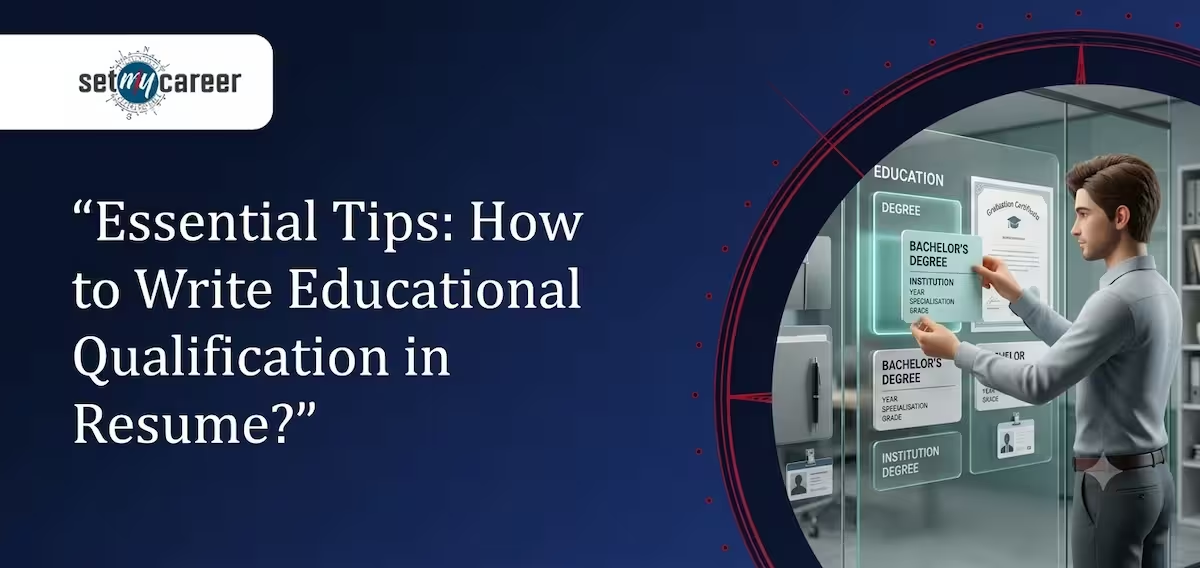
When a hiring manager reviews a stack of resumes, they typically spend just six to seven seconds deciding whether a candidate moves forward to the interview stage. In that narrow window of time, visual clarity and precise information are everything. While your professional experience often takes center stage, your educational background plays a critical role in validating your qualifications, establishing your foundational knowledge, and passing strict applicant tracking system (ATS) filters.
Properly highlighting educational qualifications strengthens a resume during a career change.
Crafting this section effectively goes far beyond simply listing the name of your college and the year you graduated. It involves strategically presenting your academic background in a way that aligns directly with your target role, highlights your unique intellectual achievements, and proves your readiness for complex professional challenges.
In a competitive job market, a well-optimized educational section acts as a powerful differentiator. Whether you are a recent graduate leveraging your degree to break into an industry, or a seasoned professional reinforcing decades of experience with specialized credentials, how you frame your education matters. This guide covers the best practices for showcasing your academic qualifications to make a lasting impact on recruiters and hiring managers.
How to Effectively Format and Present Your Educational Qualifications
Choose the Right Layout and Resume Placement
The placement and formatting of your education section should depend entirely on where you are in your career journey. The standard reverse-chronological format—listing your highest and most recent degree first—is universally accepted and preferred by recruiters.
- For Recent Graduates: If you graduated within the last one to three years, your education is likely your strongest asset. Place this section at the top of your resume, directly beneath your summary statement.
- For Experienced Professionals: Once you have a few years of relevant work history, your real-world experience becomes more valuable than your academic background. Move your educational qualifications toward the bottom of your resume.
Include the Essential Academic Details
Ambiguity frustrates hiring managers. When outlining your educational history, provide a clean, complete snapshot of your credentials. Ensure every entry contains the following core components:
- Degree Earned: Clearly state the full name of the degree or certification (e.g., Bachelor of Science, Master of Business Administration).
- Major and Minor: Specify your major, and include your minor if it is relevant to the job you are targeting.
- Institution Name and Location: List the official name of the university or college, along with the city and state.
- Graduation Date: Include the month and year of your graduation. If you are still in school, list your "Expected Graduation" date.
Example format:
Bachelor of Science in Computer Science
XYZ University, Chicago, IL | Graduated: May 2022
Tailor Your Coursework to the Job Description
A degree name alone doesn't always communicate the depth of your knowledge. Customize your educational section based on the specific role you want to land. If a job requires specific technical knowledge or theoretical understanding, leverage a "Relevant Coursework" subsection to prove your competence.
For instance, if you are applying for an entry-level data analyst position but your degree is in Business Administration, you can bridge the gap by highlighting specific coursework in statistical analysis, predictive modeling, data visualization, or relational databases.
Highlight Academic Achievements and Honors
If you maintained an exceptional academic record or took on challenging academic projects, use a brief bulleted list to showcase these achievements. This demonstrates strong work ethic, discipline, and intellectual curiosity. Consider including:
- Latin honors (Cum Laude, Magna Cum Laude, Summa Cum Laude)
- Dean’s List appearances (e.g., "Dean's List: Fall 2020 – Spring 2022")
- Academic scholarships or specialized fellowships
- Significant capstone projects, published research, or an undergraduate thesis
Example: Developed a comprehensive senior capstone marketing campaign for a local nonprofit, incorporating market research, strategy formulation, and ROI analysis.
Keep the Section Concise and Easy to Scan
While compiling a comprehensive resume is important, you must avoid overwhelming the reader with dense paragraphs or irrelevant high school achievements. A concise, visually organized educational section is far more effective. Use bold text for your degree title and keep descriptions limited to a few impactful bullet points. As a general rule, once you have earned a college degree, you should remove all high school information from your resume.
Optimize for Applicant Tracking Systems (ATS)
Modern recruitment heavily relies on Applicant Tracking Systems (ATS) to filter out unqualified candidates before a human ever reads their resume. To ensure your resume passes these automated screens, you must incorporate exact keywords from the job description.
Spell out your degree fully but consider including common acronyms so the software registers both variations (e.g., "Master of Science (MS) in Project Management"). If a job description explicitly asks for candidates with backgrounds in "agile methodologies" or "financial forecasting," ensure those exact phrases appear in your coursework or academic project descriptions.
Proofread for Absolute Accuracy
Accuracy is non-negotiable when listing your academic history. Many mid-to-large-sized companies run thorough background checks before extending an official job offer. Double-check all attendance dates, graduation years, exact degree titles, and institution names. Even minor, unintentional discrepancies can be flagged as dishonesty by a background check provider, which can result in a withdrawn job offer.
Showcase Relevant Professional Certifications
Your education doesn't stop at a traditional university degree. If you have completed industry-recognized certifications, intensive bootcamps, or specialized training programs, feature them prominently. Depending on the volume of your credentials, you can include them in your main education section or create a dedicated "Certifications & Licenses" section.
Example: Certified Data Management Professional (CDMP), Data Management Association | Issued: August 2023
Maximize the Impact of Your Academic Background
Your resume’s educational qualifications section is far more than a mandatory list of dates and institutions. It is a strategic opportunity to showcase your foundational knowledge, specialized training, and commitment to personal growth. By presenting this information clearly, tailoring it to your target audience, and optimizing it for digital screening tools, you make a significantly stronger impression on potential employers.
Navigating the nuances of modern hiring can be challenging, but you don't have to do it alone. If you are a working professional seeking to elevate your application materials and successfully pivot into a new role, contact us today. Our specialized professional resume writing services and dedicated career counselling for working professionals will help you highlight your unique value and take the next step in your career journey with absolute confidence.