





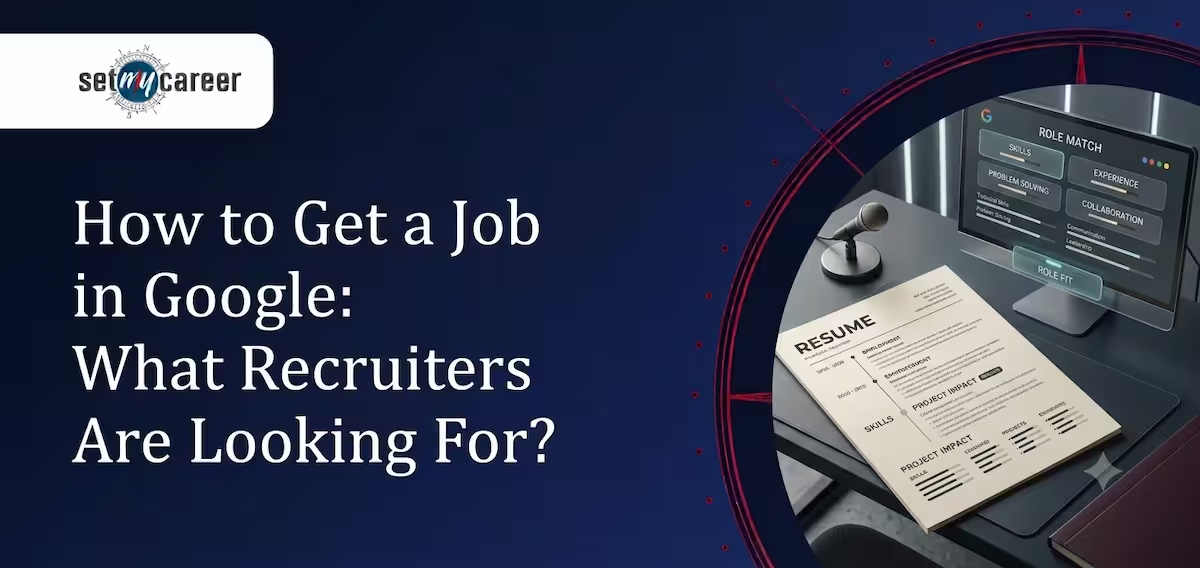
Securing a position at Google is one of the most common career aspirations for tech professionals and business innovators alike. With its legendary reputation for cutting-edge projects, competitive benefits, and a highly collaborative work environment, it is easy to see why the company receives millions of applications every year. But what exactly separates the candidates who get hired from the rest of the applicant pool?
Career counselling can help candidates prepare for and navigate the competitive Google hiring process.
Walking into a Google interview—whether virtually or at one of their global campuses—requires far more than just a polished resume. The company famously looks beyond basic qualifications, prioritizing a unique blend of cognitive flexibility, technical mastery, and a specific cultural alignment often referred to as "Googleyness." Understanding exactly how recruiters evaluate these traits is the first and most critical step in your preparation.
Below, we break down the core qualities Google looks for in prospective employees, actionable strategies to navigate their rigorous interview process, and how you can position yourself as an ideal candidate for your dream role.
Decoding Google’s Recruitment Philosophy and Hiring Criteria
Google’s hiring process is intentionally rigorous. The organization operates on the belief that it is better to pass on a good candidate than to hire the wrong one. Rather than just checking off boxes on a job description, recruiters and hiring managers evaluate candidates across a few primary dimensions.
Demonstrated Problem-Solving Skills (Cognitive Ability)
More than anything else, Google wants to know how you think. They place a massive emphasis on general cognitive ability, which translates to your capacity to process complex information, adapt to new situations, and solve highly ambiguous problems. They are less interested in whether you instantly know the right answer, and more focused on the logical steps you take to get there.
To prove your problem-solving capabilities, you must be comfortable tackling open-ended questions. During technical or strategic interviews, practice breaking massive problems down into manageable components, identifying potential edge cases, and explaining your thought process out loud. Showing that you can navigate uncertainty calmly is a massive advantage.
Elite Technical Proficiency
For engineering, product, and development roles, technical expertise is non-negotiable. Google expects a deep, foundational understanding of your craft. If you are targeting a software engineering position, for example, you must be highly proficient in core concepts like data structures, algorithms, and system design, along with specific programming languages like Python, Java, or C++.
However, technical proficiency is not limited to engineers. If you are applying for marketing, HR, or finance, you must demonstrate exceptional domain expertise. Highlighting tangible achievements—such as successful product launches, data-driven campaign results, or contributions to open-source projects—provides concrete proof of your capabilities.
Cultural Fit and "Googleyness"
Google’s workplace thrives on collaboration, and recruiters actively look for candidates who will elevate the teams they join. This is where "Googleyness" comes into play. While it sounds like a buzzword, it actually refers to a specific set of traits: intellectual humility, a collaborative nature, a bias for action, and a genuine focus on the end user.
To demonstrate this, your resume and interview answers should highlight moments where you helped a teammate succeed, took ownership of a failure and learned from it, or navigated a difficult interpersonal conflict with professionalism. Tailor your professional narrative to reflect their core mission: organizing the world's information and making it universally accessible.
Clear and Collaborative Communication
Brilliant ideas are useless if you cannot explain them to others. The ability to articulate complex concepts simply and collaborate across different departments is highly valued. You will often work with cross-functional teams comprised of designers, engineers, and product managers, requiring you to adapt your communication style to your audience.
Mock interviews are one of the best ways to refine this skill. Practice giving structured, concise answers that get straight to the point while leaving room for follow-up questions. A candidate who communicates clearly actively demonstrates that they will be an effective, low-friction teammate.
Adaptability and Learning Agility
The technology sector shifts rapidly, and Google is constantly pivoting to explore new AI integrations, search algorithms, and cloud infrastructures. Because the tools you use today might be obsolete in three years, the company looks for lifelong learners.
Highlight moments in your career where you had to adapt to a sudden change in project scope, pick up a new software platform on the fly, or take on responsibilities outside of your standard job description. Demonstrating a growth mindset proves you will thrive in their fast-paced environment.
A Genuine Passion for Innovation
Google relies on employees who are naturally curious and eager to push boundaries. They want individuals who are passionate about technology's potential to solve real-world problems. Whether you contribute to tech blogs, build apps in your free time, or actively optimize inefficient processes at your current job, showing proactive innovation will help you stand out from candidates who simply want to punch a clock.
Top Tips for Acing Your Google Interview and Landing the Offer
Knowing what Google wants is only half the battle; proving you have those qualities during an interview is the real challenge. Here are proven strategies to help you navigate the interview stages successfully:
- Deeply Understand the Role: Do not submit a generic resume. Analyze the job description meticulously, matching your past achievements directly to the required qualifications. Your application should make it instantly clear why you belong in that specific role.
- Master the Fundamentals: If you are applying for a technical role, dedicate serious time to reviewing core computer science principles. Use platforms like LeetCode or HackerRank to practice coding under time constraints, and be ready to whiteboard your solutions.
- Think Out Loud: When faced with a difficult interview question, do not sit in silence. Talk the interviewer through your assumptions, your proposed framework, and the trade-offs of your solution. This gives them a window into your cognitive process.
- Leverage the STAR Method: Behavioral questions are a guarantee. Structure your answers using the STAR format (Situation, Task, Action, Result). This ensures your stories are concise, impactful, and focused entirely on your specific contributions and the measurable outcomes.
- Embrace Intellectual Humility: If you don't know the answer to something, admit it. Google prefers candidates who are honest about their knowledge gaps and eager to find the answer over those who try to bluff their way through a technical discussion.
- Highlight Soft Skills: Emphasize your emotional intelligence. Showcasing your ability to mentor others, receive constructive feedback, and resolve team conflicts provides a clear picture of your leadership potential.
- Ask Thoughtful Questions: An interview is a two-way street. Prepare insightful questions about the team's current challenges, the company's strategic direction, or the specific metrics for success in the role. This signals genuine engagement and high-level strategic thinking.
Conclusion: Taking the Next Step Toward Your Dream Job
Securing a position at a tech giant like Google requires deliberate preparation, a deep understanding of your own professional narrative, and the ability to showcase your value under pressure. By focusing on your problem-solving methodologies, refining your technical proficiency, and leaning into the collaborative traits that define "Googleyness," you position yourself not just as a candidate, but as a future innovator.
Remember that the recruitment process is designed to be challenging, but it is entirely navigable if you prepare with intention. Take the time to master your fundamentals, structure your behavioral responses, and approach every interview as an opportunity to collaborate. Explore Dr. Rathi's expert strategies for achieving your Dream job and visit SetMyCareer for more guidance and career insights.