





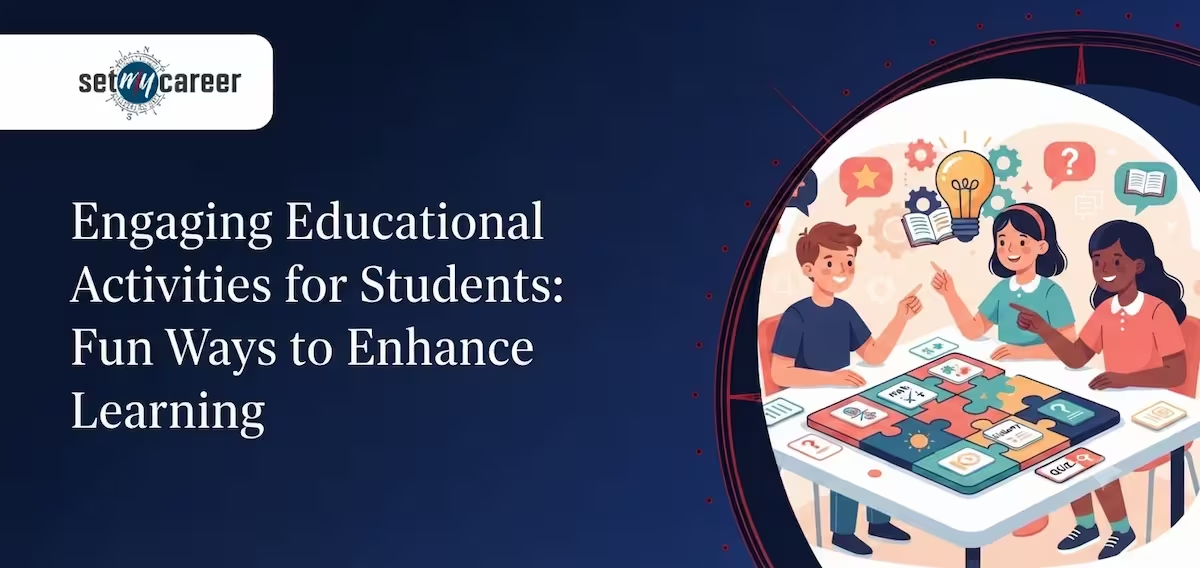
What if learning felt less like an obligation and more like a genuine adventure? Imagine swapping rote memorization for cracking secret mathematical codes, acting out pivotal historical negotiations, or transforming a standard backyard into a working biology lab. When education shifts from passive reading to active participation, the entire dynamic of the classroom—and the student's mindset—changes.
Career guidance for students incorporates engaging educational activities to enhance learning and career awareness.
The reality is that learning was never meant to be boring. The most effective lessons happen when students are encouraged to play, explore, and create. Whether you are introducing hands-on science experiments, strategic educational games, or immersive storytelling that brings ancient history to life, interactive learning builds a stronger foundation for lifelong curiosity. If you are a student exhausted by dull study sessions or a parent searching for practical ways to make academics exciting, this guide explores highly effective educational activities designed to make learning feel like an adventure.
Why Engaging Educational Activities Are Crucial for Student Success
Education requires much more than simply memorizing facts for an upcoming exam. True learning is about understanding concepts, applying them to new situations, and actually enjoying the discovery process. Integrating engaging educational activities transforms passive listening into an exciting, high-retention experience. Here is why prioritizing interactive learning matters:
- Increases Retention and Deepens Comprehension: Hands-on activities bridge the gap between abstract theory and concrete reality. When students physically engage with a concept, they grasp complex ideas much faster and retain the information far longer than they would through traditional textbook reading.
- Boosts Critical Thinking and Problem-Solving: Interactive scenarios force students to think on their feet. Rather than being handed the answer, they have to analyze the situation, test hypotheses, and develop creative solutions independently.
- Enhances Intrinsic Motivation: When students genuinely enjoy the learning process, their natural curiosity takes over. They stop asking, "Is this going to be on the test?" and start asking deeper questions that push their knowledge beyond the standard curriculum.
- Develops Essential Real-World Skills: Collaborative activities like group projects, debate prep, and role-playing inherently teach teamwork, effective communication, and adaptability. These are the exact soft skills employers look for in the modern workforce.
- Encourages Active Participation: Engaging formats require students to take ownership of their education. Instead of quietly fading into the background of a classroom, they become active drivers of their own learning, making the academic experience deeply meaningful.
Proven Strategies and Educational Activities to Make Learning Fun
Gamification: Learning Through Play
Gamification is the strategic integration of game mechanics into academic environments. By introducing point systems, friendly competition, and progression levels, educators can turn traditionally dry subjects into interactive challenges. Platforms like Kahoot! and Quizizz allow students to test their knowledge in real-time, completely removing the anxiety usually associated with quizzes. Beyond digital tools, physical scavenger hunts or escape-room-style logic puzzles tap into a student's natural desire to achieve goals, dramatically increasing focus and motivation.
Project-Based Learning (PBL): Hands-On Experience
Project-Based Learning (PBL) challenges students to apply academic theories to real-world scenarios. Instead of simply reading a chapter on renewable energy, a PBL assignment might require students to design and build a functioning solar-powered phone charger. This approach demands critical thinking, resource management, and resilience when initial designs fail. By tackling tangible problems, students quickly realize the practical value of what they are learning, bridging the gap between the classroom and the real world.
Storytelling and Role-Playing: Bringing Subjects to Life
History and literature often fall flat when taught purely through timelines and character summaries. Role-playing changes the narrative entirely. Imagine students stepping into the shoes of historical figures to recreate the signing of the Constitution, complete with assigned political motivations and debate points. Suddenly, history is no longer a list of dates—it is a series of human decisions. Similarly, using strong narrative storytelling to explain complex scientific theories can help students visualize abstract concepts, making the material highly relatable and easier to digest.
STEM Challenges: Ignite Curiosity with Experiments
Science, Technology, Engineering, and Math (STEM) education naturally lends itself to excitement. Hands-on STEM challenges—such as building load-bearing bridges out of household materials, coding basic video games, or constructing simple robotics—force students to rely on analytical thinking and spatial reasoning. Schools that host regular STEM fairs give students a platform to showcase their hard work, which builds immense confidence. Participating in structured STEM courses also helps students develop the technical resilience needed to troubleshoot failing experiments.
Outdoor and Experiential Learning: Beyond the Classroom
Changing a student's physical environment is one of the fastest ways to reset their focus. Taking education beyond the four walls of a classroom provides powerful cognitive stimulation. Field trips to historical sites, nature walks to study local ecosystems, and hands-on community gardening projects teach sustainability while making lessons deeply immersive. Extracurricular activities rooted in experiential learning play a massive role in fostering creativity and broadening a student's worldview.
Collaborative Learning: Teamwork Makes the Dream Work
Humans are inherently social, and learning is often most effective when it is shared. Group discussions, peer-to-peer teaching, and team-based assignments teach students how to navigate differing opinions and collaborate toward a shared goal. Organizing a structured debate on a controversial historical event, for instance, requires students to conduct rigorous research, practice public speaking, and critically analyze opposing viewpoints. When students learn how to defend their ideas respectfully, they build confidence that serves them well beyond graduation.
Art and Creativity-Based Learning
Art should never be restricted solely to art class. Integrating creativity into core subjects—often referred to as STEAM (adding Arts to STEM)—helps students process information uniquely. Activities like creating mind maps for complex historical events, writing creative fiction based on scientific principles, or designing infographics to explain mathematical formulas allow visual learners to thrive. Turning a standard essay assignment into a visual storytelling project or a comic strip allows students to express their comprehension in highly engaging ways.
Digital and Tech-Based Learning: The Future of Education
We are in an era where technology can make the impossible highly accessible. Interactive digital tools like virtual reality (VR), augmented reality (AR), and AI-driven tutoring platforms have completely transformed educational access. Rather than looking at a flat diagram of the solar system, students can now use VR headsets to take a virtual walk across the surface of Mars or explore the inner workings of a human cell. Leveraging these tech-based tools makes complex subjects incredibly immersive and entirely unforgettable.
Final Thoughts on Shaping the Future of Learning
Education should never feel like a heavy burden or a daily chore. By shifting away from rigid memorization and embracing interactive, engaging educational activities, students naturally develop a genuine, lifelong love for learning. Whether you achieve this through gamified study sessions, compelling storytelling, or hands-on STEM challenges, these dynamic methods ensure that knowledge is actually experienced, not just temporarily absorbed for a test.
When students are given the freedom to explore academics creatively, they build the critical thinking and adaptability skills necessary for long-term career success. If you are looking for expert career guidance on how to make learning more effective, or need help mapping out a strategic educational path, SetMyCareer is here to help. Reach out to our experts today to start building a brighter, more engaging academic future!