






Navigating a fulfilling career rarely happens by accident. While some professionals land ideal roles through fortunate timing, long-term growth and resilience require intentional strategy. Career management provides the blueprint for taking control of your professional trajectory right from the start, helping you move away from reactive job-hunting toward purposeful, long-term development.
Whether you are selecting your first professional domain, seeking rapid advancement in your current field, or preparing for an industry pivot, establishing a structured career plan gives you the clarity and confidence needed to achieve your goals.
Understanding Career Management: Beyond the Standard Job Search
Career management is the continuous, deliberate process of directing your professional life. It extends far beyond updating a resume when you need a new job. At its core, career management combines self-assessment, continuous skill acquisition, strategic networking, and informed decision-making to align your daily work with your ultimate life aspirations.
Professional paths are rarely linear. Throughout your working life, you may hold diverse roles across multiple organizations, pursue advanced degrees, or launch an entrepreneurial venture. Proactive career management ensures that each transition builds toward a cohesive overarching narrative rather than a series of disconnected jobs.
The Strategic Importance of Personal Career Management
In a dynamic global economy, relying solely on an employer to map out your career progression is a risky strategy. Taking ownership of your career development ensures you remain adaptable, competitive, and engaged in your work.
A personalized career management plan delivers several distinct advantages:
- Clarity of Purpose and Direction: Writing down specific career milestones eliminates ambiguity. It helps you evaluate job offers, promotions, and learning opportunities against a clear set of personal priorities.
- Optimal Talent Utilization: A structured plan forces you to evaluate your distinct strengths, ensuring you spend time and energy where you deliver the highest impact.
- Sustained Motivation and Accountability: Setting measurable benchmarks creates built-in accountability. Tracking your progress over time reinforces your sense of achievement and keeps you engaged during challenging phases.
- Career Resilience: By monitoring market trends and proactively addressing skill gaps, you protect yourself against economic downturns and industry disruptions.
How to Build an Actionable Career Management Plan in 7 Steps
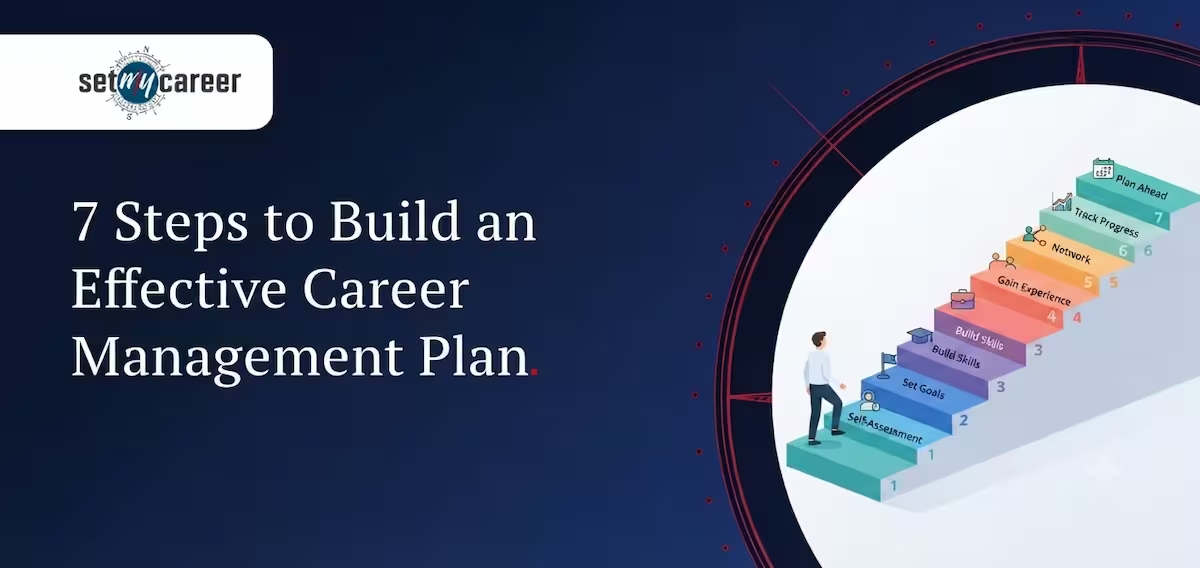
An effective career management plan serves as a practical decision-making tool. Grounded in self-awareness and market reality, this 7-step framework helps you translate big ambitions into daily progress.
1. Define Specific and Measurable Career Objectives
Vague ambitions like "getting a promotion" or "finding a better job" provide little actionable guidance. Define precisely what success looks like across short-term (1-year), medium-term (3-year), and long-term (5-year) horizons.
Ensure your objectives follow a structured standard:
- Specific: Clearly identify target job titles, industries, income benchmarks, or leadership responsibilities.
- Measurable: Define tangible indicators of success, such as managing a specific budget size, completing a major certification, or mastering a technical language.
- Achievable: Choose stretch goals that challenge your abilities while remaining grounded in realistic timelines.
- Time-Bound: Assign firm target dates to maintain momentum and evaluate progress objectively.
2. Conduct a Personal SWOT Analysis
A personal SWOT (Strengths, Weaknesses, Opportunities, Threats) analysis provides an honest audit of your current standing relative to your target industry.
- Strengths: Identify your core technical competencies, soft skills, specialized knowledge, and unique achievements that set you apart from peers.
- Weaknesses: Pinpoint skill gaps, missing credentials, or behavioral habits that hinder your performance or limit your eligibility for advancement.
- Opportunities: Analyze market shifts, emerging technologies, talent shortages, or organizational changes that create demand for your target skills.
- Threats: Recognize external factors—such as industry automation, changing regulations, or economic headwinds—that could impact your chosen field.
3. Design a Customized Learning Pathway
Once you identify the gap between your current capabilities and your target role, build a structured learning program to bridge it. Select high-impact educational resources, professional certifications, and practical projects that directly support your goals. Organizing your development into structured modules prevents overwhelm and ensures efficient learning.
4. Establish a Balanced Execution Timeline
Ambition requires structure. Assign realistic completion dates to each course, skill milestone, and career transition on your roadmap. Account for your current workload, personal commitments, and family obligations to ensure your schedule remains sustainable over the long haul. Steady, incremental progress is far more effective than short bursts of intensive effort followed by burnout.
5. Commit to Continuous Upskilling
Upskilling is the deliberate practice of expanding your knowledge base to maintain professional relevance. Technology and business models evolve rapidly; skills that made you competitive three years ago may now be baseline expectations.
Invest in continuous learning through accredited professional certifications, industry workshops, executive education, or focused self-study. Beyond formal credentials, look for cross-functional projects at your current job that push you outside your comfort zone and expand your practical experience.
6. Build a System to Track and Evaluate Progress
Maintain a dedicated record—such as a personal dashboard or professional journal—to track completed courses, key metrics, client feedback, and major project deliverables. Documenting your accomplishments as they happen simplifies resume updates, strengthens your case during annual performance reviews, and provides a visible reminder of your professional growth.
7. Seek Strategic Mentorship and Adapt Your Plan
A career management plan should be a living document, not a rigid script. Schedule formal reviews every six to twelve months to assess your trajectory against market shifts and changing personal priorities.
Partnering with a trusted mentor or industry veteran provides invaluable objective perspective. A seasoned advisor can offer honest feedback on your blind spots, introduce you to valuable professional networks, and help you recalibrate your strategy when industry dynamics shift.
Expert Implementation Strategies from SetMyCareer
Drafting a plan is only the first step; consistent execution determines your ultimate outcome. SetMyCareer experts recommend these proven tactics to bring your career management strategy to life:
- Deconstruct Large Ambitions: Break multi-year career milestones down into quarterly objectives and weekly actionable tasks.
- Dedicate Non-Negotiable Time: Schedule at least two hours each week specifically for skill development, reading industry literature, and professional networking.
- Nurture Strategic Relationships: Connect meaningfully with peers, alumni, and industry leaders. Authentic professional relationships often yield insights and unadvertised opportunities.
- Monitor Market Movements: Regularly read industry news, follow sector leaders, and review job descriptions in your target field to spot emerging skill requirements early.
Accelerating Your Growth Through Professional career counselling
While self-reflection is critical, external expertise often provides the breakthrough clarity needed for major career decisions. Professional career guidance serves as a powerful catalyst within a comprehensive career management strategy.
At SetMyCareer, experienced career counsellors utilize scientifically validated psychometric assessments to evaluate your innate personality traits, cognitive strengths, and core interests. By pairing data-driven insights with expert mentorship, career counselling helps you eliminate decision paralysis, validate your chosen path, and build an actionable career blueprint tailored to your unique potential.
Final Thoughts: Taking Ownership of Your Professional Future
A personalized career management plan is far more than an administrative exercise; it is a fundamental investment in your autonomy, confidence, and financial security. By actively directing your professional development—setting clear goals, addressing skill gaps, and adapting to industry shifts—you transition from waiting for opportunities to actively creating them.